
The Middle East’s battery energy storage market is expanding through large standalone projects and integrated solar developments. Saudi Arabia is building storage capacity to strengthen grid flexibility, while the UAE is combining batteries with solar generation to supply electricity beyond daylight hours.
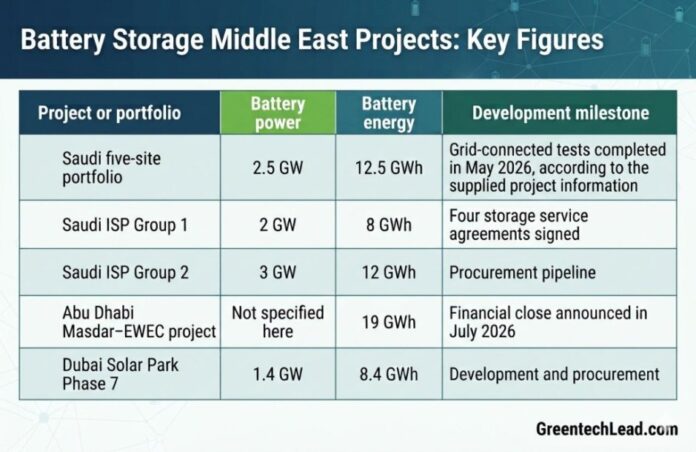
Major developments include Saudi Arabia’s 2.5 GW/12.5 GWh five-site storage portfolio, its 5 GW/20 GWh Independent Storage Provider procurement pipeline, Abu Dhabi’s 19 GWh solar-linked battery project, and Dubai’s planned 8.4 GWh storage system.
These projects represent different stages of development. Operating facilities, signed storage agreements, procurement pipelines and national targets must remain separate when assessing how much capacity is available to the grid.
Battery power, measured in MW or GW, indicates discharge capability. Energy capacity, measured in MWh or GWh, determines how much electricity can be stored. Dividing energy by power gives nominal discharge duration.
Saudi Arabia’s Five-Site Portfolio Provides 12.5 GWh
Saudi Arabia’s five-site portfolio spans Riyadh, Rabigh, Dawadmi, Jouf and Qassim. Its combined 2.5 GW/12.5 GWh rating corresponds to approximately five hours of nominal storage.
According to the supplied project information, the facilities completed grid-connected charging and discharging tests in May 2026. Alfanar handled engineering, procurement and construction, BYD supplied battery systems, and NR Electric provided grid-forming controls and more than 2,000 power-conversion units.
Applications include load shifting, frequency regulation, voltage support and black-start capability.
The portfolio demonstrates the scale of Saudi deployment, but commissioning milestones should be distinguished from sustained commercial performance. Availability, usable energy, efficiency and maintenance requirements will determine its long-term contribution.
Saudi ISP Group 1 Attracts More Than $1.16 Billion
Saudi Arabia’s first Independent Storage Provider group comprises four 500 MW/2,000 MWh projects, totaling 2 GW/8 GWh of four-hour storage.
The Saudi battery storage service agreements were announced on August 20, 2026, with investment exceeding SAR4.35 billion, approximately $1.16 billion.
The projects include Al Muwyah, Haden, Al Kahafa and Al Khushaybi. The supplied information identifies Saudi Energy, ACWA Power and Al-Sharif as participants in the first three developments.
A second procurement group adds six projects totaling 3 GW/12 GWh. Together, the two groups form a 5 GW/20 GWh pipeline, although procurement capacity should not be counted as commissioned storage.
Storage Services Agreements with Saudi Power Procurement Company provide a contractual framework for delivering grid flexibility. Actual revenue certainty depends on payment provisions, availability requirements and performance penalties.
Abu Dhabi’s 19 GWh Project Secures $6.1 Billion Investment
Abu Dhabi’s Masdar–EWEC Round-the-Clock project combines 5.2 GW of solar photovoltaic capacity with 19 GWh of battery storage. It is designed to deliver 1 GW of continuous clean electricity, with operation expected in 2027.
The Masdar–EWEC round-the-clock clean-energy project reached financial close in July 2026. Total investment is $6.1 billion, supported by $5.1 billion in financing from 13 banks and $1 billion in Masdar equity.
Its significance lies in integrating generation and storage into a scheduled electricity supply rather than selling solar output only when sunlight is available.
The investment covers the complete solar-plus-storage development and associated infrastructure. Dividing $6.1 billion by battery capacity would therefore produce a misleading standalone storage-cost estimate.
Dubai Phase 7 Plans Six-Hour Battery Storage
Dubai’s Mohammed bin Rashid Al Maktoum Solar Park Phase 7 combines planned 2 GW solar capacity with a 1.4 GW/8.4 GWh battery system under the independent power producer model.
The DEWA Phase 7 solar-plus-storage development extends nominal battery duration to six hours.
At the same power rating, six-hour storage provides 50 percent more energy capacity than a four-hour system. This can extend solar-energy delivery into evening demand, although actual discharge schedules depend on charging conditions and operating obligations.
Phase 7 remains development capacity rather than an operating addition. Construction progress, financing and commissioning will determine when it contributes to Dubai’s electricity supply.
Battery Storage Costs Require Comparable Boundaries
Saudi ISP Group 1’s investment exceeding $1.16 billion for 8 GWh implies a project-level benchmark above $145/kWh.
This is an investment-to-capacity calculation, not a battery-cell price. Project expenditure can include conversion equipment, transformers, cooling, fire protection, civil works, grid connections and development costs.
The MENA Energy Outlook 2026 reports Saudi storage capital costs of $73–75/kWh. That figure requires a consistent scope before comparison with full project investment.
Duration, usable capacity, warranties and included infrastructure can materially change quoted costs. Investors also need to account for charging electricity, financing, maintenance and future battery augmentation.
Revenue and Desert Performance Will Determine Returns
Standalone batteries can earn payments for contracted capacity and flexibility. Solar-linked systems can shift generation, reduce curtailment and support delivery commitments.
Additional services may include frequency response, reserves and voltage support, where contracts and market rules permit. These revenues cannot automatically be added together: one service can restrict capacity available for another.
Desert conditions also influence economics. Cooling consumes electricity, while dust and sand increase filtration and maintenance requirements. Battery degradation reduces usable capacity unless additional equipment is installed.
Contracts should specify who pays for augmentation, how availability is measured and what energy capacity must be maintained over time.
Middle East Battery Storage Outlook to 2030
Saudi Arabia’s stated 48 GWh storage ambition for 2030 provides a longer-term reference point, while the UAE’s large solar-linked projects demonstrate demand for extended energy shifting.
The next measure of progress will be commissioned capacity meeting contractual performance requirements. Developers must convert procurement announcements and financial close into dependable grid services.
For the region’s largest battery projects, investment quality will depend on usable GWh, discharge duration, availability, lifetime costs and revenue security. Saudi Arabia and the UAE are establishing different models, both aimed at making growing renewable generation more useful to electricity systems.
SHAFANA FAZAL
