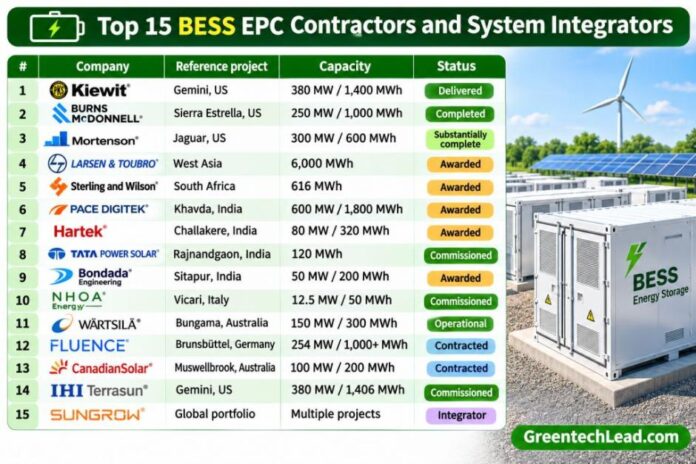
Kiewit, Burns & McDonnell, Mortenson, Larsen & Toubro, Sterling and Wilson, Pace Digitek, Hartek Power, Tata Power Solar, Bondada Engineering, NHOA Energy, Wärtsilä, Fluence, Canadian Solar, IHI Terrasun and Sungrow are competing for utility-scale battery energy storage system (BESS) projects worldwide. Their opportunities span engineering, procurement, construction, battery integration, grid connections and long-term maintenance.
India’s BESS market offers substantial opportunities. According to the Central Electricity Authority’s September 2026 storage assessment, India had 5.32 GW / 14.54 GWh of operational battery storage, with 27.73 GW / 78.96 GWh classified as under construction and 9.70 GW / 28.91 GWh awarded.
The three categories total approximately 122.42 GWh. However, CEA’s under-construction category includes projects with signed power purchase or storage agreements, not necessarily physical construction.
1. Kiewit: 1.4 GWh Gemini Battery Project
Kiewit delivered construction work for Nevada’s Gemini project, combining approximately 690 MW of solar capacity with 380 MW / 1,400 MWh of battery storage.
Its Zier project in Texas includes 208 MW of solar, 80 MW / 160 MWh of storage and approximately 3.7 miles of 138-kV transmission infrastructure.
These projects demonstrate construction and grid-interconnection capabilities.
2. Burns & McDonnell: 1 GWh Project Completed
Burns & McDonnell completed Arizona’s 250 MW / 1,000 MWh Sierra Estrella project ahead of schedule.
The four-hour facility uses 276 Tesla Megapacks.
According to Burns & McDonnell’s Sierra Estrella project record, its responsibilities included civil construction, battery installation, fire detection, electrical infrastructure and substations.
3. Mortenson: 600 MWh Jaguar Project
Mortenson served as EPC contractor for Texas’s Jaguar development, comprising two facilities totaling 300 MW / 600 MWh.
Its responsibilities included battery installation, energy management integration and two 345-kV substations.
Substantial completion was reported in October 2025.
4. Larsen & Toubro: 6 GWh West Asia Orders
Larsen & Toubro announced three BESS contracts in West Asia in August 2026, totaling 6,000 MWh.
The four-hour systems imply approximately 1,500 MW of aggregate power capacity.
L&T classified the contracts within its ₹5,000 crore–₹10,000 crore mega-order category.
The scope includes storage infrastructure, pooling substations and underground cables.
5. Sterling and Wilson: 616 MWh South African Orders
Sterling and Wilson Renewable Energy secured two South African battery storage contracts totaling 616 MWh in September 2026.
The awards extend its renewable EPC business into utility-scale storage.
Individual MW ratings and detailed contract values were not disclosed.
6. Pace Digitek: ₹2,691 Crore NTPC Contract
Pace Digitek secured a ₹2,691 crore contract, including GST, for NTPC Green Energy’s 600 MW / 1,800 MWh BESS at Khavda, Gujarat.
The three-hour project includes EPC, commissioning and 15 years of operations and maintenance.
The NSE-filed Pace Digitek contract announcement details the agreement.
Its executable order book was approximately ₹13,427 crore. Contract value is not completed revenue.
7. Hartek Power: ₹353.77 Crore Hybrid Project
Hartek Power secured a ₹353.77 crore EPC contract at Challakere, Karnataka.
The project combines 280 MW AC / 410 MWp of solar capacity with 80 MW / 320 MWh of battery storage.
The contract includes one year of operations and maintenance.
The value covers solar and storage, not batteries alone.
8. Tata Power Solar: ₹945 Crore Project Commissioned
Tata Power Solar commissioned its Rajnandgaon solar-plus-storage project in March 2024.
The installation combines 100 MW of solar generation with 120 MWh of battery storage.
The approximately ₹945 crore EPC contract was awarded by Solar Energy Corporation of India.
Tata AutoComp supplied the battery system.
9. Bondada Engineering: ₹1,338 Crore NTPC Contract
Bondada Engineering received an approximately ₹1,338 crore contract, including GST, for a project at Sitapur, Uttar Pradesh.
It combines 250 MW of solar generation with a 50 MW / 200 MWh BESS.
The four-hour storage project has an approximately 18-month execution period.
10. NHOA Energy: 50 MWh Italian Project
NHOA Energy commissioned the 12.5 MW / 50 MWh ERG Vicari battery project in Sicily in November 2025.
The four-hour installation includes power conversion and control technology.
NHOA also secured a five-year service agreement.
11. Wärtsilä: 300 MWh Australian Project
Wärtsilä supplied battery technology for South Australia’s 150 MW / 300 MWh Bungama Stage 1 project, operational since June 2026.
Enerven handled civil and electrical construction.
Wärtsilä provided system integration and lifecycle services, including its GEMS energy management technology.
12. Fluence: 1 GWh German Storage Contract
Fluence secured a contract with Vattenfall for a 254 MW battery project exceeding 1,000 MWh at Brunsbüttel, Germany.
The agreement includes Gridstack Pro 5000 technology and long-term service.
Construction is expected in 2027, with commercial operation targeted for late 2028.
13. Canadian Solar: 200 MWh Australian Project
Canadian Solar’s e-STORAGE business signed an agreement with OX2 for the 100 MW / 200 MWh Muswellbrook project.
The contract covers batteries, power conversion, controls, commissioning and 20 years of service.
Equipment shipments are scheduled for 2027 and commercial operation for 2028.
14. IHI Terrasun: Gemini Battery Integration
IHI Terrasun provided system integration, plant controls, commissioning and maintenance for Nevada’s Gemini project.
The battery installation has approximately 380 MW / 1,406 MWh of capacity.
Its responsibilities differed from Kiewit’s construction scope.
15. Sungrow: Leading Global BESS Integrator
Sungrow supplies battery systems, power conversion equipment, thermal management and energy controls.
The Wood Mackenzie energy storage research ranked Sungrow first in its 2026 global BESS integrator assessment, ahead of Tesla and CATL.
Integrator rankings should not be confused with civil EPC contractor rankings.
BESS Customer Complaints: Fire Safety, Delays and Warranty Disputes
Utility-scale BESS customers are primarily utilities and project developers rather than retail consumers.
Potential complaints include delayed commissioning, battery degradation, cooling failures, software problems and disputed performance guarantees.
The January 2025 Moss Landing battery fire in California highlighted fire safety, emergency response and environmental concerns. The incident should not be attributed to any company in this shortlist without verified evidence.
The NFPA 855 energy storage installation standard addresses stationary storage safety, while UL’s energy storage certification framework covers system-level requirements.
UL 9540A is a thermal-runaway test method, not a product certification.
For a hypothetical 200 MWh battery project, 5 percent usable-capacity loss equals 10 MWh. At $100/kWh replacement cost, replacing that capacity would require approximately $1 million before installation and associated expenses.
Warranty contracts must specify capacity retention, availability, efficiency, augmentation and responsibility for equipment failures.
BESS EPC Costs: $125/kWh Benchmark
According to Ember’s battery storage cost analysis, large utility-scale projects outside China and the United States had estimated all-in costs of approximately $125/kWh, including $75/kWh for core equipment and $50/kWh for installation and grid connection.
| Project capacity | Illustrative all-in cost |
| 100 MWh | $12.5 million |
| 200 MWh | $25 million |
| 400 MWh | $50 million |
| 1,000 MWh | $125 million |
These are benchmark calculations, not EPC quotations.
India BESS EPC Investment Outlook
India’s 78.96 GWh under-construction category and 28.91 GWh awarded category together represent approximately 107.88 GWh of potential future activity.
L&T, Pace Digitek, Hartek Power, Sterling and Wilson, Tata Power Solar and Bondada Engineering are positioned to compete for construction and integration contracts.
The strongest BESS EPC contractors and integrators in 2027 will be determined by commissioned projects, grid connectivity, safety, construction costs, enforceable warranties and long-term operating performance — not announced order values alone.
SHAFANA FAZAL