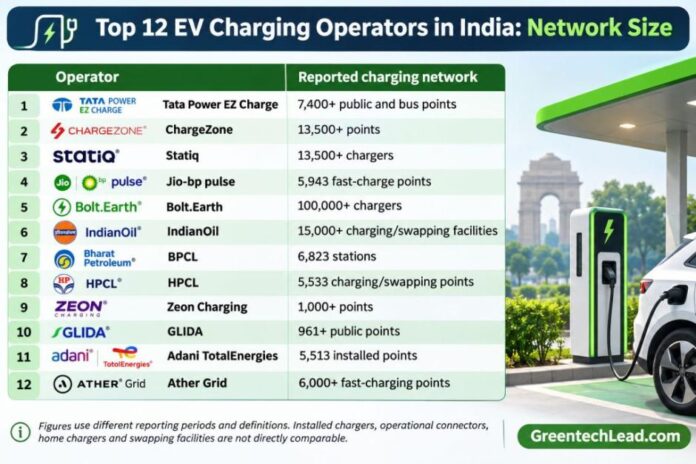
India’s electric vehicle charging market is expanding rapidly, with Tata Power, ChargeZone, Statiq, Jio-bp pulse, Bolt.Earth, IndianOil, BPCL, HPCL, Zeon, GLIDA, Adani TotalEnergies and Ather competing for customers. However, charger reliability, electricity sales, payment failures and profitability remain major challenges.
According to the Ministry of Heavy Industries’ PM E-DRIVE programme, India had 52,718 public EV charging stations registered on the BHEL portal in July 2026, including 16,561 stations equipped with fast chargers for cars.
The government allocated ₹2,000 crore for charging infrastructure. By September 28, 2026, ₹851 crore had been approved for 8,147 chargers. Approvals do not represent operational installations.
1. Tata Power EZ Charge: 7,400 Charging Points
Tata Power reported more than 7,400 cumulative public and bus charging points.
Its H1 FY27 disclosure separately identified 6,223 public and captive points, 287,508 home chargers and 1,262 bus charging points.
The Tata Power Q2 FY27 investor presentation provides network details.
Home installations should not be included in public fast-charging comparisons. Charging-specific EBITDA and network utilisation remain undisclosed.
2. ChargeZone: 13,500 Points Across 26 States
ChargeZone reports more than 13,500 charging points across 26 states and 350 cities.
Its network targets highways, passenger vehicles and commercial fleets.
Profitability depends on electricity throughput, charger power, site costs and utilisation. Comparable charging-only revenue, EBITDA and network uptime figures are unavailable.
3. Statiq: 13,500 Chargers Across 1,500 Cities
Statiq reports more than 13,500 installed chargers across over 1,500 cities.
Its platform combines charger discovery, digital payments, equipment management and network services.
However, installed chargers include different equipment categories and ownership arrangements.
Investors need active connector counts, charging sessions, electricity sales, payment success rates and revenue-sharing details.
4. Jio-bp pulse: 15.8 GWh Charging Volume
Jio-bp reported 15.8 GWh of EV charging volume in Q2 FY27, increasing 60 percent year over year.
Its network comprised 5,943 fast-charge points across more than 1,100 locations, with approximately 95 percent reported uptime.
The Reliance Industries Q2 FY27 results provide these operating figures.
Quarterly electricity delivery equalled 15.8 million kWh. Using the reported period-end charger count, this represents approximately 29 kWh per point daily over a 92-day quarter—an illustrative calculation, not reported utilisation.
5. Bolt.Earth: 100,000 Chargers and 671,000 Users
Bolt.Earth reports more than 100,000 chargers across 2,300 cities and over 671,000 active EV users.
Cumulative electricity delivery exceeded 11.4 GWh.
Its network includes lower-power devices at residential, workplace and commercial locations.
The large device count does not necessarily indicate higher installed power or electricity revenue than DC fast-charging networks.
6. IndianOil: 15,000 Charging and Swapping Facilities
IndianOil reported more than 15,000 charging and battery-swapping facilities as of March 2026.
During FY26, it commissioned 351 charging stations and 256 swapping stations.
Its fuel-retail network provides access to highway and urban locations.
However, the combined facility count is not exclusively public charging stations. Charging-specific revenue, utilisation and profitability remain undisclosed.
7. BPCL: 6,823 Stations and 580,000 Sessions
BPCL reported 6,823 EV charging stations, including 4,516 fast chargers, during FY26.
It commissioned 260 fast chargers and recorded approximately 580,000 charging sessions.
At an illustrative average of 15–30 kWh per session, these sessions would represent 8.7–17.4 GWh of electricity.
This range is calculated, not BPCL-reported energy sales.
8. HPCL: Charging Revenue Grows 345%
HPCL reported 5,533 combined charging and swapping points in FY26.
Revenue from these activities increased from ₹1.51 crore to ₹6.72 crore, representing approximately 345 percent growth.
The ₹5.21 crore increase demonstrates business expansion, but the revenue includes battery swapping.
Electricity procurement, depreciation, maintenance and site expenses must be deducted before profitability can be assessed.
9. Zeon Charging: 1,000 Points Across 500 Locations
Zeon Charging reports more than 1,000 charging points across over 500 locations.
Its business focuses on electric car charging along highways and at destinations.
Highway profitability depends on traffic, charging frequency, grid capacity and equipment availability.
Network-wide electricity sales and operating margins are not publicly disclosed in comparable detail.
10. GLIDA: 961 Points Across 17 States
GLIDA reports more than 961 public charging points across 17 states, 39 cities and 18 highways.
Previously known as Fortum Charge & Drive India, its network supports CCS, DC001 and Type 2 charging.
Different connector standards serve different vehicles and charging speeds.
Revenue, uptime and utilisation data remain important disclosure gaps.
11. Adani TotalEnergies: 4,809 Operational Points
Adani Total Gas reported 5,513 installed charging points across 225 cities and 26 states and union territories in Q2 FY27.
Of these, 4,809 were operational, representing approximately 87.2 percent of installed points.
Another 704 points were not yet operational. Installed charging capacity reached approximately 63 MW.
The distinction between installed and operational equipment matters because uncommissioned chargers cannot generate normal charging revenue.
12. Ather Grid: 6,000 Two-Wheeler Charging Points
Ather Energy reported more than 6,000 fast-charging points in May 2026.
Its network primarily serves electric two-wheelers using the LECCS charging standard.
Management indicated that charging sessions were growing faster than charging-point additions and described underlying charging unit economics as positive.
However, positive unit economics do not establish audited profitability for the entire charging business.
Consumer Complaints: Broken Chargers, Payment Failures and Waiting Times
An India Today investigation into Delhi’s EV charging infrastructure in July 2026 identified substantial reliability problems at selected locations.
| Location | Reported problem |
| Central Secretariat | Only 1 of 6 points operational |
| Talkatora Stadium | 3 of 4 stations non-functional |
| Kashmere Gate | 2 of 3 chargers not working |
Some motorists reported waiting nearly three hours, including charging time.
Separately, a Business Standard report on charging reliability cited historical industry findings that approximately 12,100 of 25,000 chargers experienced downtime in February 2024.
These are location-specific or historical findings, not nationwide failure rates for November 2026.
Consumer complaints also involve failed payments, incompatible connectors, incorrect app availability information, interrupted sessions and delayed refunds.
A government audit of the FAME programme found that only 148 of 2,877 approved city charging stations examined had been commissioned by four implementing agencies. The findings concern earlier implementation periods.
Charging Prices and Profitability
The Ministry of Power’s EV Charging Infrastructure Guidelines provide for electricity supply tariffs linked to the average cost of supply, with different solar-hour and non-solar-hour rates.
Retail charging prices can additionally include service charges, parking fees and taxes.
For a hypothetical 60 kW charger operating 30 days monthly at ₹15/kWh:
| Utilisation | Monthly gross revenue |
| 5% | ₹32,400 |
| 10% | ₹64,800 |
| 20% | ₹1,29,600 |
| 30% | ₹1,94,400 |
These figures exclude electricity costs, rent, maintenance, financing and taxes.
Which EV Charging Operators Are Better Positioned?
Jio-bp provides useful electricity-throughput and uptime disclosures. BPCL reports charging sessions, HPCL discloses combined charging and swapping revenue, and Adani TotalEnergies distinguishes installed from operational points.
Tata Power, ChargeZone, Statiq and Bolt.Earth demonstrate network scale, but comparable charging-only profitability data remain limited.
India’s EV charging leaders will increasingly be determined by working chargers, successful charging sessions, electricity sales, transparent prices and sustainable operating margins — not installed charger counts alone.
SHAFANA FAZAL