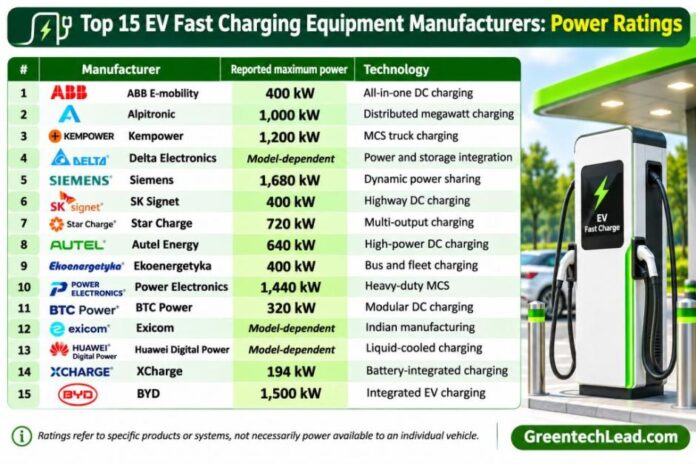
Global EV fast charging equipment manufacturers are investing in 400 kW to 1.5 MW charging systems as electric vehicle adoption accelerates. ABB E-mobility, Alpitronic, Kempower, Siemens, Delta Electronics, SK Signet, Star Charge, Autel Energy, Ekoenergetyka, Power Electronics, BTC Power, Exicom, Huawei Digital Power, XCharge and BYD are competing on charging speed, efficiency, manufacturing costs and reliability.
According to the International Energy Agency’s Global EV Outlook 2026, worldwide public EV charging infrastructure exceeded 7 million points at the end of 2025, following nearly 1.8 million additions during the year.
China accounted for more than 65 percent of global public charging points, while India had approximately 88,000.
Equipment manufacturers are increasingly targeting megawatt charging for electric trucks, modular power distribution, liquid cooling and battery-integrated charging.
1. ABB E-mobility: 400 kW Charging With 97% Efficiency
ABB’s A400 charger supports 200 kW, 300 kW and 400 kW configurations.
It provides two charging outlets, dynamic power sharing in 50 kW increments and reported conversion efficiency of up to 97 percent.
At 97 percent efficiency, delivering 100 kWh requires approximately 103.1 kWh of electricity input, excluding additional site losses.
2. Alpitronic: 1 MW Charging for Eight Vehicles
Alpitronic’s HYC1000 provides 1,000 kW of total charging power across up to eight vehicles.
Power is distributed in 62.5 kW increments.
Its Megawatt Charging System supports current up to 1,500A for electric trucks.
Eight outlets share the installed power capacity; they cannot each deliver 1 MW simultaneously.
3. Kempower: €303.5 Million Orders and 1.2 MW Charging
Kempower’s Mega Satellite Flex supports 1.2 MW MCS charging and up to 560 kW through CCS.
The company reported 2025 revenue of €251.3 million, order intake of €303.5 million and year-end backlog of €141.3 million.
Revenue reached €201.7 million during January–September 2026, although third-quarter revenue declined 10 percent year over year.
These are company-wide figures, not megawatt charger revenue.
4. Delta Electronics: Charging and Battery Storage Integration
Delta Electronics combines EV charging equipment with power conversion, energy storage and energy management.
Its systems target passenger vehicles, commercial properties and fleet depots.
Battery-integrated charging can reduce peak grid demand, although savings depend on electricity tariffs, storage costs and utilisation.
5. Siemens: 1.68 MW SICHARGE FLEX
Siemens’ SICHARGE FLEX offers configurable power from 480 kW to 1,680 kW.
Supported configurations provide current up to 1,500A and dynamic distribution across multiple outlets.
Siemens announced its first commercial SICHARGE FLEX deployment at an OMV charging location in Austria in September 2026.
6. SK Signet: 400 kW Highway Charging
SK Signet supplies DC fast chargers rated up to 400 kW for public networks, highways and commercial fleets.
Its North American business depends on equipment deliveries, connector compatibility, maintenance services and warranty performance.
Actual charging speed varies with vehicle voltage and battery limitations.
7. Star Charge: 720 kW and 12 Charging Outputs
Star Charge’s Nova V4 offers 480 kW and 720 kW configurations.
The system supports up to 12 charging outputs and reports peak conversion efficiency of 97 percent.
Distributed power architecture allows operators to allocate capacity among vehicles rather than installing separate power systems for every outlet.
8. Autel Energy: 640 kW Charging System
Autel Energy’s DC HiPower provides up to 640 kW total output.
Supported configurations deliver up to 480 kW to one vehicle or 320 kW each to two vehicles.
The company combines charging hardware, management software and remote diagnostics.
9. Ekoenergetyka: 400 kW Fleet Charging
Poland-based Ekoenergetyka supplies charging equipment for electric buses, fleets and public networks.
Its Axon Easy DLBS platform offers 160 kW, 240 kW, 320 kW and 400 kW configurations.
Dynamic load balancing supports scheduled fleet charging and shared electrical capacity.
10. Power Electronics: 1.44 MW Truck Charging
Power Electronics’ Megawatt Charging System delivers up to 1,440 kW continuous power and 1,500A current.
It supports one to four charging outputs, depending on configuration.
The technology targets electric trucks, buses and commercial depots requiring higher energy delivery than conventional passenger-car chargers.
11. BTC Power: 320 kW Modular Charging
BTC Power’s fourth-generation all-in-one DC charger provides 320 kW total power.
It supports two 160 kW outputs, operates up to 1,000V DC and uses modular power stacks.
Its communications support includes OCPP 1.6J and OCPP 2.0.1.
12. Exicom: ₹216 Crore Hyderabad Manufacturing Investment
Indian charging equipment manufacturer Exicom inaugurated a Hyderabad manufacturing facility in March 2026 following an investment of ₹216 crore.
The facility targets approximately 2.5 times Phase I production capacity and more than 750 direct jobs.
Production covers EV chargers, battery packs and power electronics.
13. Huawei Digital Power: Liquid-Cooled Charging
Huawei’s FusionCharge technology combines liquid-cooled high-power charging with digital energy management.
Its broader portfolio supports integration with solar generation and battery storage.
Liquid cooling helps manage heat in high-current charging equipment and cables.
14. XCharge: 215 kWh Battery-Integrated Charger
XCharge’s GridLink combines a 215 kWh LFP battery with up to 194 kW DC charging output.
Its approximately 44 kW AC input allows temporary charging output above the grid connection’s continuous capacity.
However, storage investment, battery degradation and conversion losses affect profitability.
15. BYD: 1,500 kW FLASH Charging
BYD’s FLASH technology supports charging power up to 1,500 kW for compatible vehicles.
The company reported 4,239 charging stations installed in China by March 5, 2026.
Its target of 20,000 stations by year-end was a deployment goal, not confirmed completed capacity.
EV Charging Consumer Complaints: Reliability and Payment Problems
The UK consumer organisation Which reported findings from Zapmap’s 2025 charging survey, highlighting recurring difficulties among drivers who experienced charging problems.
| Consumer complaint | En-route | Destination |
| Charger not working | 75% | 68% |
| Insufficient chargers | 51% | 49% |
| Payment unavailable | 30% | 29% |
| Charging too expensive | 29% | 31% |
| Power below advertised level | 25% | 20% |
Percentages refer to surveyed problem experiences, not the failure rate of all chargers.
The J.D. Power 2025 US EV Public Charging Study reported that 14 percent of surveyed EV owners visited a public charger without successfully charging.
DC fast-charging satisfaction declined 10 points to 654 out of 1,000.
These complaints involve equipment, payment platforms and network operations; they cannot automatically be attributed to individual charger manufacturers.
Charger Efficiency and Investment Economics
A DC charger operating at 97 percent efficiency requires approximately 1.031 GWh of electricity to deliver 1 GWh.
At 94 percent efficiency, input increases to approximately 1.064 GWh.
The difference is approximately 32,900 kWh annually, equivalent to ₹2.63 lakh at an illustrative ₹8/kWh electricity price.
At 20 percent average power utilisation, theoretical annual electricity delivery is:
| Charger power | Annual electricity |
| 150 kW | 262,800 kWh |
| 400 kW | 700,800 kWh |
| 1,000 kW | 1,752,000 kWh |
These calculations exclude downtime, charging taper and site-specific constraints.
India EV Charging Market: 520,000 Points by 2035
The IEA’s Global EV Outlook 2026 projects that India’s public charging network could exceed 520,000 points by 2035 under its Current Policies Scenario, requiring approximately 43,000 annual additions.
Its Stated Policies Scenario projects approximately 1.2 million points by 2035.
India’s PM E-DRIVE programme allocates ₹2,000 crore for charging infrastructure, creating opportunities for domestic manufacturers such as Exicom and international suppliers.
In 2027, EV charger manufacturers will compete on equipment reliability, charging efficiency, confirmed orders, manufacturing costs, warranty performance and after-sales service — not maximum advertised charging power alone.
SHAFANA FAZAL