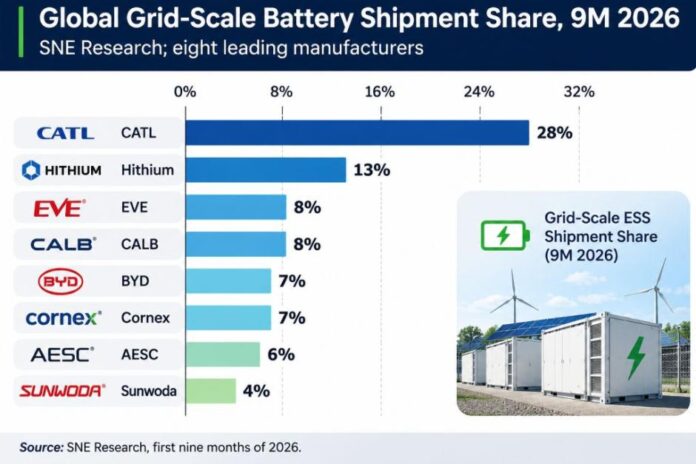
Global grid-scale battery shipments reached 575.9 GWh in the first nine months of 2026, with CATL leading at 28 percent market share. Hithium, EVE Energy, CALB, BYD, Cornex, AESC and Sunwoda are expanding their utility-scale storage businesses, while REPT BATTERO, Gotion High-Tech, LG Energy Solution and Samsung SDI are competing for international battery energy storage system (BESS) contracts.
According to SNE Research’s energy storage market analysis, global energy storage system shipments reached 779.9 GWh during January–September 2026, increasing 73 percent year over year.
Grid-scale applications accounted for 575.9 GWh, representing 73.8 percent of shipments.
Separately, InfoLink Consulting’s battery shipment rankings recorded 747.63 GWh of storage-cell shipments, including 650.30 GWh for utility-scale applications. These datasets have different coverage and should not be combined.
Top 12 Battery Manufacturers: Shipments, Projects and Financial Performance
1. CATL: 28% Market Share and RMB423.7 Billion Revenue
CATL led global grid-scale battery shipments with 28 percent market share.
Its total energy storage shipments reached 198.3 GWh across grid-scale and other applications.
In 2025, CATL generated RMB423.7 billion in revenue, RMB72.2 billion in net profit and RMB133.2 billion in operating cash flow.
Its 772 GWh manufacturing capacity covers batteries for both electric vehicles and energy storage.
CATL’s financial strength and manufacturing scale support international expansion, although buyers must independently assess warranty coverage, battery degradation and after-sales service.
2. Hithium: 13% Share and 4 GWh Saudi Project
Hithium secured 13 percent of global grid-scale battery shipments, with 75.7 GWh of total ESS shipments.
Its 4 GWh Saudi Electricity Company project with Alfanar uses 1,175 Ah battery cells and 6.25 MWh storage systems.
The project represents a major commercial contract, but the full 4 GWh should not be classified as commissioned capacity.
Hithium’s specialization in stationary storage is an advantage, subject to verified manufacturing utilization and local technical support.
3. EVE Energy: 8% Share and 71.6 GWh Shipments
EVE Energy captured 8 percent of the grid-scale market and shipped 71.6 GWh across energy storage applications.
Its 628 Ah Mr Giant battery platform targets higher energy density at the system level and fewer electrical connections.
A 200 MW / 400 MWh project provides a deployment reference.
Customers should assess thermal management, usable energy, cell degradation and performance warranties.
4. CALB: 8% Share in Utility-Scale Batteries
CALB held 8 percent grid-scale market share and ranked among InfoLink’s five largest utility-scale battery cell suppliers.
Its portfolio includes large-format lithium-ion cells for energy storage applications.
However, publicly disclosed storage-only manufacturing utilization and commissioned project data remain important information gaps.
Buyers should request named project references, delivery records and independently verified performance.
5. BYD: 12.5 GWh Saudi Battery Project Commissioned
BYD captured 7 percent of global grid-scale shipments.
Its Saudi Electricity Company project comprises five installations totaling 2.5 GW / 12.5 GWh.
The installations were commissioned in June 2026 following grid-tied testing.
BYD supplied the battery systems, Alfanar served as EPC contractor, and NR Electric provided grid-forming controls and power-conversion equipment.
The project provides a significant international execution reference, with clear distinctions between supplier responsibilities.
6. Cornex: 7% Share and 588 Ah Battery Cells
Cornex achieved 7 percent grid-scale market share and entered InfoLink’s five largest global storage-cell suppliers during the first nine months of 2026.
Its product portfolio includes 588 Ah battery cells designed for utility-scale applications.
Manufacturing expansion and customer agreements support growth, but framework agreements should not be treated as completed deliveries.
Factory utilization, warranty strength and commissioned projects remain important evaluation criteria.
7. AESC: 6% Share and 110% Shipment Growth
AESC captured 6 percent grid-scale market share, with shipments increasing 110 percent year over year.
Its agreement with Prevalon provides for potential deployments of up to 10 GWh over three years.
This represents forward supply potential rather than completed installations.
AESC’s international manufacturing footprint could support regional sourcing requirements, subject to factory readiness and product qualification.
8. Sunwoda: 4% Grid-Scale Share
Sunwoda held 4 percent of global grid-scale battery shipments and returned to InfoLink’s global top ten storage-cell suppliers.
The company supplies batteries across utility-scale, commercial, industrial and residential applications.
Investors should distinguish grid-scale shipments from smaller storage products when evaluating growth.
9. REPT BATTERO: ESS Revenue Jumps 86.8%
REPT BATTERO reported 2025 energy storage battery revenue of RMB13.56 billion, increasing 86.8 percent year over year.
Total company revenue reached RMB24.33 billion, with an ESS gross margin of 10.8 percent.
REPT reported cumulative battery supply exceeding 1.5 GWh for Energy Vault projects.
Supplied batteries should not automatically be counted as commissioned storage capacity.
10. Gotion High-Tech: RMB9.07 Billion Storage Revenue
Gotion High-Tech reported RMB9.07 billion in 2025 energy storage system revenue and RMB3.62 billion in operating cash flow.
Its business covers automotive batteries and stationary energy storage.
A reported 6 GWh Saudi project award represents future delivery potential rather than operating capacity.
Investors should examine storage-specific profitability, international manufacturing and service infrastructure.
11. LG Energy Solution: 981 MWh Poland Contract
LG Energy Solution ranked ninth in InfoLink’s third-quarter 2026 utility-scale battery shipment assessment.
Its 981 MWh supply agreement for Poland’s Żarnowiec project schedules deliveries across 2026 and 2027.
Expansion into lithium iron phosphate (LFP) batteries and international production could strengthen its stationary storage business.
Project delivery, pricing and ESS profitability remain key performance indicators.
12. Samsung SDI: 16 GWh Jupiter Power Agreement
Samsung SDI is developing its LFP battery storage business, particularly for the US market.
Its 16 GWh agreement with Jupiter Power is scheduled to begin deliveries in 2029.
The contract provides longer-term revenue potential but does not represent 2026 operating capacity.
Manufacturing readiness, customer qualification and project execution will determine its commercial contribution.
Battery Customer Complaints: Fire Safety, Degradation and Warranty Disputes
Grid-scale battery customers include utilities, developers and industrial operators. There is no verified, comparable public database ranking complaints against these 12 manufacturers.
Potential customer concerns include battery overheating, premature capacity loss, software failures, unexpected shutdowns, delayed replacements and disputes over performance guarantees.
These are industry risks, not verified allegations against individual companies.
The US Environmental Protection Agency’s lithium-ion battery guidance highlights the importance of safe battery handling and fire prevention.
| Customer concern | Commercial impact |
| Premature battery degradation | Lower usable capacity |
| Thermal incidents | Safety risks and downtime |
| BMS or software faults | Unexpected shutdowns |
| Delayed warranty replacements | Lost storage revenue |
| Lower round-trip efficiency | Higher charging costs |
| Inadequate local support | Extended repair periods |
Contracts should specify capacity retention, availability, thermal safety, augmentation obligations, replacement timelines and remedies for underperformance.
Grid-Scale Battery Economics: $50 Million for 400 MWh
An Ember battery storage cost analysis estimated approximately $125/kWh in all-in capital expenditure for large utility projects outside China and the United States.
At that benchmark, a 100 MW / 400 MWh project would cost approximately $50 million.
Assuming 400 MWh of daily AC discharge and 90 percent round-trip efficiency, annual electricity delivery would reach 146,000 MWh, requiring approximately 162,222 MWh of charging electricity.
At a $30/MWh purchase price and $80/MWh sale price, the illustrative annual trading margin would be approximately $6.81 million before operating costs, financing, degradation and taxes.
These are analytical assumptions, not manufacturer quotations or guaranteed investment returns.
India BESS Market: 14.54 GWh Operational, 78.96 GWh Under Construction
India’s Central Electricity Authority BESS status report recorded 5.32 GW / 14.54 GWh of operational battery storage as of September 30, 2026.
Another 27.73 GW / 78.96 GWh was classified as under construction under the CEA’s reporting methodology, which includes projects with signed PPA or BESPA agreements.
India’s expanding storage pipeline offers opportunities for battery cells, containers, battery management systems, power electronics, installation and maintenance.
CATL, Hithium, EVE Energy and BYD have established significant grid-scale positions, while emerging competitors are expanding manufacturing and contracts. Future market leadership will depend on verified shipments, commissioned projects, safety, customer service, financial strength and lifetime storage economics — not announced capacity alone.
SHAFANA FAZAL