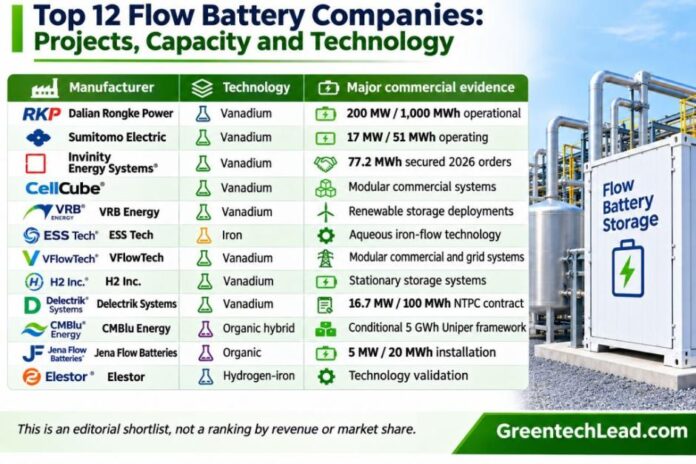
Flow battery manufacturers are expanding grid-scale energy storage capacity as utilities seek alternatives to lithium-ion batteries for six- to twelve-hour electricity storage. Dalian Rongke Power, Sumitomo Electric, Invinity Energy Systems, CellCube, VRB Energy, ESS Tech, VFlowTech, H2 Inc., Delectrik Systems, CMBlu Energy, Jena Flow Batteries and Elestor are competing through vanadium, iron, organic and hydrogen-based technologies.
Flow batteries store energy in electrolytes and use electrochemical stacks to convert it into electricity. Unlike conventional lithium-ion batteries, their power capacity and energy capacity can be expanded relatively independently.
This architecture is attractive for renewable energy integration, grid balancing and long-duration storage. However, manufacturing costs, round-trip efficiency, pumping losses, project financing and maintenance determine commercial competitiveness.
1. Dalian Rongke Power: 1 GWh Vanadium Battery Operating in China
Dalian Rongke Power has one of the largest disclosed vanadium redox flow battery portfolios.
Its 200 MW / 1,000 MWh CTG Jimusaer project in Xinjiang reached full-capacity operation at the end of 2025.
Other references include Xinhua Wushi at 175 MW / 700 MWh and the first 100 MW / 400 MWh phase of Dalian ConCurrent, commissioned in 2022.
Rongke also delivered a 12 MW / 60 MWh Panzhihua installation using leased vanadium electrolyte.
These four references total 475 MW / 2,160 MWh, although they have different commissioning histories.
Electrolyte leasing may reduce initial capital requirements, but customers must evaluate recurring payments and residual-value provisions.
2. Sumitomo Electric: Operating VRFB Projects and 20-Year Service Contract
Japan’s Sumitomo Electric has extensive experience in vanadium flow batteries.
Its Minami-Hayakita references include a 17 MW / 51 MWh system operating since April 2022 and a separate 15 MW / 60 MWh demonstration system continuing commercial operation.
At Kashiwazaki, completed phases total 24 MWh, with another 1 MW / 8 MWh installation scheduled for spring 2027.
Sumitomo also secured an 11 MW / 33 MWh Minami-Hayakita project for completion by May 2029, including a 20-year service agreement.
The Sumitomo Electric project announcement details its latest contract and operating references.
Long-term maintenance commitments are important because flow batteries require pumps, membranes, sensors and stack servicing.
3. Invinity Energy Systems: 77.2 MWh Orders and 12.5 GWh Pipeline
UK-based Invinity Energy Systems supplies VS3 and Endurium vanadium flow battery platforms.
The company reported 34.2 MWh of customer orders in the first half of 2026.
A subsequent 43 MWh Dairyland Power contract increased secured 2026 orders to 77.2 MWh.
Its prospective project pipeline exceeded 12.5 GWh, while the global installed fleet had cumulatively dispatched 11 GWh of electricity.
The 20.7 MWh Copwood system had been delivered, although grid connection and full commissioning remained pending at the interim reporting date.
Invinity targets a 66 percent product-cost reduction for Endurium deliveries in 2027.
Its 2026 interim financial results distinguish confirmed orders from prospective opportunities.
The main investment considerations are manufacturing costs, gross margins, cash requirements and delivery performance.
4. CellCube: Modular Vanadium Storage and Electrolyte Recovery
CellCube, associated with Austrian developer Enerox, provides modular vanadium flow battery technology.
Its systems separate electrolyte storage from electrochemical stacks, allowing developers to configure discharge duration.
Vanadium electrolyte can retain recoverable material value, potentially supporting end-of-life economics.
However, electrolyte tanks, pumps, civil construction and electrical infrastructure increase upfront costs.
Customers should verify current manufacturing arrangements, completed installations, stack replacement costs and warranty responsibility.
5. VRB Energy: Vanadium Batteries for Renewable Integration
VRB Energy develops vanadium flow battery systems for stationary storage and renewable electricity integration.
The company has been associated with projects in China and international markets.
Its commercial assessment requires distinguishing technology ownership, manufacturing responsibilities and project warranties.
Relevant indicators include commissioned capacity, actual production, customer references, electrolyte supply and technical service coverage.
Prospective projects should not be treated as operating installations or secured revenue.
6. ESS Tech: Iron Flow Batteries Target Lower Material Costs
US-based ESS Tech develops aqueous iron flow batteries using relatively abundant materials.
Its technology targets long-duration electricity storage without relying on vanadium or lithium-ion cell chemistry.
Iron-based systems may reduce exposure to certain critical mineral prices.
However, lower raw-material costs do not automatically translate into cheaper delivered electricity.
Manufacturing yields, energy efficiency, operating availability, maintenance and stack durability remain important.
Buyers should request independently verified operating hours, delivered energy, degradation and warranty information.
7. VFlowTech: Singapore-Based Modular Vanadium Batteries
VFlowTech develops vanadium redox flow battery systems for commercial, industrial and grid applications.
Its modular approach targets renewable energy integration and longer-duration electricity storage.
Potential revenue streams include battery equipment, energy management software, installation and maintenance.
For tropical markets such as India and Southeast Asia, customers should examine cooling requirements, auxiliary consumption and performance at high ambient temperatures.
Commercial expansion will depend on repeat orders, local service partners, manufacturing scale and financing.
8. H2 Inc.: South Korean Vanadium Flow Battery Technology
South Korea’s H2 Inc. develops vanadium flow battery systems for stationary electricity storage.
Its technology targets applications requiring frequent cycling and longer operating lives.
Potential customers should evaluate completed installations, AC round-trip efficiency, electrolyte management and operating expenditure.
International expansion requires dependable spare parts, technical support and warranties.
Demonstration installations and announced production capacity alone do not establish commercial bankability.
9. Delectrik Systems: 100 MWh NTPC Project Creates India Opportunity
India’s Delectrik Systems secured a contract with NTPC Renewable Energy and Bondada Engineering for a 16.7 MW / 100 MWh vanadium flow battery system at Khavda, Gujarat.
The installation provides approximately six hours of storage duration.
Commissioning is expected in the second half of 2027.
The agreement includes ten years of operations and maintenance.
Delectrik previously deployed a 3 MWh demonstration installation at NTPC’s NETRA facility.
Planned manufacturing investments include electrolyte production in Gujarat and stack manufacturing in Gurugram.
The Khavda contract provides a potential domestic commercial reference, but the project is not yet operational.
10. CMBlu Energy: Conditional 5 GWh Uniper Supply Framework
Germany’s CMBlu Energy develops SolidFlow technology combining organic flow chemistry with solid storage materials.
Its agreement with Uniper covers at least 5 GWh of potential supply through 2037.
The framework anticipates call-offs beginning in 2027, with individual tranches of at least 100 MWh.
However, the agreement is conditional, and the full 5 GWh should not be reported as firm orders or revenue.
The CMBlu and Uniper agreement outlines the proposed commercial structure.
Manufacturing scale, operating performance and firm purchase commitments remain decisive.
11. Jena Flow Batteries: 20 MWh Organic Flow Battery Reference
Jena Flow Batteries develops aqueous organic, metal-free battery technology.
Its parent company reported commissioning a 5 MW / 20 MWh installation in Ordos, China, in 2025.
The four-hour project was described as a major operating reference for aqueous organic flow batteries.
However, one installation does not establish long-term fleet reliability.
Investors should examine electrolyte stability, operating efficiency, manufacturing costs and repeat customer contracts.
12. Elestor: Hydrogen-Iron Flow Battery Development
Netherlands-based Elestor is developing hydrogen-iron flow battery technology.
Its current approach differs from the company’s earlier hydrogen-bromine concept.
The technology combines a hydrogen circuit with an aqueous iron electrolyte.
Potential advantages include independently scalable energy and power capacity.
However, hydrogen handling, membrane durability, safety engineering and energy efficiency require validation.
Extended laboratory cycling is not equivalent to a commercially operating grid-scale project.
Flow Battery Customer Complaints: Efficiency, Maintenance and Reliability
Utility-scale flow batteries are purchased mainly by utilities and industrial customers, so public consumer complaint statistics are limited. There is no verified manufacturer-by-manufacturer complaint ranking for these 12 suppliers.
Key customer concerns include lower-than-guaranteed AC efficiency, pump failures, electrolyte leakage, membrane deterioration, delayed commissioning and inadequate technical support.
For a 100 MW / 800 MWh system, a five-percentage-point reduction in round-trip efficiency represents 40 MWh of additional energy losses per full cycle, assuming consistent measurement boundaries.
Contracts should specify AC efficiency, availability, electrolyte containment, stack replacement, maintenance response times and performance penalties. These are potential procurement risks, not documented complaints against the listed companies.
India Flow Battery Investment: ₹14,500 Crore Storage Scheme
India’s November 2026 viability gap funding scheme allocates ₹14,500 crore to support 92 GWh of energy storage, comprising 30 GWh of battery storage, 60 GWh of pumped hydro and 2 GWh of emerging technologies.
The government estimates ₹97,600 crore in associated investment and projects 411 GWh of storage requirements by 2031–32.
The Cabinet’s official announcement details the allocations. The emerging-technology provision is not exclusively reserved for flow batteries.
Outlook for 2027
Vanadium systems currently have the strongest large-project references among these technologies. Iron, organic and hydrogen-based systems offer alternatives but require further commercial validation.
The leading flow battery manufacturers in 2027 will be determined by commissioned capacity, verified efficiency, lifetime electricity costs, reliable maintenance, financial strength and repeat customer orders — not announced project pipelines alone.
SHAFANA FAZAL