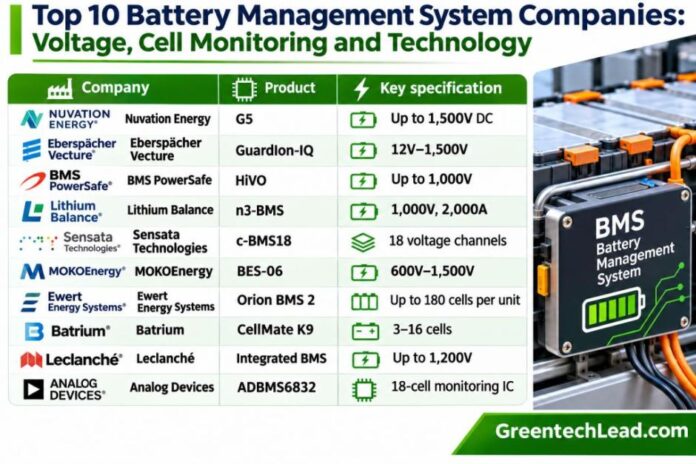
Battery management system (BMS) companies are competing for opportunities in grid-scale battery energy storage systems (BESS) as demand grows for 1,500V battery protection, cell monitoring, thermal safety and predictive diagnostics. Nuvation Energy, Eberspächer Vecture, BMS PowerSafe, Lithium Balance, Sensata Technologies, MOKOEnergy, Ewert Energy Systems, Batrium, Leclanché and Analog Devices offer different technologies for lithium-ion, sodium-ion and industrial battery applications.
Battery management systems monitor cell voltage, temperature and current, estimate state of charge (SoC) and state of health (SoH), balance battery cells and initiate protective responses.
Their performance affects usable storage capacity, equipment availability, battery degradation and integration with power conversion systems (PCS) and energy management systems (EMS).
However, suppliers differ substantially. Some manufacture complete high-voltage BMS platforms, while others provide pack-level controllers, integrated battery controls or monitoring semiconductors.
This is an editorial selection based on technical specifications and product relevance, not a ranking by revenue or market share.
Specifications are manufacturer-reported and cover different product categories. A monitoring chip or pack controller is not directly interchangeable with a complete utility-scale BMS.
1. Nuvation Energy: 1,500V BMS for Utility-Scale Storage
Nuvation Energy develops battery management systems for stationary energy storage applications.
Its G5 high-voltage platform supports battery stacks operating at up to 1,500V DC.
The distributed architecture combines cell monitoring, stack-level control, diagnostics, continuous balancing and open-wire detection.
Nuvation is also developing G5 Plus, which adds 64 cell-voltage and busbar measurements and up to 64 thermistor inputs.
Evaluation units are planned for early 2027, so G5 Plus should not be treated as an established commercial product.
The Nuvation G5 technical specifications provide product details.
2. Eberspacher Vecture: GuardIon-IQ Supports 12V–1,500V
Eberspächer Vecture launched GuardIon-IQ in September 2026.
The modular platform supports systems ranging from 12V to 1,500V across integrated and distributed architectures.
Six variants address different applications: IQ Prime, IQ Pro, IQ Power, IQ Command, IQ Sentinel and IQ Apex.
The portfolio includes integrated control, higher-current configurations, distributed cell monitoring and high-voltage node monitoring.
The GuardIon-IQ launch announcement outlines the product range.
However, a recent product launch does not establish long-term utility-scale operating reliability.
3. BMS PowerSafe: HiVO Supports Up to 1,000V
BMS PowerSafe develops HiVO, a high-voltage battery management platform using master-and-slave architecture.
The system supports battery packs operating at up to 1,000V.
It can connect as many as 20 cell-monitoring units in series, with each unit monitoring five to twelve cells depending on chemistry.
Supported chemistries include lithium iron phosphate (LFP), nickel manganese cobalt (NMC), lithium titanate (LTO) and sodium-ion.
The supplier describes a design aligned with ISO 26262 ASIL B.
However, automotive functional-safety alignment does not automatically establish compliance for stationary battery storage installations.
4. Lithium Balance: 1,000V and 2,000A BMS
Lithium Balance develops integrated and distributed battery management systems.
Its n3-BMS supports up to 1,000V and 2,000A, with configurations covering as many as 360 series-connected cells.
The platform includes distributed monitoring, battery control and Creator configuration software.
The company lists ISO 26262 ASIL C certification for its product.
Its applications include electric trucks and buses, so stationary storage buyers should request ESS-specific operating references.
The Lithium Balance n3-BMS product information provides further specifications.
5. Sensata Technologies: c-BMS18 Offers ±0.5mV Accuracy
Sensata Technologies supplies the c-BMS18 battery management platform for pack-level applications.
The system provides 18 cell-voltage measurement channels and supports up to ten battery packs in parallel.
Its specified voltage measurement accuracy is ±0.5mV at 25°C, while temperature measurement accuracy is ±1°C.
The platform supports passive balancing up to 325mA peak per cell.
It also includes SoC and SoH estimation, power calculations and event logging.
These specifications make the product relevant to battery pack manufacturers and integrators, but it is not a direct substitute for a complete 1,500V utility-scale BMS.
6. MOKOEnergy: BES-06 Targets 1,500V Energy Storage
MOKOEnergy markets BMS products for stationary energy storage applications.
Its BES-06 platform lists an input range of 600V–1,500V and continuous discharge current of 1,000A.
The company also reports support for up to 4,000 cells.
Communications options include CAN, RS485, Ethernet and cellular connectivity.
The manufacturer lists balancing current of 3A per cell, which requires verification under actual operating and thermal conditions.
The MOKOEnergy BES-06 specifications provide the reported capabilities.
Buyers should establish whether maximum voltage, current and cell-count specifications can be achieved simultaneously.
7. Ewert Energy Systems: Orion BMS 2 Monitors 180 Cells
Ewert Energy Systems develops Orion battery management systems for custom battery packs and electrification projects.
Orion BMS 2 supports monitoring of up to 180 cells per unit, with expansion options.
Functions include cell balancing, state estimation and charge/discharge current limits.
The platform may suit custom stationary battery applications, subject to engineering validation.
Customers should confirm supported voltage, parallel-string architecture, PCS integration and contactor control.
8. Batrium: CellMate K9 Monitors 3–16 Cells
Batrium provides modular battery monitoring products, including WatchMon, CellMate and ShuntMon.
CellMate K9 monitors and balances three to sixteen series-connected cells.
The platform supports selected lithium and sodium battery chemistries.
ShuntMon measures pack voltage and current, with a stated voltage limit of 850V.
These products may suit custom battery banks, but their specifications do not automatically establish suitability for multi-megawatt utility installations.
9. Leclanché: Integrated BMS Supports Up to 1,200V
Leclanché integrates battery management technology into its own high-voltage battery systems.
The company states that its BMS is not sold as a standalone product.
Its published features include operation up to 1,200V, cell balancing, SoC and SoH monitoring, pre-charge control, contactor management and isolation-fault detection.
Communications include CAN and RS485.
Leclanché identifies SIL 2 capability for relevant systems.
Buyers should verify the certification scope and performance guarantees of the complete battery system.
10. Analog Devices: ADBMS6832 Monitors 18 Battery Cells
Analog Devices supplies battery monitoring semiconductors rather than complete BMS platforms.
Its ADBMS6832 integrated circuit monitors up to 18 series-connected cells.
The component specifies lifetime total measurement error of ±1.8mV at 3.3V per cell and passive balancing up to 300mA per channel.
Its stackable architecture and isolated isoSPI communications support high-voltage battery monitoring designs.
However, developers must supply additional controllers, protection logic, software, communications and system-level validation.
BMS Customer Complaints: Battery Failures, False Alarms and Warranty Disputes
Battery management systems are generally sold to battery manufacturers, integrators and industrial customers. There is no verified public database comparing complaint rates across these ten suppliers.
Potential customer complaints include inaccurate battery charge readings, unexpected shutdowns, cell imbalance, overheating, communication failures and delayed technical support.
| Customer concern | Potential impact |
| Incorrect SoC readings | Reduced usable battery capacity |
| False alarms | Unnecessary system shutdowns |
| Cell-balancing failures | Accelerated degradation |
| Communication faults | PCS or EMS disconnection |
| Firmware problems | Operational disruption |
| Warranty disputes | Higher replacement costs |
These are industry risks, not documented complaints against individual companies.
Battery Safety Standards and Procurement Requirements
The UL 1973 battery safety standard and IEC 62619 requirements are relevant to industrial and stationary battery safety.
UL 9540 addresses energy storage system safety, while UL 9540A evaluates thermal runaway fire propagation. Neither should be described as a standalone BMS certification.
A 1,000V, 1,000A battery circuit represents up to 1 MW of electrical power. Protection design must therefore account for high-voltage faults, isolation, contactor operation and emergency shutdown.
Buyers should request product-specific certificates, fault-test reports, operating references and firmware support commitments.
Investment Outlook for 2027
Nuvation, Eberspächer Vecture, BMS PowerSafe and Lithium Balance offer high-voltage or distributed platforms. Sensata, Ewert and Batrium address pack-level applications, while Leclanché provides integrated controls and Analog Devices supplies monitoring semiconductors.
The most competitive BMS suppliers will demonstrate verified safety, measurement accuracy, reliable integration, cybersecurity, long-term software support and competitive lifecycle costs — not merely high voltage or cell-count specifications.
SHAFANA FAZAL