
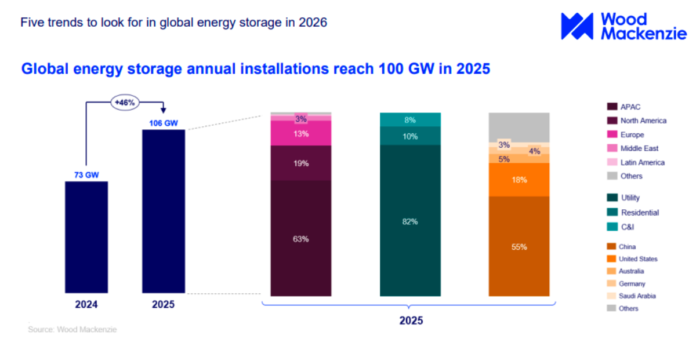
The global energy storage industry is moving into a more nuanced growth cycle in 2026 after delivering its strongest-ever performance in 2025. While some mature markets are expected to slow due to policy changes and supply constraints, overall deployment continues to rise worldwide, supported by accelerating demand from emerging economies, grid operators and large power consumers, according to a report from Wood Mackenzie.
Wood Mackenzie’s latest outlook identifies five structural trends that are reshaping the energy storage landscape. These trends point to a market that is no longer driven solely by volume growth, but by changes in regulation, technology choices and the role storage plays in supporting modern power systems.
Record installations mask regional divergence
Global energy storage installations crossed 106 GW in 2025, setting a new benchmark for the sector. This milestone was reached even as several major markets adjusted incentive frameworks and procurement models, creating short-term uncertainty for developers.
Europe delivered one of the strongest regional performances, with energy storage additions rising sharply compared with the previous year. Growth momentum also strengthened across the Middle East, parts of Asia and other emerging regions, highlighting a broader geographic spread of storage investment beyond traditional strongholds.
Energy storage supply chains face restructuring pressure
China remains the central hub of global energy storage manufacturing, but structural imbalances are forcing change. Excess domestic capacity, combined with tighter localisation rules in overseas markets, is encouraging Chinese suppliers to rethink their international strategies.
Manufacturers are increasingly expected to shift production, ownership structures and partnerships outside China to maintain access to key markets such as the United States. At the same time, supply tightness that emerged toward the end of 2025 is expected to continue into mid-2026, keeping pressure on project timelines and developer margins.
According to Wood Mackenzie, this environment is likely to accelerate overseas expansion by Chinese suppliers, as international markets offer more stable pricing and stronger demand than the highly competitive domestic market.
Grid stability drives regulation of advanced storage systems
As renewable energy penetration continues to rise, grid stability has become a central concern for power system operators. In 2026, grid-forming energy storage is expected to transition from a voluntary technical feature to a regulated requirement in several regions.
The share of variable renewable energy in global electricity capacity is increasing rapidly, reducing the contribution of conventional synchronous generation that traditionally provided system stability. Grid-forming inverters, which can set voltage and frequency independently, are increasingly viewed as essential infrastructure rather than optional enhancements.
Europe is setting the pace, with transmission system operators establishing common technical standards that are expected to be formalised into regulation, creating a clear framework for future storage deployments.
Alternative battery technologies gain commercial relevance
While lithium-ion batteries remain dominant, alternative storage technologies are beginning to achieve meaningful scale. Sodium-ion batteries, flow batteries and iron-air systems are attracting attention for their ability to complement lithium-based solutions, particularly for applications that require longer duration or improved cost stability.
Sodium-ion technology is advancing quickly due to its compatibility with existing manufacturing lines and the availability of raw materials. Large-scale projects under development in North America signal growing confidence in the technology’s commercial potential outside China.
Storage becomes critical infrastructure for large electricity users
The rapid expansion of data centers and other power-intensive facilities is reshaping demand for flexible capacity. With gas turbine supply constrained and delivery times stretching, energy storage is increasingly being deployed to manage load growth, improve resilience and support grid connections.
In regions such as the United States, Europe and China, hundreds of gigawatts of new data center capacity are in development. Energy storage is being integrated into these projects to support interconnection, manage rapid load changes and enable higher use of clean power sources.
Although onsite generation remains limited across the global data center pipeline, storage is emerging as a preferred solution alongside conventional generation technologies.
Hybrid energy storage projects expand beyond the US
The combination of energy storage with renewable generation is gaining momentum globally. Falling solar capture prices and increased price volatility are encouraging developers to pair batteries with solar and wind projects to improve revenue stability.
Australia and India are at the forefront of this trend in the Asia-Pacific region, where a growing share of new storage projects is being announced alongside renewables. Europe is also moving in this direction, as frequent negative pricing events make co-located storage increasingly attractive compared with standalone systems.
Overall, Wood Mackenzie expects the energy storage market to continue expanding in 2026, despite near-term headwinds in certain regions. Structural drivers such as grid modernisation, technology diversification and rising demand from large electricity consumers are reinforcing the role of energy storage as a cornerstone of the global energy transition.
BABURAJAN KIZHAKEDATH
