
The adoption of electric vehicles (EVs) is reshaping global energy dynamics, with analysis from Ember revealing that the global EV fleet avoided the consumption of 1.7 million barrels of oil per day in 2025. This figure nearly matches the 2.4 million barrels exported daily by Iran through the Strait of Hormuz, underscoring the growing impact of electrification on oil demand.
Rising Oil Vulnerability Exposes Global Economy
Oil dependence continues to pose a major risk to the global economy. According to Ember, nearly 79 percent of the world’s population lives in oil-importing countries, making them highly sensitive to price fluctuations. A $10 per barrel increase in oil prices can raise the global net import bill by approximately $160 billion annually, Ember report prepared by Daan Walter, Sam Butler-Sloss, Dave Jones, said.
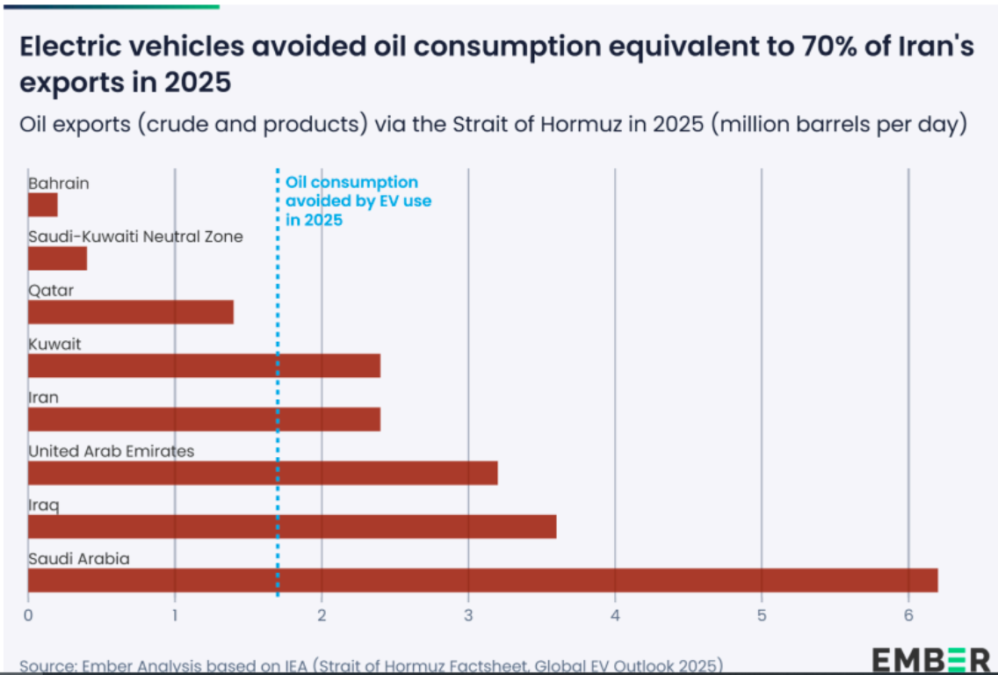
The Strait of Hormuz remains one of the most critical and vulnerable energy chokepoints, carrying about 20 percent of global oil exports. The broader Gulf region accounts for 29 percent of global oil supply, making it a key geopolitical risk area, especially for Asian economies that import around 40 percent of their oil through this route.
Even oil-producing regions are not immune. In Texas, one of the world’s largest oil-exporting hubs, gasoline prices surged by over 25 percent following recent geopolitical disruptions, exceeding increases seen in oil-importing regions like United Kingdom and France.
Electric Vehicles Emerge as a Strategic Alternative
The transition to EVs offers a compelling solution to reduce reliance on imported fossil fuels. Ember estimates that replacing oil used in transport with electric vehicles could cut global fossil fuel imports by one-third, translating into annual savings of nearly $600 billion.
Unlike past oil crises, such as those in the 1970s, countries now have access to scalable alternatives. Renewable energy sources like wind and solar can meet domestic energy needs, enabling nations to reduce exposure to volatile global oil markets.
Asia Leads EV Adoption, Slowing Oil Demand Growth
Emerging economies, particularly in Asia, are playing a critical role in accelerating EV adoption and reducing oil demand growth. Countries like Vietnam, Thailand, and Indonesia have seen EV sales shares surpass those of the United States.
Globally, 39 countries now report EV sales shares above 10 percent, a sharp rise from just four in 2019. China crossed a major milestone in 2025, with EVs accounting for over 50 percent of total car sales.
Meanwhile, countries like India and Brazil are also gaining momentum, surpassing EV adoption levels in Japan.
Significant Cost Savings from Reduced Oil Imports
The economic benefits of EV adoption are already becoming evident. With oil priced at $80 per barrel, China saves over $28 billion annually by avoiding oil imports due to its EV fleet. Europe saves approximately $8 billion, while India achieves savings of around $0.6 billion each year.
According to forecasts by the International Energy Agency, global oil demand is expected to peak by 2029. However, the accelerating shift toward electrification and renewable energy could bring this peak forward.
Energy Transition Reshaping Global Security
The growing disruption in oil supply chains and fluctuating demand highlights the urgency of scaling renewable energy and electrification technologies. As EV adoption accelerates worldwide, countries are increasingly positioning themselves to enhance energy security, reduce import dependence, and shield their economies from volatile oil markets.
BABURAJAN KIZHAKEDATH
