
Britain’s rapidly expanding renewable energy capacity is proving critical in shielding the country from volatile fossil fuel markets, as new analysis from Ember highlights significant cost savings during the latest global energy crisis.
Renewables Offset Surge in Gas Power Costs
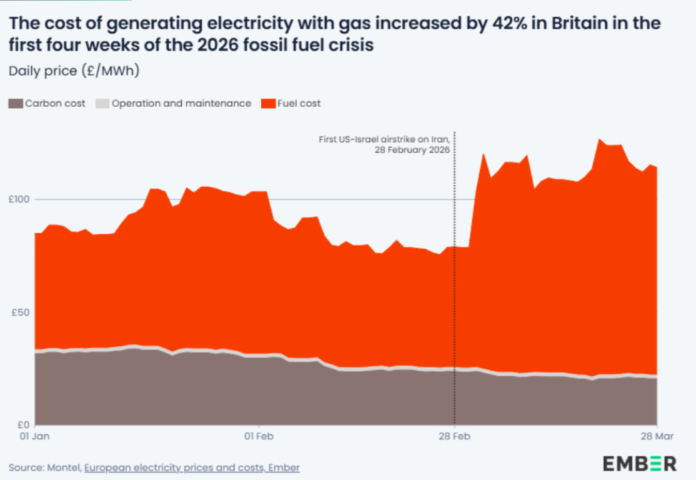
In the first four weeks following the US-Israel war with Iran, gas-fired power generation costs in Britain surged by 42 percent, rising to £110.42/MWh from £77.75/MWh prior to the conflict. Despite this sharp increase, wind and solar energy played a stabilising role, supplying 40 percent of electricity demand, while gas contributed only 23 percent.
This strong renewable output reduced reliance on expensive gas purchases, delivering net savings of approximately £7 million per day compared to previous energy crises.
Expansion of Wind and Solar Capacity Strengthens Energy Security
Since the 2021-23 energy crisis, Britain has expanded its wind and solar capacity by 28 percent, bringing total installed capacity close to 55 GW. This includes 7.7 GW of new wind power and 7.6 GW of solar installations across more than 130 projects.
The increased renewable capacity has significantly reduced dependence on gas-fired generation. In March 2026, gas-based electricity production was 39 percent lower than in March 2021. Without this shift, gas-related power costs during the current crisis would have been 52 percent higher.
“The latest fossil fuel crisis proves that wind and solar have already lowered our dependence on gas and delivered genuine savings. We now need to deploy more renewables and reduce our reliance on volatile gas for good,” Josie Murdoch, Energy Analyst at Ember, said.
Global Conflict Drives Fossil Fuel Price Volatility
The escalation of geopolitical tensions in the Middle East, particularly following airstrikes involving the US and Israel on Iran, has disrupted global energy markets. The temporary closure of the Strait of Hormuz – a critical route for nearly one-fifth of global oil and LNG supplies – intensified concerns over fuel availability and pricing.
Although Britain sources only around 1 percent of its gas from Qatar, it remains exposed to global price fluctuations, which directly impact wholesale electricity costs.
Renewable Generation Reaches Record Levels
Between late February and late March 2026, wind and solar generation in Britain increased by 52 percent compared to the same period in 2021. On several days, wind energy alone accounted for more than half of the country’s electricity supply.
This marks a major shift from 2021, when gas contributed 38 percent of electricity generation, leaving the system far more vulnerable to price shocks.
Strong Project Pipeline to Drive Future Growth
Britain’s renewable energy momentum is set to continue, with more than 750 wind and solar projects either under construction or approved since October 2021. These projects represent a potential pipeline of 60 GW in additional capacity.
Under the Contracts for Difference (CfD) scheme, the country is expected to deploy 45 GW of wind and solar capacity by 2031. The government has also accelerated future CfD allocation rounds to fast-track renewable deployment.
Renewables Key to Long-Term Energy Stability
The latest crisis reinforces the strategic importance of renewables in reducing dependence on volatile fossil fuels. Wind and solar energy are not only lowering electricity costs but also strengthening Britain’s resilience against global energy disruptions.
As deployment accelerates, continued investment in renewable infrastructure will be essential to securing long-term energy stability and protecting consumers from future gas price shocks.
BABURAJAN KIZHAKEDATH
