
Australia’s mining industry is confronting growing financial and operational risks due to its heavy reliance on diesel, with new analysis from the Institute for Energy Economics and Financial Analysis (IEEFA) highlighting structural challenges tied to fuel costs, emissions growth, and policy settings.
Diesel remains a cornerstone of mining operations, particularly in remote and off-grid regions where access to electricity infrastructure is limited. However, increasing exposure to volatile global fuel prices is driving up operating costs and creating long-term uncertainty for mining companies.
At the same time, decarbonization pressures are intensifying, placing Australia’s mining sector under scrutiny as it continues to depend heavily on diesel-powered equipment, IEEFA’s Andrew Gorringe said in a report.
Diesel Dependence Drives Costs and Emissions Higher
IEEFA estimates that Australia’s mining sector consumes around 9.6 billion litres of diesel annually, representing roughly 35 percent of total national diesel demand. This makes mining the single largest diesel-consuming sector in the country.
This dependence is also contributing to rising emissions. Diesel-related emissions in mining are increasing at an average rate of about 6 percent per year, reflecting growing energy intensity across operations.
Major miners BHP, Rio Tinto, Glencore and Anglo American have all deferred diesel decarbonisation to beyond 2035.
A key factor is the shift toward deeper and lower-grade ore bodies, which require more energy-intensive extraction processes. According to IEEFA, diesel intensity in open-cut mining has risen by around 50 percent over the past decade due to higher strip ratios and increasingly complex mining conditions.
Fuel Tax Credits Reinforce Structural Dependence
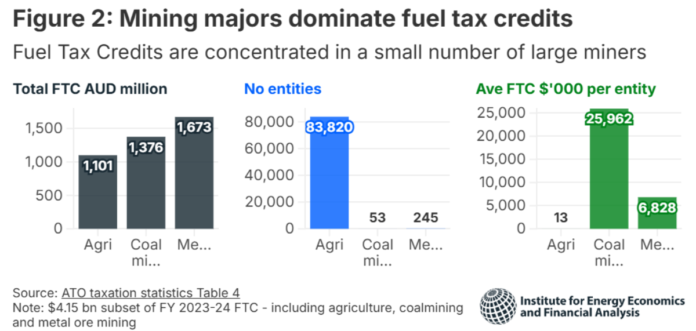
A major driver of continued diesel use is Australia’s fuel tax credit system. IEEFA estimates that the mining sector receives approximately AUD 4.5 billion annually in fuel tax credits, accounting for nearly 47 percent of total fuel tax credit expenditure nationwide.
These credits significantly reduce the effective cost of diesel for mining companies. Importantly, off-road diesel use in mining is not linked to emissions performance, unlike on-road transport sectors that face stricter environmental regulations.
IEEFA argues that this policy structure weakens incentives for mining companies to transition toward cleaner energy alternatives and may delay emissions reduction efforts.
Concentrated Subsidies Shape Industry Economics
The analysis shows that fuel tax credit benefits are highly concentrated within the mining sector, reflecting both the scale of diesel consumption and the dominance of a relatively small number of large operators.
While subsidies are not attributed to specific firms, this concentration reinforces the economic viability of diesel-intensive operations and sustains reliance on fossil fuels in mining energy systems.
Leading Mining Companies and Diesel Use
BHP Group, Rio Tinto, Fortescue Metals Group, Newmont Corporation, and South32 operate extensive diesel-powered fleets across Australia’s mining regions.
These fleets include haul trucks, excavators, drills, and on-site generators, many of which operate continuously in remote areas such as the Pilbara. Diesel is particularly critical for haul trucks, which are among the largest energy consumers at mine sites.
For instance, BHP’s Australian operations alone consume roughly 1.5 billion litres of diesel annually, with haul trucks accounting for a significant share of this demand.
Diesel often accounts for up to 90 percent of direct (Scope 1) emissions in surface mining, underscoring its central role in both operations and environmental impact.
Rising Costs and Energy Security Concerns
Diesel plays a vital role in maintaining operational reliability, especially in isolated mining regions. However, growing fuel price volatility is increasing cost pressures and exposing companies to supply risks.
As mining operations expand into deeper deposits and require greater material movement, diesel consumption continues to rise, further amplifying cost and emissions challenges.
Investment Trends Reflect Policy Distortions
IEEFA analysis suggests that existing policy settings, including fuel tax credits, are influencing investment decisions by lowering the effective cost of diesel. This reduces the urgency for companies to allocate capital toward cleaner alternatives such as electrification, renewable energy, and battery storage.
However, broader industry insights from the International Energy Agency and International Renewable Energy Agency indicate that integrating renewables and electrified systems can deliver long-term cost savings while reducing exposure to fuel price volatility.
Gradual Shift Toward Cleaner Energy Solutions
Leading mining companies are beginning to respond. BHP, Rio Tinto, and Fortescue are investing in renewable energy integration, electrified mining equipment, and alternative fuels such as hydrogen.
Rio Tinto is also exploring renewable diesel and biofuels as interim solutions, while Fortescue has set a target to eliminate fossil fuel use in its operations by 2030 through large-scale electrification initiatives.
Although the pace of transition varies, these efforts signal a broader industry shift toward reducing diesel dependence over time.
Global Competition and Investor Pressure Build Momentum
Internationally, mining jurisdictions are increasingly adopting renewable energy solutions, supported by favorable policies and resource availability. Analysis from IEA and IRENA suggests that regions advancing faster in energy transition are better positioned to manage costs and reduce emissions intensity.
At the same time, investor expectations and ESG considerations are reshaping capital allocation decisions. Mining companies are under growing pressure to demonstrate credible pathways for reducing diesel use and lowering emissions.
Outlook: Policy Reform Key to Energy Transition
IEEFA concludes that aligning fuel tax credits with emissions performance could accelerate the mining sector’s energy transition. Linking subsidies to environmental outcomes or tightening conditions for high-emission operations may help redirect investment toward cleaner technologies.
FASNA SHABEER
