
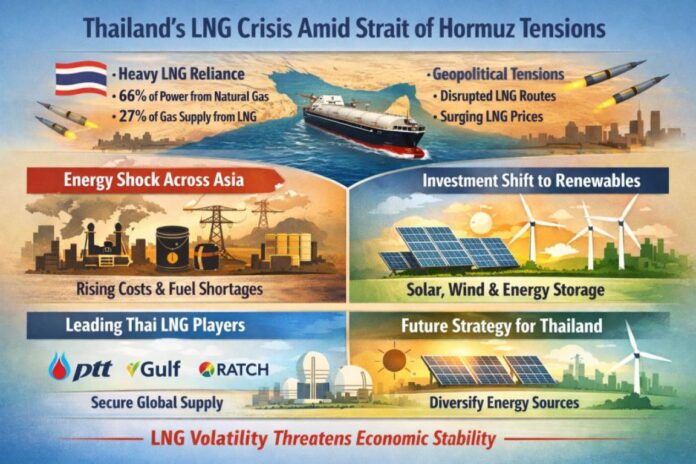
The geopolitical tensions linked to the Strait of Hormuz crisis in 2026 are revealing deep structural vulnerabilities in Thailand’s energy system, where heavy reliance on liquefied natural gas (LNG) is emerging as a major risk to economic stability, energy security, and long-term investment planning.
A recent report by the Institute for Energy Economics and Financial Analysis (IEEFA) highlights how Thailand’s dependence on imported LNG is amplifying exposure to global supply disruptions, price volatility, and currency fluctuations. At the same time, the crisis is accelerating a broader shift across Asia toward renewable energy and diversified energy strategies.
LNG Dependence Puts Thailand Under Pressure
Thailand relies on natural gas for nearly 66 percent of its power generation, with LNG accounting for about 27 percent of total gas supply. A significant share of LNG cargoes transits through the Strait of Hormuz, making the country highly vulnerable to geopolitical disruptions.
The current crisis has removed a large portion of global LNG supply, triggering a sharp surge in spot prices and intensifying competition among importers. For Thailand, this has translated into rising power generation costs, higher electricity tariffs, and increased financial strain on utilities and consumers. Currency depreciation has further compounded import costs, worsening the economic impact.
With more than 7 percent of GDP spent on oil and gas imports, Thailand’s structural dependence on external energy sources leaves it highly exposed to global shocks, driving inflationary pressures and fiscal challenges.
LNG Leaders in Thailand Accelerate Strategic Investments
Thailand’s LNG sector is led by a mix of state-backed incumbents and private players, all expanding infrastructure and securing global supply to navigate market volatility.
PTT remains the dominant force, operating key LNG import terminals and pipeline networks. The company is building a global LNG trading portfolio targeting 10 million tonnes per year by 2030, supported by long-term supply agreements with international players such as Cheniere Energy.
Through subsidiaries like PTT LNG Company, PTT is expanding regasification capacity at Map Ta Phut. Its joint venture PE LNG Company Limited with the Electricity Generating Authority of Thailand underscores efforts to strengthen infrastructure and optimize terminal operations.
Gulf Energy Development has emerged as a key private LNG importer following market liberalization. The company holds a license to import up to 6.4 million tonnes per year and is investing heavily in infrastructure, including the Map Ta Phut Industrial Port Phase 3 LNG terminal project, expected to be completed around 2027. The project involves global engineering firms such as POSCO E&C.
Gulf is also securing long-term LNG supply through international partnerships, including agreements with ADNOC, strengthening Thailand’s supply diversification strategy.
RATCH Group, in collaboration with Gulf, has played a pioneering role in private LNG imports, particularly for projects such as the Hin Kong power plant. This marks a significant shift toward private sector participation in LNG procurement and power generation.
Asia Faces Widespread Energy Shock
The disruption linked to the Iran conflict has created one of the most severe energy supply shocks in recent years, with widespread ripple effects across Asia. LNG tanker disruptions, constrained export capacity, and surging demand have pushed prices sharply higher, with some markets experiencing increases of over 100 percent.
Governments across the region are responding with emergency measures, including energy conservation policies and temporary shifts toward coal and alternative fuels. While these steps address short-term shortages, they are increasing carbon emissions even as long-term clean energy transitions gain urgency.
Tight LNG Supply to Reshape Global Markets
Damage to critical energy infrastructure in the Middle East, including gas production and LNG export facilities, is expected to keep global LNG markets tight for years. Prolonged supply constraints will sustain elevated prices and intensify competition, particularly between Asian and European buyers.
Historically, such conditions disadvantage price-sensitive economies like Thailand, making it harder to secure affordable long-term LNG contracts and increasing exposure to spot market volatility.
LNG’s Role as a Transition Fuel Under Scrutiny
The crisis is accelerating a structural shift in the global energy sector. LNG, once viewed as a reliable transition fuel, is increasingly seen as volatile and high-risk due to geopolitical exposure, infrastructure vulnerabilities, and pricing instability, Reuters news report said.
As a result, several Asian countries are reassessing LNG demand forecasts, delaying new infrastructure projects, and prioritizing energy security and system resilience.
Renewable Energy Investments Gain Momentum
Rising LNG prices are driving a significant shift in global energy investment patterns. Capital is increasingly flowing into renewable energy, grid modernization, battery storage, and electrification as more stable, long-term solutions.
In Thailand, solar energy is already demonstrating the potential to offset LNG imports and reduce fuel costs. This is strengthening the economic case for accelerating renewable deployment while reducing dependence on imported fuels.
Investors are also becoming more cautious about LNG infrastructure, given the growing risk of stranded assets in a rapidly evolving energy landscape. Governments, meanwhile, are increasing policy support for clean energy to enhance resilience against global market shocks.
Diverging Energy Strategies Across Asia
Across Asia, countries are adopting different strategies to manage energy security risks. China is reducing LNG dependence through domestic production and pipeline imports, while Taiwan is diversifying supply contracts and strengthening exporter partnerships.
In South and Southeast Asia, nations such as Bangladesh, Pakistan, and the Philippines are temporarily increasing coal usage to manage shortages while continuing to explore renewable expansion. Meanwhile, Japan and South Korea are maintaining LNG reliance but accelerating diversification, efficiency, and low-carbon investments.
These contrasting approaches highlight a growing divide, where economies that diversify energy sources and invest in renewables are better positioned to withstand global disruptions.
Strategic Outlook: A Turning Point for Thailand
The Hormuz crisis represents a critical inflection point for Thailand’s energy strategy. It underscores the risks of heavy reliance on imported LNG in a volatile geopolitical environment while accelerating the shift toward renewable energy and system diversification.
Going forward, Thailand is expected to expand investments in solar, wind, and energy storage, while strengthening domestic energy capabilities and reducing LNG dependence. Policy reforms and updated power development plans are likely to reflect a stronger focus on resilience, sustainability, and long-term energy security.
FASNA SHABEER
