
Amazon, Microsoft, Google and Meta are emerging as the biggest electricity consumers in the global AI data center industry, while Oracle, CoreWeave, xAI and OpenAI-backed infrastructure projects could drive substantial additional demand by 2030. The competition is shifting from securing AI chips to obtaining gigawatts of reliable electricity.
Global data center electricity consumption is projected to increase from approximately 485 terawatt-hours (TWh) in 2025 to 950 TWh by 2030, according to the International Energy Agency’s Energy and AI analysis.
AI-focused data center electricity demand could triple during this period as companies expand infrastructure for AI training, inference, cloud computing and enterprise applications.
However, no company publishes a complete, consistently comparable forecast of its AI-only electricity consumption through 2030. The most useful comparison therefore combines disclosed electricity consumption, data center capacity, announced projects and expansion commitments.
Which AI Data Center Companies Require the Most Power?
| Company | AI infrastructure position | Power demand outlook through 2030 |
| Amazon / AWS | Global hyperscale cloud and AI infrastructure | Very high; candidate for largest total demand |
| Microsoft / Azure | Azure AI, OpenAI workloads and global cloud infrastructure | Very high; among the largest consumers |
| Google / Alphabet | Google Cloud, Gemini and AI computing | Very high; rapidly expanding |
| Meta | AI training, inference and social media infrastructure | Very high; major dedicated AI campuses |
| Oracle | OCI AI infrastructure and large GPU clusters | High; potentially rapid growth |
| CoreWeave | Specialist GPU cloud and AI computing | High growth from a smaller base |
| xAI | Large AI training clusters and data center expansion | High growth; concentrated facilities |
| OpenAI / Stargate | AI infrastructure developed with partners | Potentially very high; capacity depends on project delivery |
| Crusoe | AI-focused data center development and infrastructure | High growth potential |
| Nebius | AI cloud and GPU infrastructure | High growth potential |
Amazon, Microsoft, Google and Meta are the strongest candidates for the highest absolute electricity consumption, given their established global infrastructure and AI expansion.
Oracle, CoreWeave, xAI, Crusoe and Nebius may experience faster percentage growth because they are expanding from smaller installed bases.
The table is a qualitative assessment, not a verified ranking of company-level AI electricity consumption.
1. Amazon AWS: Leading Candidate for Highest Total Power Demand
Amazon Web Services operates one of the world’s largest cloud infrastructure businesses, supporting enterprise applications, databases, AI training and inference.
AWS electricity requirements are increasing through investments in AI accelerators, Amazon Trainium infrastructure, cloud regions and dedicated computing capacity.
Amazon also supports data center expansion through renewable energy procurement and nuclear-related power arrangements.
Why Amazon could lead: Its extensive existing cloud operations combined with expanding AI workloads create substantial demand for continuous electricity.
However, Amazon does not disclose a standardized annual electricity figure exclusively attributable to AWS AI data centers.
2. Microsoft Azure: OpenAI and Enterprise AI Drive Electricity Requirements
Microsoft is another leading contender for the largest AI data center power demand.
Azure supports enterprise cloud computing, AI model training, inference, Microsoft 365 Copilot and other AI services.
Microsoft’s infrastructure expansion involves high-density GPU clusters, advanced cooling systems and new data center campuses.
The company has also pursued nuclear electricity procurement, including a 20-year agreement with Constellation associated with restarting the Three Mile Island Unit 1 reactor, renamed the Crane Clean Energy Center.
Power demand outlook: Microsoft could remain among the largest electricity consumers through 2030 because it combines established cloud demand with expanding AI services.
3. Google: Gemini and Google Cloud Accelerate Power Consumption
Google requires electricity for search, YouTube, Google Cloud, Gemini and its internal AI infrastructure.
Alphabet reported approximately 30.8 TWh of electricity consumption in 2024, compared with approximately 24.3 TWh in 2023. These figures cover its reported operations and are not exclusively attributable to AI.
Google is expanding its electricity procurement through renewable energy, nuclear projects and grid investments.
In October 2026, Google and Constellation announced a 20-year agreement supporting 890 MW of additional nuclear generation capacity through upgrades at 11 existing units.
The Google–Constellation nuclear power agreement demonstrates the scale of electricity procurement associated with AI expansion.
4. Meta: AI Supercomputing Creates Gigawatt-Scale Demand
Meta is developing large AI computing facilities supporting its Llama models, recommendation engines, advertising systems and consumer AI applications.
Unlike AWS, Azure and Google Cloud, Meta primarily develops infrastructure for its own digital platforms and AI services.
Its Hyperion AI data center project in Louisiana has been described as a multigigawatt development, with plans potentially reaching 5 GW of capacity.
At a hypothetical continuous facility demand of 5 GW, annual electricity consumption would reach approximately 43.8 TWh.
This is a mathematical illustration, not a forecast of Hyperion’s actual consumption. Full development, operating load and energization schedules determine real demand.
Meta could become one of the largest individual AI campus electricity consumers, even if its total global power demand remains below that of some hyperscale cloud providers.
5. Oracle: Rapidly Expanding AI Cloud Infrastructure
Oracle is becoming an important electricity consumer through Oracle Cloud Infrastructure (OCI), which supports large GPU clusters and AI workloads.
Its participation in the Stargate infrastructure initiative increases its exposure to multigigawatt data center developments.
Unlike established hyperscalers, Oracle’s electricity requirements could increase sharply as new AI facilities become operational.
However, electricity used by Oracle-hosted OpenAI workloads should not be counted separately as OpenAI consumption when calculating total industry demand.
6. CoreWeave: Specialist AI Cloud Provider
CoreWeave focuses on GPU-based computing infrastructure for AI developers, cloud customers and enterprises.
Its electricity requirements depend on operational GPU capacity, data center utilization and the power density of installed accelerators.
CoreWeave’s growth strategy involves securing large amounts of computing capacity through owned and leased infrastructure.
CoreWeave could become one of the largest specialist AI infrastructure electricity consumers by 2030, although its total consumption remains difficult to compare with established hyperscalers.
7. xAI, Crusoe and Nebius: Emerging High-Power AI Operators
xAI is developing large computing clusters for Grok model training and inference. Its Colossus infrastructure in Memphis illustrates the concentrated electricity requirements of AI supercomputing.
Crusoe develops infrastructure for large AI computing projects, including facilities supporting the Stargate ecosystem.
Nebius is expanding GPU cloud infrastructure for AI companies and enterprise customers.
These companies could record substantial increases in electricity consumption as new campuses receive grid connections.
Their growth depends on financing, customer contracts, GPU deliveries and electricity availability.
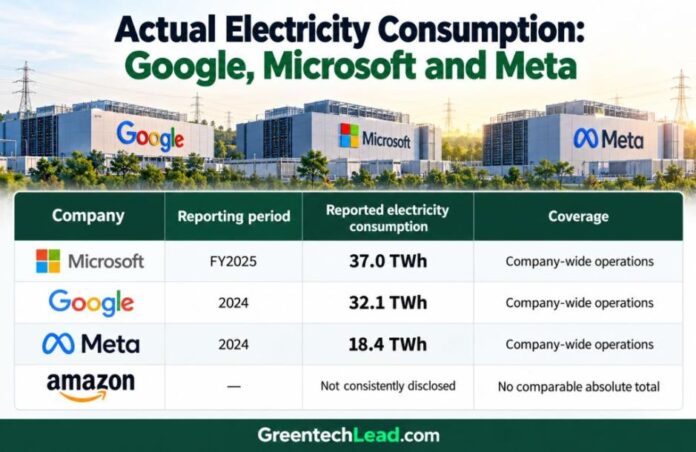
Actual Electricity Consumption: Google, Microsoft and Meta
Published historical figures provide a more reliable benchmark than future campus announcements.
The figures show that Microsoft, Google and Meta already operate electricity-intensive businesses. They do not establish which company uses the most electricity specifically for AI.
Google’s data centers accounted for approximately 30.8 TWh in 2024, while Meta’s accounted for approximately 18.1 TWh. Microsoft does not provide an equivalent data center-only figure in the cited comparison.
How Much Electricity Does a 1 GW AI Data Center Need?
The relationship between power capacity and annual consumption illustrates the scale of AI infrastructure investment.
| Continuous facility power demand | Annual electricity consumption | Annual cost at $0.08/kWh |
| 100 MW | 0.876 TWh | $70 million |
| 500 MW | 4.38 TWh | $350 million |
| 1 GW | 8.76 TWh | $701 million |
| 2 GW | 17.52 TWh | $1.40 billion |
| 5 GW | 43.80 TWh | $3.50 billion |
Illustrative calculations assume continuous facility-level electricity demand throughout the year. Actual consumption depends on utilization and operational conditions.
A 1 GW AI data center operating continuously could consume approximately 8.76 TWh annually, creating a significant electricity procurement requirement.
The IEA estimates that AI server rack power density increased 11-fold between 2020 and 2025, with a further fourfold increase possible by 2027. This intensifies demand for transformers, cooling equipment and high-capacity electricity connections.
Which Power Companies Will Benefit From AI Data Centers?
The expansion of AI infrastructure creates opportunities for electricity suppliers, renewable energy developers, nuclear operators and grid equipment manufacturers.
Companies including Constellation Energy, NextEra Energy, Vistra, GE Vernova, Siemens Energy and Schneider Electric are positioned across electricity generation, grid infrastructure and power management.
AI data centers also create opportunities for battery storage providers because computing workloads require stable electricity supplies.
The IEA World Energy Investment 2026 report provides context for investment in electricity generation, networks and clean energy infrastructure.
However, the largest beneficiaries will depend on actual power contracts, equipment orders and project completion rather than announced data center capacity alone.
Conclusion: Which AI Company Will Need the Most Power by 2030?
Amazon AWS, Microsoft Azure, Google and Meta are the leading candidates for the largest absolute AI-related electricity requirements through 2030. Oracle, CoreWeave, xAI, Crusoe and Nebius represent important sources of additional demand.
Among companies with publicly comparable historical figures, Microsoft and Google have reported particularly large electricity requirements. Amazon remains a major contender, but incomplete disclosures prevent a definitive ranking.
The central challenge is converting announced gigawatts into operational computing capacity.
As global data center electricity consumption approaches a projected 950 TWh by 2030, securing reliable power at competitive prices could become as important to AI infrastructure companies as obtaining advanced processors.
The companies that secure electricity, complete grid connections and maintain high computing utilization will be better positioned to translate AI infrastructure investment into revenue.
SHAFANA FAZAL
