Renewable energy growth depends on electricity networks capable of delivering power from solar parks and wind farms to homes, factories and businesses. Without sufficient transmission lines, substations and distribution capacity, new generation can face delayed connections or restrictions on output.
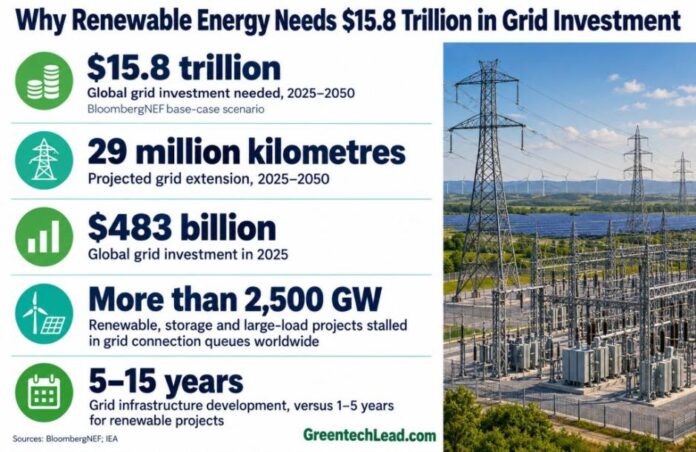
BloombergNEF’s report says global grid investment reached $483 billion in 2025. Yet spending must continue rising as countries connect renewable projects, replace ageing infrastructure and accommodate electricity demand from transport, industry and digital services.
Why the Grid Investment Requirement Runs Into Trillions
BloombergNEF’s long-term grid investment outlook estimates $15.8 trillion in investment between 2025 and 2050 under its base-case energy-transition scenario.
The projection includes a 29-million-kilometre grid extension, with most investment directed toward physical infrastructure such as cables, towers, wires and substations. Replacing ageing assets and connecting renewable generation remain major spending drivers.
Data centers directly account for only 3 percent of global grid capital expenditure in this scenario, although supplying their electricity also requires investment in generation connections. The grid expansion challenge therefore extends well beyond artificial intelligence.
Separately, the International Energy Agency estimates that annual grid investment must increase approximately 50 percent from its $400 billion baseline by 2030, implying roughly $600 billion annually. This annual requirement and BloombergNEF’s cumulative forecast use different methodologies and should not be treated as interchangeable estimates.
Renewable Projects Are Being Built Faster Than Grids
Solar and wind resources are often located far from major electricity consumers. Transmission networks must move that power across regions, while substations and distribution systems deliver it at usable voltages.
The IEA’s Electricity 2026 grid assessment identifies more than 2,500 GW of renewable, storage and large-load projects stalled in connection queues worldwide.
The timing mismatch is substantial. Planning, permitting and completing grid infrastructure can take 5–15 years, compared with 1–5 years for renewable projects. Generation can therefore become available before the network needed to transport it.
Connection queues do not represent entirely construction-ready projects, but their scale demonstrates why transmission planning must begin alongside renewable development.
Grid Constraints Reduce the Value of Clean Power
When networks cannot transport or absorb available electricity, operators may curtail renewable output. Developers then lose potential sales, while consumers receive less benefit from installed generation.
India illustrates the problem. Approximately 1.8 billion units of renewable electricity were turned away during July and August 2026, while about 4.2 percent of solar generation could not be absorbed, according to findings from the Centre for Research on Energy and Clean Air.
Transmission, storage and flexible electricity demand address different parts of this challenge. Batteries can shift surplus solar output into evening hours, but they cannot replace every transmission corridor needed to connect remote renewable resources.
Five Investments Expanding Grid Capacity and Supply
1. National Grid: At Least £70 Billion Through March 2031
National Grid’s five-year infrastructure investment programme commits at least £70 billion across its businesses through March 2031.
The programme includes approximately £31 billion for UK Electricity Transmission and Strategic Infrastructure and £9 billion for UK Electricity Distribution. Transmission investment supports connections for new generation, including offshore wind, while distribution spending accommodates local connections, electric vehicles and heat pumps.
The £70 billion total covers a broader portfolio, including gas networks, and should not be described entirely as renewable electricity grid expenditure.
2. Iberdrola: €37 Billion for Networks Through 2028
Iberdrola’s 2025–2028 network investment strategy allocates €37 billion to electricity networks: €12 billion for transmission and €25 billion for distribution.
More than 70 percent of network investment is directed toward the UK and US. The company aims to expand its regulated network asset base to approximately €70 billion by 2028.
The distribution allocation highlights an essential requirement: renewable integration also depends on neighbourhood networks handling rooftop solar, charging demand and changing electricity flows.
3. TenneT Germany: €4.1 Billion Invested in First-Half 2026
TenneT Germany invested €4.1 billion in transmission expansion and modernisation during the first half of 2026, approximately 14 percent more than a year earlier.
Its programme covers onshore and offshore infrastructure. Reported progress included completion of tunnelling for the ElbX crossing, a key section of SuedLink, and commissioning of the Ostbayernring transmission line in July.
Unlike a multi-year spending pledge, this figure represents investment already recorded during a completed reporting period.
4. US Department of Energy: Approximately $1.9 Billion for Grid Upgrades
In March 2026, the US Department of Energy announced $1.9 billion through its SPARK funding opportunity.
US Department of Energy’s $1.9 billion funding targets reconductoring and advanced transmission technologies. Replacing existing conductors with higher-capacity alternatives can increase electricity transfer capability along established routes.
5. Hitachi Energy: $528 Million Transformer Factory
Hitachi Energy announced a $528 million transformer factory in Gallman, Mississippi, within an approximately $1.5 billion US manufacturing expansion programme.
Production at Hitachi Energy’s transformer factory in Gallman is scheduled to begin in 2029. The new facility is expected to more than double capacity relative to the existing Crystal Springs plant, whose transformer production will move to Gallman.
Smarter Networks Can Complement New Construction
The IEA estimates that dynamic ratings, topology optimisation and advanced power-flow controls could enable up to 330 GW of additional generation, storage and demand to connect to existing networks without reinforcement.
Connecting equivalent capacity through network expansion would require approximately $100 billion. These technologies adjust operating limits to actual conditions and route electricity around congestion, but their benefits vary with network design and weather. They complement new construction and cannot deliver unlimited capacity.
For governments and utilities, the priority is to coordinate renewable connections, transmission construction, equipment procurement and flexible demand. Progress should be measured through shorter connection waits, lower curtailment, additional transfer capacity and reliable service. Those outcomes determine whether grid investment converts renewable capacity into affordable electricity consumers can actually use.
SHAFANA FAZAL