
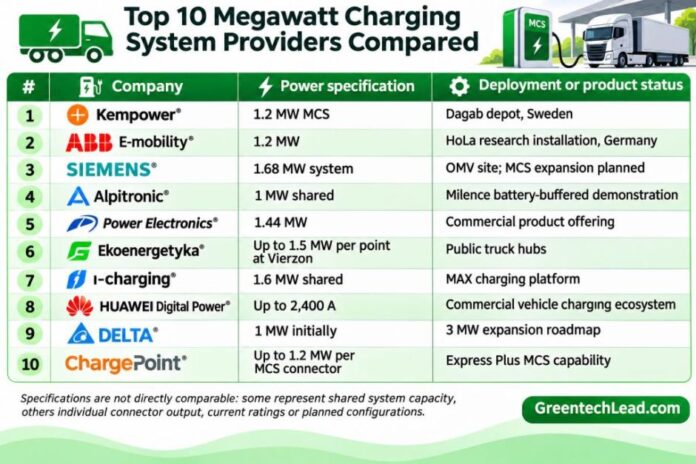
Megawatt Charging Systems (MCS) are creating new opportunities for electric truck manufacturers, logistics companies, charging network operators and power equipment suppliers. Leading MCS providers, including ABB E-mobility, Kempower, Siemens, Alpitronic, Power Electronics, Ekoenergetyka, i-charging, Huawei Digital Power, Delta Electronics and ChargePoint, are developing high-power infrastructure to support heavy-duty electric freight transport.
The CharIN Megawatt Charging System standard supports a maximum of 3.75 MW, 1,250 volts and 3,000 amps. These are technical limits rather than the output delivered by every commercial charger.
According to estimates from the European Automobile Manufacturers’ Association (ACEA), cited by Germany’s VDA, Europe could require approximately 35,000 public MCS charging points by 2030. Separately, European Alternative Fuels Observatory data recorded 730 public heavy-duty charging points exceeding 350 kW in July 2026, including CCS chargers.
1. Kempower: Megawatt Charging for Logistics Depots
Kempower offers the Mega Satellite Flex, supporting up to 1.2 MW through MCS and 560 kW through CCS.
Swedish grocery logistics company Dagab inaugurated a Mega Satellite Flex installation at Bålsta on November 10, 2026, replacing a 400 kW charger. Scania subsidiary Erinion designed, installed and operates the system.
The Kempower announcement on Dagab’s charging installation provides a commercial depot reference.
Its current operating voltage range is 150–1,000 VDC, while 1,250 VDC capability remains future-ready.
2. ABB E-mobility: High-Power Electric Truck Charging
ABB E-mobility offers the MCS1200, delivering up to 1.2 MW and 1,500 amps continuously.
ABB commissioned an MCS point at Lipperland Süd on Germany’s A2 motorway under the publicly funded HoLa research project.
Three MCS-ready trucks completed charging demonstrations at 650–695 kW during the September 2025 opening.
The ABB MCS1200 technical documentation details the equipment configuration.
The installation demonstrates technical interoperability but does not establish a large-scale commercial rollout.
3. Siemens: Flexible Megawatt Charging Infrastructure
Siemens developed SICHARGE FLEX with a power range of 480 kW to 1.68 MW and dynamic allocation between charging points.
At OMV’s Kufstein charging location in Austria, the initial configuration includes two truck charging points rated up to 400 kW each.
A subsequent phase envisages MCS charging points rated between 600 kW and 1.2 MW.
The planned megawatt capacity should not be counted as operational infrastructure.
4. Alpitronic: Battery-Buffered Megawatt Charging
Alpitronic offers the HYC1000, delivering up to 1 MW of shared charging power.
At IAA Transportation 2026, Alpitronic demonstrated battery-buffered charging with Pixii technology for Milence.
According to Pixii’s measured charging demonstration, charger demand reached 1,029.7 kW, with 173.9 kW supplied by the grid and 855.8 kW by battery storage.
The installation combined a 260 kW grid connection with a 1 MW/2 MWh battery system.
The configuration is intended for Milence’s Osnabrück charging hub and illustrates how storage can reduce immediate grid connection requirements.
5. Power Electronics: Dedicated Heavy-Duty MCS Equipment
Power Electronics offers MCS charging equipment with up to 1.44 MW continuous output and 1,500 amps.
Its configurations can combine megawatt charging with other charging outputs.
Logistics customers should evaluate simultaneous charging capacity, cable cooling, maintenance availability and power-sharing capabilities before deployment.
6. Ekoenergetyka: Public Megawatt Truck Charging Hubs
Ekoenergetyka supplies high-power charging technology for commercial vehicles and public freight corridors.
Customer and project examples include a truck charging hub in Bochum, Germany, developed with Graf Transporte and nanuq, and a Voltix charging location in Vierzon, France.
Vierzon opened with four charging points rated up to 1.5 MW each and provision for eight points.
These projects provide public charging references, although charging network investment and financing should not be attributed entirely to the equipment supplier.
7. i-charging: Shared-Power Megawatt Charging
i-charging offers the MAX platform with up to 1.6 MW of shared charging capacity.
The system distributes power dynamically in 50 kW increments and supports MCS current up to 1,500 amps.
Depending on configuration, the platform can serve up to eight vehicles.
Its suitability for logistics depots depends on simultaneous charging requirements, interoperability and service performance.
8. Huawei Digital Power: Liquid-Cooled Truck Charging
Huawei Digital Power supplies liquid-cooled charging equipment specified for up to 2,400 amps, alongside energy management and storage integration.
Huawei’s 2025 annual report described partnerships with more than ten commercial vehicle manufacturers and support for 59 megawatt-charging vehicle models.
These are ecosystem figures rather than a count of operational Huawei-owned MCS locations.
9. Delta Electronics: Megawatt Charging Roadmap
Delta Electronics introduced an MCS solution with initial output of 1 MW and a roadmap extending to 3 MW.
Its specifications include up to 1,500 amps and 1,250 volts, with energy storage integration.
The 3 MW capability remains a planned expansion rather than a verified commercial deployment.
10. ChargePoint: Megawatt Charging and Fleet Software
ChargePoint has announced MCS support for its Express Plus charging architecture using Power Link 2000 equipment.
Its technical configuration supports up to 1.2 MW per MCS connector, depending on available power blocks and cable specifications.
ChargePoint’s broader fleet management capabilities include charger monitoring, energy reporting and charging operations.
Commercial adoption will depend on confirmed MCS installations, customer orders and equipment reliability.
Customer Examples: Scania, Volvo, MAN and Milence
Electric truck manufacturers and logistics operators are beginning to validate megawatt charging under commercial operating conditions.
Scania’s electric truck programme and Erinion’s Dagab installation demonstrate how vehicle manufacturers are extending into depot charging infrastructure. Volvo Trucks and MAN Truck & Bus are also developing electric heavy-duty transport solutions requiring high-power charging.
Milence, backed by Daimler Truck, TRATON Group and Volvo Group, is developing European truck charging infrastructure. Its Alpitronic and Pixii demonstration provides evidence of battery-buffered megawatt charging.
These examples demonstrate ecosystem participation, not confirmed purchasing relationships with every supplier listed.
Customer Complaints: Grid Delays, Charging Failures and High Costs
Electric truck operators face several recurring infrastructure problems: delayed grid connections, charger–vehicle compatibility issues, high installation expenditure and insufficient charging availability.
The European Commission’s Alternative Fuels Infrastructure Regulation establishes requirements for heavy-duty charging infrastructure, reflecting the need for dependable charging coverage.
The International Energy Agency’s Global EV Outlook examines charging infrastructure development and the challenges associated with electric heavy-duty transport.
For fleet operators, the main complaints and procurement risks involve unavailable chargers during scheduled stops, insufficient power during simultaneous charging, expensive grid upgrades and slow maintenance response.
MCS Investment Outlook for 2027
Megawatt charging economics depend on electricity procurement, demand charges, grid capacity, charger utilisation and contracted fleet volumes.
For illustration, a 4 MW charging hub operating at 40 percent average utilisation would deliver approximately 14,016 MWh annually. At ₹20 per kWh, gross charging revenue would reach approximately ₹28.03 crore, before electricity, financing, maintenance and other costs.
Kempower, ABB, Alpitronic and Ekoenergetyka have identifiable installation or demonstration references. Siemens, Huawei, Delta, Power Electronics, i-charging and ChargePoint offer different levels of product maturity and deployment evidence.
Fleet operators should prioritize commissioned MCS installations, measured charging performance, maintenance guarantees and grid readiness rather than advertised maximum charging power alone.
SHAFANA FAZAL
