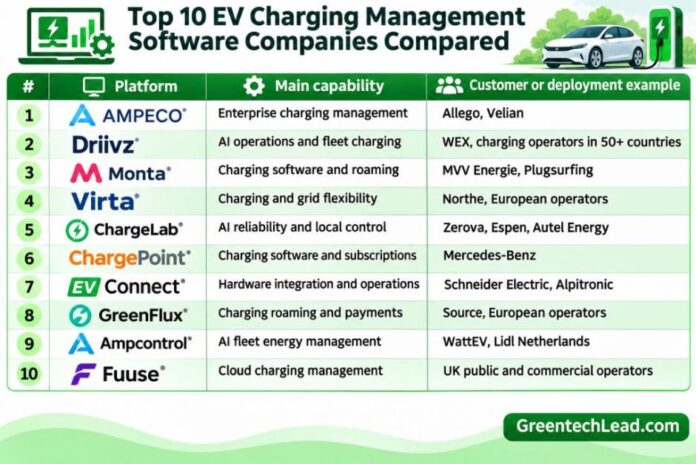
EV charging management software is becoming a critical investment for charging point operators, electric vehicle fleets, utilities and commercial property owners. Leading providers, including AMPECO, Driivz, Monta, Virta, ChargeLab, ChargePoint, EV Connect, GreenFlux, Ampcontrol and Fuuse, are competing through artificial intelligence, charging automation, roaming, billing and energy management.
The commercial opportunity extends beyond installing chargers. Operators need reliable charging sessions, higher utilisation, lower electricity costs and integration with fleet schedules. Software providers generate revenue through subscriptions, transaction processing, enterprise services and energy optimisation.
The International Energy Agency’s Global EV Outlook 2025 examines expanding public charging infrastructure and the importance of charging availability as electric vehicle adoption increases.
1. AMPECO: Enterprise EV Charging Management
AMPECO provides white-label charging software, billing, roaming, APIs and enterprise charge-point management.
In October 2026, Allego migrated more than 32,000 charging points across 15 countries to AMPECO in under five hours. The project included more than 70 roaming connections and a migration team exceeding 100 people.
Dutch operator Velian, with more than 33,000 charge points, also selected AMPECO for a substantial portion of its charging operations.
These deployments demonstrate software scalability, although network size does not establish profitability or charger utilisation.
2. Driivz: AI-Based Charging Operations
Driivz, a Vontier company, provides charging management, fault detection, energy optimisation and billing.
The company reports deployments in more than 50 countries, support for over 2,500 charger models and analysis of more than four billion charging data points.
Its 2026 partnership with WEX integrates fleet payment services with charging operations through OCPI.
Driivz targets charging operators requiring improved session reliability, automated maintenance and integration with commercial fleet systems.
3. Monta: Enterprise Charging and European Roaming
Monta provides charge-point management, payments, smart charging and roaming.
German utility MVV Energie selected Monta in September 2026 to manage approximately 6,600 charging points, including more than 500 public chargers and nearly 6,100 business chargers.
Monta’s November 2026 integration with Plugsurfing expanded roaming access to approximately 938,200 usable charging points across 27 European countries through nearly 500 operator connections.
These are roaming-access figures, not chargers directly operated by Monta.
4. Virta: EV Charging and Grid Flexibility
Virta combines charging management, payments, roaming and energy flexibility.
The company reached 100 million cumulative charging events in April 2026.
Its grid flexibility services expanded in France and the United Kingdom in September 2026, enabling charging operators to participate in electricity flexibility markets.
Virta Broker can generate additional income from managed charging demand, although actual revenue depends on local electricity markets, contracts and available capacity.
5. ChargeLab: AI Charging Reliability
ChargeLab develops EV charging management software for commercial locations and fleet operators.
In August 2026, ChargeLab joined a C$1.2 million Ontario Vehicle Innovation Network project to develop an AI-powered local charging controller.
Ontario contributed C$400,000, while ChargeLab and industry partners committed C$800,000.
The technology aims to maintain charging operations during internet outages. ChargeLab also integrated equipment from Autel Energy and worked with Zerova and Espen on certified charging solutions.
6. ChargePoint: Subscription Revenue and Financial Performance
ChargePoint combines charging software, network operations, hardware and fleet services.
Its Q2 FY2027 financial results showed revenue increasing 18 percent to $116.1 million.
Subscription revenue grew 10 percent to $43.7 million, representing approximately 37.6 percent of total quarterly revenue.
Networked charging systems revenue increased 25 percent to $62.9 million.
Adjusted EBITDA loss narrowed to $4.8 million from $22.1 million, while cash and restricted cash totalled $95.7 million.
ChargePoint also expanded its Mercedes-Benz fleet charging relationship.
7. EV Connect: Integrated Charging Software
EV Connect combines charging management software, hardware integrations and network services.
In October 2026, EV Connect expanded support for Alpitronic DC fast chargers, reporting more than 2,500 existing Alpitronic connectors on its platform.
Its collaboration with Schneider Electric combines Charge Pro hardware with EV Connect Software+ for commercial properties, fleets, hotels and retail locations.
EV Connect’s Joule AI technology targets customer-service efficiency.
8. GreenFlux: EV Roaming and Interoperability
GreenFlux provides charging management, roaming, payment processing and network interoperability.
Its October 2026 partnership with Source, a charging venture involving SSE and TotalEnergies, expanded access to UK ultra-rapid charging locations.
GreenFlux reports more than 1.26 million accessible charging points, over 540 operators, more than 100 e-mobility service providers and over 20 million customer tokens.
These figures describe roaming reach, not GreenFlux-owned charging assets.
9. Ampcontrol: AI Fleet Charging and Grid Management
Ampcontrol provides AI-based charging scheduling, energy optimisation and load management for electric fleets.
At WattEV’s Fresno depot in California, commissioned in June 2026, the charging infrastructure includes seven megawatt charging system chargers and fifteen 240 kW CCS chargers.
According to the Ampcontrol WattEV deployment announcement, software enables access to up to 3.6 MW during most hours despite approximately 1 MW of firm grid capacity.
Ampcontrol also supports Lidl Netherlands’ fleet electrification programme targeting all 440 Dutch stores by 2027. This remains a target, not a completed rollout.
10. Fuuse: Cloud Charging Management
Fuuse provides software for public charging networks, workplaces, destinations and fleets.
Its previously announced £8.7 million Series A financing supported business expansion.
At the time, Fuuse reported more than 750 clients, 70,000 active users and over 60 employees.
In October 2026, Fuuse partnered with ANS on Microsoft Azure infrastructure and AI initiatives, including Microsoft Copilot adoption.
The company reports more than 9,000 UK public chargers managed through its platform.
More Enterprise Customers and Charging Network Deployments
Additional customer evidence demonstrates the role of charging software in scaling operations.
AMPECO’s published customer case studies include Powy, which migrated approximately 1,200 connectors across Italy and Spain in a two-hour window, and Wattif, which reported 370 percent revenue growth while expanding across six European markets. Other customers include AGL, Ignitis ON, Elaway, PAZ Charge and EOS Linx.
Ampcontrol’s fleet customer portfolio includes First Student, which selected the platform for 500 electric buses across 30 sites, Global Container Terminals in Canada and AlphaStruxure’s Montgomery County transit depot microgrid. Takealot and Aeversa reported energy cost reductions of up to 65 percent.
Electrada reported 99 percent charger uptime and 99.995 percent software uptime using Ampcontrol’s charging management technology. These are customer-reported results, not independent industry benchmarks.
Customer Complaints: Charging Failures, Billing Errors and Software Reliability
Customer complaints reveal why charging software reliability matters as much as network expansion.
On ChargePoint’s Better Business Bureau customer review page, a September 2026 reviewer reported a $125 payment hold for a $2 charging session. Another reviewer complained about unreliable equipment and inadequate technical support. These are individual allegations, not independently established findings.
ChargePoint complaints recorded by the Better Business Bureau also describe charger-app communication failures, disputed transactions and difficulties obtaining refunds.
In Apple App Store reviews of ChargePoint, users have reported charging sessions failing to start, confusing app workflows and limitations managing multiple home chargers.
Software integration problems also affect operators. AMPECO’s We.EV customer case study describes difficulties with inconsistent charger firmware, weak OCPP implementations and integrating payments and roaming before selecting AMPECO.
EV Charging Software Investment Outlook for 2027
Software companies should be evaluated on recurring revenue, gross margins, customer retention, implementation costs and cash generation. Charging operators should measure successful sessions, energy delivered, revenue per active connector, uptime and maintenance expenditure.
AMPECO and Monta have substantial enterprise integration references, Driivz and Ampcontrol emphasize operational optimisation, Virta and GreenFlux expand roaming and energy services, while ChargePoint provides publicly reported financial performance.
The strongest investment opportunities will be platforms that convert growing charger networks into reliable charging sessions, lower operating costs and sustainable recurring software revenue.
SHAFANA FAZAL