
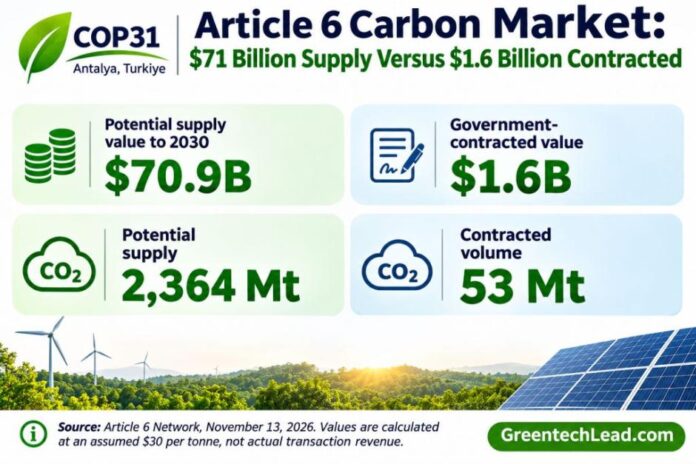
COP31 climate negotiations in Antalya, Turkiye, have exposed a major imbalance in international carbon markets: governments and project developers are preparing billions of tonnes of carbon credits for sale, but actual transactions, verified emission reductions and financing reaching climate projects remain far smaller. A new COP31 report identifies $70.9 billion in potential Article 6 carbon-credit supply through 2030, compared with only $1.6 billion in contracted government demand.
The State of the Article 6 Carbon Market 2026 report, released on November 13, estimates that 2.36 billion tonnes of carbon credits could become available by 2030.
However, sovereign buyers have contracted approximately 53 million tonnes, representing just 2.2 percent of identified potential supply. Only 151,566 tonnes of internationally transferred mitigation outcomes (ITMOs) have actually moved between countries.
These figures highlight the difference between potential carbon-credit supply, signed purchasing agreements, completed transfers and measurable climate investment.
The report estimates demand associated with national climate commitments at approximately 200 million tonnes by 2030, worth $6 billion at the same assumed price.
Since October 2025, governments have announced new tenders and agreements covering 27.3 million tonnes, valued at approximately $819 million.
The volume includes Singapore’s procurement programme and Norway’s agreement to purchase up to 12 million tonnes from Indonesia, announced during COP31.
These transactions could generate financing for emissions-reduction projects, but contract announcements alone do not establish that developers have received payment or delivered verified credits.
Carbon Credit Prices: From $9 Forest Credits to $36 Government Purchases
Carbon-credit prices vary significantly according to project type, verification, buyer requirements and eligibility under international climate agreements.
According to OPIS’s November 9 COP31 carbon market assessment, Switzerland paid an average of approximately $36.58 per tonne for internationally transferred credits in 2025.
Singapore’s initial procurement averaged approximately $27.30 per tonne, while Japanese Joint Crediting Mechanism credits were offered by a trader at $18–22 per tonne during 2026.
Some forest-related credits were assessed at substantially lower prices, with OPIS reporting a broad REDD+ price assessment range extending from $0.15 to $9.20 per tonne.
OPIS, A Dow Jones Company
| Carbon-credit category | Reported price | Market context |
| Switzerland Article 6 purchases | $36.58/t | 2025 average |
| Singapore Article 6 procurement | $27.30/t | Initial procurement average |
| Japan JCM credits | $18–22/t | 2026 trader offers |
| High-integrity cookstove credits | $15–18/t | 2025 transactions |
| Selected REDD+ credits | $0.15–9.20/t | November 2026 assessment range |
Sources: OPIS and Fastmarkets. Prices reflect different credit types, contract structures and dates; they are not directly interchangeable.
Lower prices are not automatic evidence of fraudulent credits, just as higher prices do not guarantee genuine emissions reductions. The decisive factors are additionality, conservative emissions accounting, permanence, independent verification and safeguards against double counting.
Voluntary Carbon Market: 169 Million Credits Retired in 2025
The Fastmarkets 2026 carbon-credit assessment shows that retirements across seven major registries reached approximately 169 million tonnes of CO₂ equivalent in 2025, compared with 174.5 million tonnes in 2024.
This represents a decline of approximately 3.2 percent, indicating that demand for voluntary credits remained relatively weak despite growing corporate climate commitments.
Shell was the largest identified corporate user, retiring 9.75 million credits in 2025, down from more than 14 million in 2024. Eni retired 6.44 million credits, an increase exceeding 80 percent.
Gold Standard’s 2025 annual report provides another important comparison.
| Gold Standard indicator | 2025 |
| Registered and pipeline projects | 4,464 |
| New projects entering certification pipeline | 482 |
| Carbon credits issued | 81 million |
| Carbon credits retired | 37 million |
| Estimated shared value generated | $12.4 billion |
Gold Standard’s 37 million retirements represented approximately 46 percent of its 81 million issuances during 2025. However, credits retired in a particular year may have been issued in earlier years, so this ratio is not a project-level retirement rate.
Its $12.4 billion shared-value estimate includes environmental and socioeconomic benefits. It is not carbon-credit sales revenue or verified cash investment.
India Leads Historical Voluntary Credit Issuance With 405 Million Tonnes
The Berkeley Carbon Trading Project’s voluntary offset database tracks carbon-credit issuance and retirement across major international registries.
An analysis published by the US Congressional Research Service found that Indian projects accounted for approximately 405 million tonnes of cumulative voluntary carbon-credit issuance from 2004 through 2025, across 1,855 projects.
India ranked first in the dataset for both issued credits and project count. Worldwide voluntary credit issuance reached approximately 253 million tonnes during 2025.
India’s domestic carbon market is also developing. According to the International Institute for Sustainable Development’s November 2026 analysis, approximately 490 industrial facilities across seven sectors completed their first compliance reporting cycle under India’s Carbon Credit Trading Scheme in July 2026.
For Indian developers, Article 6 creates potential export opportunities for verified reductions from eligible projects, including methane abatement and qualifying clean-energy activities. However, international transfers require appropriate authorization and accounting adjustments, while domestic compliance credits follow a separate regulatory framework.
Can Renewable Energy and Methane Projects Generate Credible Carbon Revenue?
Renewable-energy carbon credits face increasing scrutiny because solar and wind projects are commercially competitive in many markets. A developer must demonstrate that carbon-credit revenue supports emissions reductions that would not otherwise occur.
Methane-abatement projects can offer more directly measurable benefits when emissions are monitored through reliable equipment and independently verified against credible baselines.
The Verra Verified Carbon Standard requires projects to undergo validation, monitoring and third-party verification before credits are issued. Its registry records issuance and retirement, but commercial sale prices and developer revenues are generally negotiated outside the registry.
This creates a major transparency limitation: even when a credit is verified and retired, publicly available registry information may not reveal how much money reached the underlying renewable-energy or methane project.
COP31 Article 6: Verification and Actual Investment Must Become the Priority
The Gold Standard Impact Registry provides public records of project certification, credit issuance, transfers and retirement. Such records allow buyers to check whether credits exist and have been used, but they do not independently establish every project’s financial additionality or realized investment returns.
At COP31, the central issue is whether carbon markets can move beyond large prospective supply figures toward measurable reductions and transparent financial transactions.
The evidence shows that Article 6 has approximately $70.9 billion of potential supply value but only $1.6 billion in government-contracted demand. Voluntary credit retirements have also declined slightly, while substantial differences persist between prices for different project categories.
Carbon markets can finance credible climate projects, but neither low-cost credits nor expensive credits automatically guarantee genuine emissions reductions. The most meaningful indicators are independently verified reductions, credits actually transferred and retired, corresponding adjustments where required, and disclosed revenue reaching project developers.
For India and other developing economies, stronger verification and transparent financing could turn carbon markets into an additional source of clean-energy and methane-abatement investment rather than merely a mechanism for companies to purchase inexpensive emissions offsets.
BABURAJAN KIZHAKEDATH
