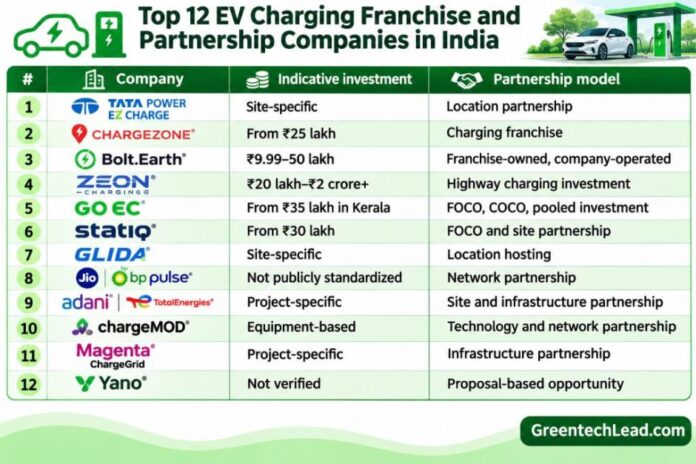
India’s electric vehicle charging market is attracting investors, property owners, fleet operators and entrepreneurs seeking recurring revenue from charging infrastructure. Companies including Tata Power EZ Charge, ChargeZone, Bolt.Earth, ZEON Charging, GO EC, Statiq and Jio-bp pulse offer different franchise, site-hosting and charging partnership opportunities.
However, EV charging franchise profitability depends on electricity sales, charger utilisation, installation costs, maintenance and revenue-sharing agreements, rather than advertised investment packages.
According to the Ministry of Heavy Industries, India had 52,718 public EV charging stations as of July 2026, including 16,561 equipped with fast chargers for cars.
A State Bank of India sector assessment indicated that charging infrastructure may require approximately 10–15 percent utilisation to cover operating expenses under certain assumptions. Actual break-even levels vary significantly by location, electricity tariff and investment structure.
1. Tata Power EZ Charge
Tata Power EZ Charge provides charging infrastructure, software and operational support for commercial properties, highway locations and business premises.
Potential partners include shopping malls, hotels, corporate offices, fuel stations and residential developments.
Investors should request a site-specific quotation covering charger ownership, electricity connection, installation, maintenance and revenue sharing.
2. ChargeZone
ChargeZone has advertised franchise investment starting around ₹25 lakh, including configurations using 30 kW and 60 kW chargers.
Its charging business targets highway corridors, fleet operators and commercial locations.
Investors must establish whether the quoted investment includes transformer upgrades, land development, electricity deposits and working capital.
3. Bolt.Earth
Bolt.Earth offers a franchise-owned, company-operated arrangement in which investors finance infrastructure while the company handles charging operations and customer support.
Published investment packages range from approximately ₹9.99 lakh to ₹50 lakh.
Investors should verify whether electrical infrastructure, installation, taxes and civil works are included and obtain actual station-level utilisation figures.
4. ZEON Charging
ZEON Charging focuses on fast charging for highways and intercity electric vehicle travel.
Indicative packages have included approximately ₹20–24 lakh for a 120 kW configuration and ₹70 lakh–₹2 crore for larger 180–800 kW projects.
These are indicative offers, not universal installed prices. Highway traffic, charging demand and grid availability are critical to profitability.
5. GO EC
GO EC promotes franchise-owned, company-operated, company-owned and pooled-investment arrangements.
Its investor material has indicated minimum investments of ₹35 lakh in Kerala and ₹55 lakh in Karnataka, alongside advertised returns of up to 10 percent.
Investors should establish whether projected returns are conditional, how payments are calculated and what contractual remedies apply if revenue falls below expectations.
6. Statiq
Statiq provides charging infrastructure, network management and site partnership opportunities.
Published franchise guidance has indicated investment starting around ₹30 lakh.
Commercial property owners and fleet operators should examine electricity costs, software fees, charger maintenance, revenue settlement and minimum service commitments.
7. GLIDA
GLIDA provides EV charging infrastructure and location partnership opportunities.
Hotels, offices, commercial properties and highway operators can explore hosting arrangements.
Site owners should clarify parking allocation, electricity billing, installation expenditure, equipment ownership and revenue-sharing responsibilities.
8. Jio-bp pulse
Jio-bp pulse operates an EV charging network targeting passenger vehicles, commercial properties and fleet requirements.
Its partnership opportunities should not be confused with a publicly standardized fixed-price franchise.
Investors should request written proposals covering equipment ownership, tariffs, operational responsibilities and revenue sharing.
9. Adani TotalEnergies E-Mobility
Adani TotalEnergies offers opportunities associated with EV charging infrastructure and energy services.
Potential locations include commercial complexes, logistics facilities, transport hubs and highways.
Project economics depend on whether the arrangement involves location hosting, infrastructure investment or equipment procurement.
10. chargeMOD
chargeMOD supplies EV charging equipment, software and network-related solutions.
Its technology can support residential, workplace and public charging deployments.
Equipment purchases should not be interpreted as guaranteed franchise revenue. Investors remain responsible for validating customer demand and operating arrangements.
11. Magenta ChargeGrid
Magenta operates within the electric mobility and charging infrastructure ecosystem.
Its ChargeGrid offering has included charging infrastructure and technology services.
Investors should distinguish charger supply agreements from charging-network partnerships and verify the current commercial structure.
EV Charging Customer Examples: Fleet Operators, Hotels and Commercial Properties
EV charging companies have several customer categories beyond individual car owners.
Tata Power, ChargeZone, Statiq and Jio-bp serve public charging requirements associated with highway travel and commercial destinations. Fleet operators, including electric taxi companies, delivery businesses and corporate transport providers, represent potential sources of repeat charging demand.
Hotels, shopping centres, hospitals and office campuses can use charging infrastructure to attract visitors, while residential associations and property developers may install chargers for residents.
However, a company’s presence in these customer segments does not establish a guaranteed utilisation rate for a new franchise location. Investors should request actual energy sales and revenue records from comparable sites.
Customer Complaints: Faulty Chargers, Payment Failures and Poor Maintenance
Customer complaints present a significant commercial risk for EV charging franchise investors.
The 2026 HERE-SBD EV Index findings indicated that 77 percent of surveyed EV owners had encountered non-working charging stations, while 83 percent had avoided trips because of charging concerns.
The Institute for Energy Economics and Financial Analysis identified unreliable chargers, incompatible charging networks, high public charging costs and delayed grid connections as major problems.
A Mint investigation into India’s public charging experience documented complaints about chargers delivering less power than advertised, fragmented applications and confusing charging-session procedures. One ChargeZone user described difficulty initiating charging when the application displayed an incorrect connector status.
The 2026 Comptroller and Auditor General audit examined 104 charging stations installed through three public-sector agencies. Of 72 REIL stations, 43 recorded no charging activity, while 19 chargers had been removed from their locations. The audit identified inadequate sanctioned electricity loads, non-functional charging management systems and maintenance problems.
These findings demonstrate the importance of contractual uptime guarantees, transparent payment systems and reliable maintenance. They do not establish that every operator listed has the same problems.
EV Charging Franchise Profitability: Revenue and Payback
Consider a 60 kW charging station selling electricity at ₹18 per kWh, with variable costs of ₹12 per kWh, fixed monthly expenses of ₹20,000 and investment of ₹15 lakh.
| Daily electricity sales | Monthly revenue | Operating surplus |
| 150 kWh | ₹81,000 | ₹7,000 |
| 300 kWh | ₹1.62 lakh | ₹34,000 |
| 450 kWh | ₹2.43 lakh | ₹61,000 |
The corresponding simple payback periods are approximately 17.9, 3.7 and 2.1 years. These estimates exclude financing, taxes, revenue sharing and major equipment replacement.
A Redseer EV charging infrastructure assessment estimated that more than half of approximately 30,000 public charging stations were non-operational in FY2025, highlighting the risks of low utilisation and poor maintenance.
Investment Outlook for 2027
Tata Power, ChargeZone, Bolt.Earth, ZEON, GO EC and Statiq offer identifiable franchise or investor partnership routes. Other companies may be more suitable for site hosting, equipment procurement or network partnerships.
Investors should prioritize verified daily electricity sales, complete installation costs, contractual revenue sharing, charger uptime and maintenance responsibilities. A profitable EV charging franchise requires dependable customer demand, not simply a low entry price or an advertised return.
SHAFANA FAZAL