Agrivoltaics is emerging as a new investment opportunity in India’s renewable energy and agriculture sectors, allowing farmers to generate electricity and cultivate crops on the same land.
The technology, also known as agricultural photovoltaics or AgriPV, uses elevated, spaced or vertical solar panels to maintain agricultural production while generating renewable electricity.
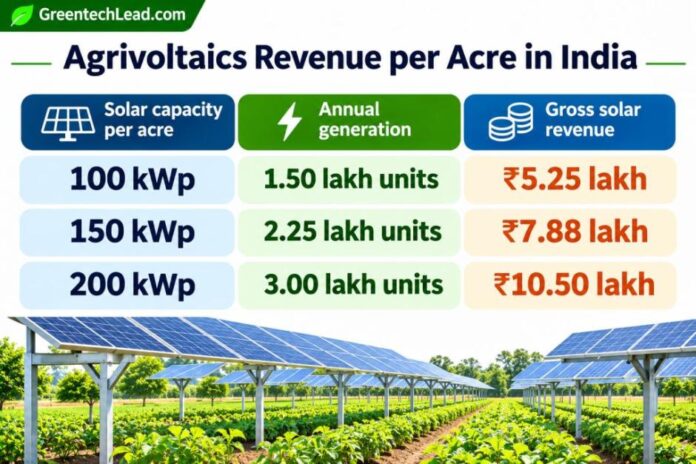
Under illustrative commercial assumptions, 100–200 kWp of solar capacity per acre could generate ₹5.25 lakh to ₹10.50 lakh in annual gross electricity revenue, excluding agricultural income.
However, these figures represent solar project sales rather than the income farmers retain after financing, maintenance, land rental and other expenses.
According to a TERI assessment of agrivoltaics in India, approximately 47.5 million hectares could be technically suitable for agrivoltaics, with a more realistic deployment scenario covering around 16 million hectares.
Government data recorded 36 operational agrivoltaic projects totalling 37.54 MW in August 2025, with another ten pilot projects under development.
Agrivoltaics Revenue per Acre in India
Solar electricity revenue depends on installed capacity, generation, tariffs and whether the farmer owns the project or leases land to a developer.
Assuming annual electricity generation of 1,500 kWh per kWp and a selling price of ₹3.50 per unit:
These are illustrative calculations, not guaranteed yields or typical farmer earnings. Actual solar capacity per acre depends on panel spacing, structure height, access for machinery and crop requirements.
A farmer who owns the installation may receive electricity revenue after operating expenses and loan repayments. Under a developer-owned model, the farmer typically receives agreed land rent or a share of project revenue.
Delhi Agrivoltaics Project Demonstrates ₹5.1 Lakh Annual Income per Acre
The 110 kWp agrivoltaic project at Krishi Vigyan Kendra Ujwa in southwest Delhi provides an Indian reference for combined agricultural and solar income.
Reported annual income was approximately ₹1.5 lakh per acre from farming and ₹3.6 lakh from electricity generation, giving combined revenue of ₹5.1 lakh per acre.
The International Water Management Institute’s project account documents the project as an example of combining agricultural activities with renewable electricity production.
However, its financial performance should not be treated as representative of all Indian farms because crop choices, land conditions, electricity tariffs and project ownership differ.
Agrivoltaics Project Cost, Payback and IRR
Agrivoltaic installations generally require higher capital expenditure than conventional ground-mounted solar plants because of elevated mounting structures, stronger foundations and farm-access requirements.
Consider an illustrative 1 MW project with an investment of ₹5.96 crore, a 21 percent capacity utilisation factor and an electricity tariff of ₹4 per unit.
| Financial indicator | Illustrative estimate |
| Project capacity | 1 MW |
| Initial investment | ₹5.96 crore |
| Annual electricity generation | 18.4 lakh units |
| Annual electricity revenue | ₹73.6 lakh |
| Annual maintenance cost | ₹7.55 lakh |
| Annual land lease cost | ₹4 lakh |
| Annual surplus before financing and taxes | ₹62.05 lakh |
| Simple project payback | 9.6 years |
The figures combine assumptions from different industry assessments and should not be interpreted as an independently validated project forecast.
A TERI assessment of the Khare Energy agrivoltaic installation estimated an 8.20 percent project internal rate of return (IRR) and 9 percent equity IRR, compared with 11.04 percent and 13.12 percent, respectively, for conventional solar.
Estimated payback was 10.83 years for agrivoltaics versus 8.84 years for conventional solar.
The TERI Khare Energy assessment highlights how higher installation costs can weaken project returns even when land is used for both farming and electricity generation.
Major Agrivoltaics Projects in India
Khare Energy – Madhya Pradesh: The Tikamgarh project received approval for 2 MW, with approximately 1.4 MW operational across 5.5 acres. The developer sells electricity under a 25-year power purchase agreement. TERI reported approximately 25 percent water savings and a 17 percent reduction in evapotranspiration, although some crop yields declined.
Renkube and Professor Jayashankar Telangana State Agricultural University – Telangana: A 10.8 kWp pilot demonstrated the integration of elevated solar panels with crop cultivation. An assessment reported crop yields equivalent to 97.8 percent of open-field levels for the evaluated configuration.
Sahyadri Farms – Maharashtra: The Nashik-based agricultural enterprise has deployed a 500 kWp agrivoltaic installation associated with grape cultivation, demonstrating opportunities for solar integration with horticulture.
Krishi Vigyan Kendra Ujwa – Delhi: The 110 kWp demonstration provides evidence of combined crop and electricity income under specific local conditions.
These projects demonstrate different technical and commercial approaches, rather than a single standard model for agrivoltaic development.
Additional Agrivoltaics Technology Vendors and Developers
India’s agrivoltaics market creates opportunities for solar module manufacturers, mounting-system suppliers, EPC contractors and agricultural technology companies.
Renkube develops solar technologies intended to improve the compatibility of photovoltaic generation with agricultural applications.
Tata Power Solar, Waaree Energies, Vikram Solar and Premier Energies manufacture solar products that could support agrivoltaic installations, although their general solar manufacturing capacity should not be counted as dedicated agrivoltaic deployment.
Mahindra Susten, Jakson Green and Sterling and Wilson Renewable Energy have solar engineering and project-development capabilities relevant to specialised agricultural solar installations.
International agrivoltaic technology companies include Next2Sun, which develops vertical bifacial solar systems; Sun’Agri, which focuses on dynamic agrivoltaic structures; and BayWa r.e., which has developed agricultural solar projects in European markets.
These vendors illustrate potential equipment and project-development options, not confirmed participation in every Indian agrivoltaic project.
Which Crops Can Generate Higher Agrivoltaic Returns?
Agrivoltaic profitability depends on crop selection as well as electricity revenue.
Shade-tolerant vegetables, coriander, turmeric, ginger and selected medicinal crops may be suitable for particular solar configurations.
A Junagadh trial reported tomato yield improvements of up to 15.09 percent under one configuration.
However, other studies found yield reductions for wheat, pulses and spices, demonstrating that solar shading does not automatically improve agricultural productivity.
Farmers should evaluate crop-specific results, irrigation requirements, local temperatures and market prices before installing elevated solar systems.
PM-KUSUM and Agrivoltaics Investment Opportunities
India’s PM-KUSUM programme supports decentralised solar generation and agricultural solarisation.
However, PM-KUSUM is not a dedicated subsidy for every agrivoltaic installation. Project eligibility depends on the applicable scheme component and implementation rules.
Farmer Producer Organisations, agricultural cooperatives and private solar developers could use shared ownership, leasing or revenue-sharing arrangements to reduce individual investment requirements.
Agrivoltaics Investment Outlook in India
Agrivoltaics offers opportunities to increase land productivity, diversify farmer income and support India’s renewable energy expansion.
However, the investment case depends on solar CAPEX, electricity tariffs, crop yields, operating costs, financing, grid connectivity and contractual revenue sharing.
The most important measure for farmers is not gross electricity revenue per acre but the additional annual cash income they retain after agricultural losses, solar operating expenses and financing costs.
Agrivoltaics can become commercially attractive where dependable solar electricity revenue is combined with productive farming, suitable crops and long-term contracts that protect farmers’ economic interests.
SHAFANA FAZAL