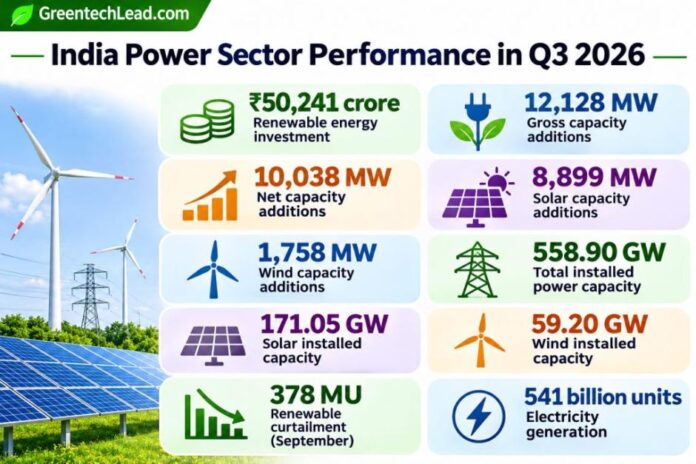
India attracted ₹50,241 crore ($5.284 billion) in renewable energy investment during Q3 2026, an increase of 21 percent quarter on quarter and 1 percent year on year, according to the Institute for Energy Economics and Financial Analysis (IEEFA).
The investment growth was driven by major financing transactions involving Aditya Birla Renewables, Avaada Energy, ReNew, ACME Solar, Serentica Renewables, CleanMax, Brookfield and Power Grid Corporation of India.
India added 12,128 MW of gross power generation capacity during July–September 2026, including 8,899 MW of solar and 1,758 MW of wind.
However, net capacity additions declined 37.7 percent quarter on quarter to 10,038 MW, while renewable electricity curtailment reached 378 million units in September.
The IEEFA POWERup Q3 2026 report highlights the growing importance of battery storage, transmission infrastructure, financing and grid flexibility as India expands renewable generation.
Non-fossil technologies accounted for 87.9 percent of gross capacity additions, with solar contributing 73.4 percent and wind 14.5 percent.
India’s total non-fossil installed capacity reached 308.03 GW, representing 55.1 percent of the national electricity generation fleet.
Coal and lignite accounted for 231.44 GW, or approximately 41.4 percent.
Renewable Energy Investment Rises 21 Percent to $5.284 Billion
India’s renewable energy investment increased from $4.349 billion in Q2 2026 to $5.284 billion in Q3.
The latest quarterly figure was also above the $5.229 billion recorded in Q3 2025.
IEEFA identified 13 significant financing and investment transactions with a combined announced value of approximately $8.98 billion.
These transactions include acquisition loans, project financing, refinancing, grants and planned investments. Their combined value should not be added to the quarterly renewable investment estimate because the two measures cover different financing activities.
Aditya Birla, Avaada and ReNew Lead Major Financing Deals
Aditya Birla Renewables secured a ₹15,213 crore term loan from MUFG for its proposed acquisition of Shell’s Solenergi Power, including Sprng Energy.
The ₹17,322 crore acquisition covers approximately 5 GWp of renewable assets, including 3.3 GWp operational and 1.7 GWp contracted capacity.
Avaada Energy achieved financial closure for a 2.15 GW renewable portfolio across Gujarat and Maharashtra.
The ₹12,360 crore financing package from SBI, REC and Canara Bank supports 1.35 GW of hybrid capacity and 800 MW of solar projects, with MSEDCL and GUVNL serving as electricity offtakers.
ReNew and Mitsui secured a ₹6,941 crore green financing package from 12 banks for a 320 MW hybrid renewable project across three states. The financing includes refinancing existing debt and supporting project costs.
Brookfield, through Lumara, outlined plans to deploy approximately $600 million into solar, wind and battery storage projects, targeting an initial portfolio exceeding 6 GW.
ACME Solar, Serentica and CleanMax Expand Storage Investments
ACME Solar secured ₹3,404 crore from Power Finance Corporation for a 250 MW solar-wind-battery project in Rajasthan and Gujarat, backed by a 25-year electricity supply agreement with NHPC.
ACME also obtained ₹2,647 crore from REC for a 450 MW/1,800 MWh renewable energy and storage development associated with a 25-year SJVN agreement.
Serentica Renewables secured ₹3,280 crore through an ADB-led financing consortium for development and refinancing of a 395.4 MW hybrid project in Karnataka.
CleanMax raised ₹2,500 crore through green debentures involving IFC, NaBFID and IIFCL to support commercial and industrial renewable energy projects.
These transactions illustrate growing demand for hybrid renewable electricity, battery storage and long-term corporate power supply arrangements.
Solar Manufacturing, Rooftop and Transmission Investments
Agastya Green Energy announced a ₹7,800 crore investment in Andhra Pradesh to develop 12 GW each of solar ingot and wafer manufacturing capacity.
The World Bank approved ₹8,462 crore for the PM Surya Ghar rooftop solar programme, while the Asian Development Bank approved approximately ₹8,082 crore in additional support.
The programme targets 30 GW of rooftop solar capacity across 10 million households.
The PM Surya Ghar rooftop solar initiative is expected to create opportunities for module manufacturers, inverter suppliers, installers and financing companies.
Power Grid Corporation of India secured financing of up to JPY80 billion, approximately ₹4,820 crore, from the Japan Bank for International Cooperation for the Khavda–Nagpur high-voltage direct-current transmission project.
Indian Railway Finance Corporation provided ₹4,200 crore to Damodar Valley Corporation for solar and battery storage projects in Jharkhand and West Bengal.
Gujarat and Rajasthan Lead Renewable Capacity Additions
Gujarat added 3,972 MW of renewable capacity during Q3 2026, followed by Rajasthan with 2,103 MW.
Uttar Pradesh added 912 MW, Karnataka 890 MW, Andhra Pradesh 479 MW, Madhya Pradesh 340 MW, Tamil Nadu 294 MW and Maharashtra 254 MW.
Karnataka recorded 48 percent quarter-on-quarter growth, while Maharashtra and Tamil Nadu experienced declines of 77 percent and 56 percent, respectively.
During January–September 2026, India added 45,167 MW of net power capacity, including 41,239 MW of renewables.
Solar contributed 35,242 MW during the nine-month period.
Renewable Curtailment Reaches 378 Million Units
India curtailed approximately 378 million units of renewable electricity in September 2026, including 314 million units of solar and 64 million units of wind generation.
Gujarat recorded 187.76 million units of curtailment, followed by Rajasthan with 110 million units.
Together, the two states accounted for approximately 79 percent of reported renewable curtailment.
The figures highlight transmission congestion, insufficient energy storage and limited grid flexibility.
Battery Storage and Grid Investment Become Strategic Priorities
India’s Central Electricity Authority projects a requirement for 73.93 GW of energy storage capacity by FY2031–32, including 47.24 GW of batteries and 26.69 GW of pumped storage.
Separately, the government approved ₹14,500 crore of viability-gap funding in November 2026 for 92 GWh of storage, comprising 60 GWh of pumped hydro, 30 GWh of batteries and 2 GWh of emerging technologies.
The programme is expected to support investment of approximately ₹97,600 crore.
The government’s energy storage funding announcement outlines the programme’s financing and technology allocations.
The Green Energy Corridor Phase III programme, approved in September 2026, has an estimated outlay of ₹1.864 lakh crore, including ₹1.364 lakh crore for transmission and ₹50,000 crore for battery storage.
The Green Energy Corridor Phase III approval targets infrastructure to evacuate up to 135 GW of renewable electricity.
Additional Renewable Energy Developers and Equipment Vendors
Beyond the major financing transactions, NTPC Green Energy, Tata Power Renewable Energy, JSW Energy, Adani Green Energy, Greenko, Juniper Green Energy and Hero Future Energies are participating in India’s expanding renewable generation and storage market.
Equipment and technology suppliers including Waaree Energies, Vikram Solar, Premier Energies, Sungrow, Hitachi Energy, Siemens Energy, GE Vernova and BHEL are positioned to serve different parts of the solar, battery storage and transmission supply chains.
These companies provide examples of potential industry beneficiaries rather than additional transactions included in IEEFA’s quarterly investment total.
India Power Sector Investment Outlook
India’s ₹50,241 crore renewable investment in Q3 2026 demonstrates continued financing activity despite slower quarterly capacity additions.
The next investment phase is increasingly focused on battery energy storage, hybrid renewable projects, rooftop solar, grid transmission and domestic manufacturing.
For investors and developers, the key performance indicators will be project CAPEX, electricity tariffs, contracted revenue, financing costs, grid connectivity, curtailment, construction schedules and commissioning progress.
India’s renewable energy expansion will deliver stronger financial and operational results when generation investments are matched by sufficient storage capacity, transmission infrastructure and reliable electricity offtake.
SHAFANA FAZAL