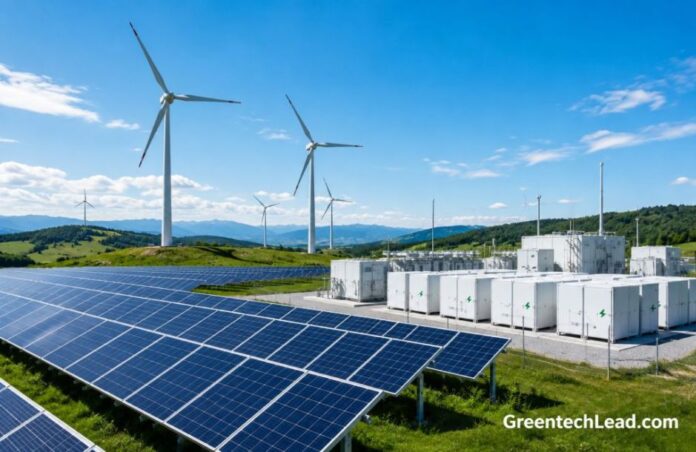
The US renewable energy market is heading for a record expansion in 2026, with developers planning 86 GW of new utility-scale generating capacity. Solar accounts for 43.4 GW, battery storage 24 GW and wind 11.8 GW. Landmark developments such as the 3.65 GW SunZia Wind project, 837 MW Tehuacana Creek solar project and rapidly expanding Texas battery market show that US clean-energy investment is evolving from standalone generation toward integrated solar, storage, transmission and long-term power contracts.
The investment cycle is being reinforced by rising US electricity demand from data centers, artificial intelligence, advanced manufacturing and electrification. For developers, the opportunity now extends beyond building solar and wind farms to battery storage, transmission, domestic manufacturing and corporate power purchase agreements (PPAs).
US Plans Record 86 GW of New Power Capacity in 2026
The scale of the expansion is substantial.
The US Energy Information Administration expects developers to add a record 86 GW of utility-scale generating capacity during 2026, if all planned projects reach commercial operation.
Solar dominates with 43.4 GW, or 51 percent, followed by battery storage with 24 GW, or 28 percent, and wind with 11.8 GW, or 14 percent. Solar additions alone would be about 60 percent higher than the 27.2 GW installed in 2025.
Texas accounts for around 40 percent of planned US utility-scale solar additions, followed by Arizona and California at 6 percent each and Michigan at 5 percent.
The EIA’s 2026 US power capacity outlook demonstrates how decisively investment is shifting toward solar and storage.
But planned capacity should not be confused with completed capacity. Projects still need to navigate financing, permitting, interconnection, equipment procurement and construction.
Tehuacana Creek: 837 MW Solar + 418 MW Battery Storage
One of the most important projects scheduled for 2026 is Tehuacana Creek 1 Solar and BESS in Texas.
The project combines 837 MW of solar PV with 418 MW of battery storage, making it the largest solar photovoltaic project that EIA expected to come online in the US during 2026.
The configuration demonstrates an important change in solar-project economics.
A standalone solar plant produces most of its electricity during daylight hours, when growing solar penetration can depress wholesale prices. Adding batteries allows a developer to store some of that generation and deliver electricity during higher-value evening periods.
Storage can also provide grid services, but it raises capital requirements through battery cells, containers, power-conversion systems, cooling, fire protection and control systems.
The economics therefore depend on battery duration, cycling, degradation, electricity-price spreads and grid-service revenues, rather than solar module prices alone.
US Battery Storage Capacity Approaches 52 GW
Battery storage is becoming one of America’s fastest-growing power infrastructure segments.
Operational utility-scale battery capacity stood at 43.6 GW at the end of 2025. Another 8.3 GW was added during H1 2026, lifting total nameplate capacity to nearly 52 GW.
Operators have reported plans for another 54 GW over the following two-and-a-half years.
Major projects scheduled for 2026 include:
Lunis Creek BESS, Texas — 621 MW
Clear Fork Creek Solar and BESS, Texas — 600 MW
Bellefield 2 Solar & Energy Storage, California — 500 MW
Tehuacana Creek BESS, Texas — 418 MW
Texas alone represents 12.9 GW, or 53 percent, of planned US battery additions in 2026. California accounts for 3.4 GW and Arizona 3.2 GW.
The latest EIA battery-storage data show that US battery capacity has recorded an average annual growth rate of around 70 percent during the past three years.
SunZia 3.65 GW Becomes America’s Largest Land-Based Wind Project
The biggest individual clean-energy development of 2026 is the 3.65 GW SunZia Wind project in New Mexico.
SunZia became operational during the second quarter and is now the largest land-based wind project ever built in the United States. It drove approximately 3.6 GW of New Mexico’s new clean-power additions during the quarter.
ACP says the project can generate enough electricity for as many as one million homes across the western United States.
Its importance goes beyond the wind turbines.
SunZia is integrated with major transmission infrastructure designed to move renewable electricity from New Mexico toward demand centers in the western US.
This illustrates one of the central investment challenges facing American renewables: some of the country’s best wind and solar resources are located far from the cities, factories and data centers that need the electricity.
A low-cost renewable project can lose much of its economic advantage if insufficient transmission causes congestion or curtailment.
US Clean-Power Pipeline Reaches Record 205 GW
Actual deployment accelerated significantly during Q2 2026.
The American Clean Power Association says 164 utility-scale solar, wind and storage projects entered operation during the quarter, adding a record 17.1 GW.
Total US clean-power capacity consequently approached 388 GW, enough to serve the equivalent of around 83 million homes.
The development pipeline reached a record 205 GW, including approximately:
111 GW — utility-scale solar
56 GW — battery storage
The ACP Q2 2026 Clean Energy Market Report shows that the pipeline increased 11 percent year over year.
However, ACP also warns that permitting and federal review delays remain a risk, particularly for wind development.
Meta and Google Drive Renewable PPAs
The AI boom is creating another powerful source of renewable-energy investment: hyperscaler electricity procurement.
US utilities and companies signed 96 clean-power contracts representing 28.1 GW during H1 2026, up from approximately 22.4 GW a year earlier.
Solar-only agreements represented more than 10 GW across 46 transactions.
Meta and Google were the two largest offtakers.
Meta accounted for 9.83 GW of clean-power deal volume, while Google represented 6.47 GW. Together they accounted for more than half of total US clean-power contracting during the first half.
The largest transaction was Salt River Project’s 3 GW agreement with NextEra Energy Resources, covering 500 MW of solar capacity annually in Arizona between 2029 and 2034.
The S&P Global analysis of US clean-energy PPAs shows how AI and data-center growth are increasingly translating directly into renewable-project development.
For developers, creditworthy corporate buyers can provide the long-term revenue visibility required to finance billion-dollar projects.
AI Data Centers Change the Renewable Investment Equation
The relationship between AI and renewable energy goes beyond PPAs.
US electricity demand is accelerating after years of relatively modest growth, driven partly by large industrial loads including data centers. ACP expects electricity demand could grow 35-50 percent by 2050 compared with 2024 levels.
AI data centers create a particular challenge because they require large amounts of reliable electricity around the clock.
Solar alone cannot satisfy that requirement.
The emerging infrastructure model therefore combines solar + BESS + wind + transmission + firm generation, allowing hyperscalers and utilities to build diversified electricity portfolios.
This is one reason battery storage is expanding almost as rapidly as solar.
Offshore Wind Remains a High-Cost Investment Segment
Offshore wind represents a different investment proposition from solar and onshore wind.
EIA’s 2026 outlook includes the approximately 800 MW Vineyard Wind 1 in Massachusetts and 715 MW Revolution Wind serving Rhode Island and Connecticut.
Offshore projects require turbines, foundations, subsea cables, specialized installation vessels, ports and onshore grid infrastructure.
They therefore carry substantially different construction and financing risks from onshore renewable projects.
The strategic attraction is the ability to generate large quantities of renewable electricity relatively close to densely populated coastal markets, but project returns depend heavily on financing costs, equipment procurement, construction execution and long-term electricity contracts.
Transmission Becomes the Next Renewable Investment Opportunity
The US renewable buildout increasingly depends on the ability to move electricity between regions.
SunZia demonstrates the value of developing generation and transmission together. Other proposed projects reinforce the trend.
Southern Spirit Transmission is planned as a 320-mile, 525-kV HVDC project with approximately 3 GW of bidirectional capacity, connecting ERCOT in Texas with the Southeast through Louisiana and Mississippi. Southline Phase 2 in New Mexico is planned as a 108-mile, 345-kV line offering 1 GW of bidirectional capacity.
Transmission investment can unlock renewable resources that otherwise face congestion and curtailment.
As solar and wind penetration rises, access to transmission could become as important to project returns as the cost of panels, turbines or batteries.
Which US Renewable Investments Offer the Biggest Opportunity?
The 2026 numbers point to four major investment areas.
Utility-scale solar remains the largest source of new generating capacity, with 43.4 GW planned.
Battery storage is becoming core grid infrastructure, with 24 GW planned during 2026 and installed capacity already approaching 52 GW.
Wind and transmission can unlock enormous resource-rich regions, demonstrated by the 3.65 GW SunZia project.
Corporate PPAs are creating long-term demand, with 28.1 GW of clean-power contracts signed during H1 2026 and hyperscalers emerging as the largest buyers.
The opportunity, however, is moving beyond simply building more megawatts.
The strongest US renewable projects will increasingly be those capable of combining competitive generation costs, storage, reliable offtake, transmission access and fast execution.
With a record 205 GW development pipeline and AI-driven electricity demand accelerating, the US clean-energy market is becoming a broader power-infrastructure investment cycle — one in which solar farms, batteries, transmission networks and data centers are increasingly interconnected.
SHAFANA FAZAL