
Indonesia’s growing liquefied petroleum gas (LPG) subsidy burden is emerging as a major fiscal challenge, prompting fresh calls for a nationwide shift to electric induction cooking.
According to a July 17, 2026 briefing from the Institute for Energy Economics and Financial Analysis (IEEFA), replacing subsidized LPG with electric induction stoves offers the most cost-effective path to reducing government spending, improving energy security, and accelerating the country’s clean energy transition. The report, Solving Indonesia’s LPG Subsidy Challenge Requires Induction, Not Swapping Fuels, authored by Randi Bachtiar, concludes that switching to other fossil fuels such as compressed natural gas (CNG) or coal-based dimethyl ether (DME) would increase subsidy costs rather than reduce them.
Indonesia remains heavily dependent on subsidized LPG for household cooking. Data from the Central Statistics Agency (BPS) shows that 89.7 percent of Indonesian households used LPG as their primary cooking fuel in 2025. Subsidized 3 kg LPG cylinders represented 92 percent of total LPG consumption, with the government providing a subsidy of IDR 30,000 per cylinder, equivalent to IDR 10,000 per kilogram. Total LPG subsidy spending reached approximately IDR 87 trillion during 2025, IEEFA report said.
The country’s reliance on imported LPG continues to increase financial pressure. More than 80 percent of Indonesia’s LPG demand is met through imports, costing between IDR 130 trillion and IDR 140 trillion, or approximately USD 7.9 billion to USD 8.5 billion annually. Around 29 percent of these imports originate from the Middle East, exposing Indonesia to geopolitical risks affecting key shipping routes such as the Strait of Hormuz. To contain rising energy costs, the government allocated an additional IDR 100 trillion in emergency funding during 2026, supplementing the IDR 381.3 trillion already earmarked for energy subsidies in September 2025.
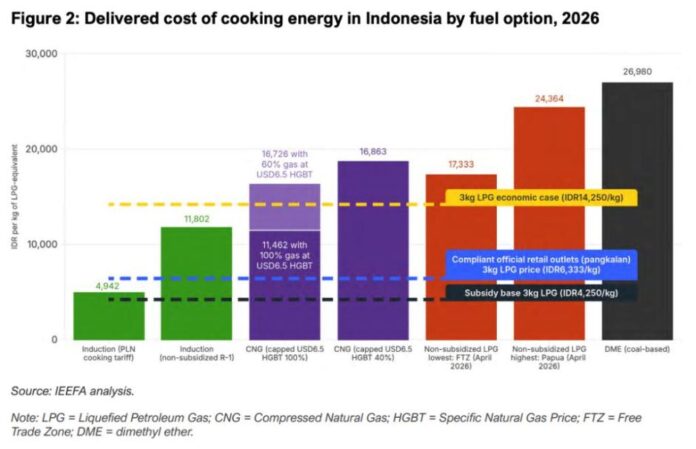
Government price controls further illustrate the scale of subsidy support. On April 18, 2026, Pertamina increased the retail price of non-subsidized 12 kg LPG cylinders by 18.75 percent, raising prices from IDR 192,000 to IDR 228,000 per cylinder. In contrast, subsidized 3 kg LPG cylinders continue to be sold at a wholesale price of IDR 12,750 per cylinder, or IDR 4,250 per kilogram, despite an estimated market supply cost of IDR 42,750 per cylinder, or IDR 14,250 per kilogram. This widening price gap continues to increase government subsidy obligations.
IEEFA’s analysis finds that alternative fossil fuel solutions would not solve the subsidy challenge. Developing nationwide CNG infrastructure would add at least IDR 6,721 per kilogram of LPG-equivalent fuel in infrastructure costs. Even with Indonesia’s regulated industrial gas price of USD 6.50 per MMBtu, delivered CNG would cost around IDR 11,462 per kilogram. If regasified liquefied natural gas is used, costs would rise to approximately IDR 23,500 per kilogram, about 65 percent higher than the current LPG supply cost.
Coal-based dimethyl ether (DME) performs even worse economically. The report estimates DME would require government subsidies of IDR 22,730 per kilogram, approximately 2.3 times higher than the existing LPG subsidy. A nationwide transition to DME would increase annual subsidy spending to roughly IDR 194 trillion, making it the most expensive option assessed.
Among all alternatives, electric induction cooking delivers the strongest long-term economic benefits. IEEFA estimates that providing induction cooking equipment nationwide would require a one-time investment of approximately IDR 105 trillion, or around USD 6 billion. However, lower LPG subsidy payments would allow the government to recover this investment in approximately 1.7 years. Over a five-year period, Indonesia could save nearly IDR 200 trillion, equivalent to about USD 11.7 billion, while simultaneously reducing LPG imports, strengthening energy security, and supporting national decarbonization goals.
To accelerate adoption, IEEFA recommends introducing a dedicated electricity tariff for cooking based on Indonesia’s 2022 induction cooking pilot program. The report also proposes redirecting subsidies directly to eligible households instead of subsidizing LPG cylinders, reducing subsidy leakage and improving targeting efficiency. In addition, nationwide public awareness campaigns highlighting the economic, environmental, and safety benefits of induction cooking could help accelerate consumer adoption.
Drawing on data from Indonesia’s Central Statistics Agency (BPS), the Ministry of Energy and Mineral Resources (MEMR), the World Bank, and the U.S. Department of Energy, the report concludes that electric induction cooking is the only solution capable of delivering substantial fiscal savings while improving energy security. As Indonesia seeks to reduce its dependence on imported LPG and manage rising subsidy costs, electrifying household cooking could become a key pillar of the country’s long-term clean energy strategy.
SHAFANA FAZAL
