
The escalating conflict in the Middle East and disruptions around the Strait of Hormuz are reshaping global energy investment strategies, with governments and energy companies accelerating diversification plans to strengthen long-term energy security, according to the International Energy Agency’s 2026 World Energy Investment report.
The IEA said global energy investment is projected to reach $3.4 trillion in 2026, reflecting continued growth in spending on electricity infrastructure, renewables, nuclear power, battery storage, and energy efficiency. Of the total investment, approximately $2.2 trillion will be directed toward grids, storage, low-emissions fuels, renewables, nuclear energy, electrification, and efficiency technologies, while around $1.2 trillion will go into oil, natural gas, and coal projects.
The report highlights that the closure-related disruptions in the Strait of Hormuz have intensified concerns over trade route reliability, especially in Asia and the Middle East. The current crisis comes only a few years after the energy market disruptions caused by Russia’s invasion of Ukraine in 2022, making this the second major global energy crisis within five years.
IEA Executive Director Fatih Birol said the world is facing the largest energy security crisis in history, which is expected to trigger structural changes in investment strategies similar to the oil shocks of the 1970s. Countries are increasingly investing in diversified energy routes and domestically available resources including renewables, nuclear power, coal, oil, and gas, while also expanding electricity infrastructure and energy efficiency programs.
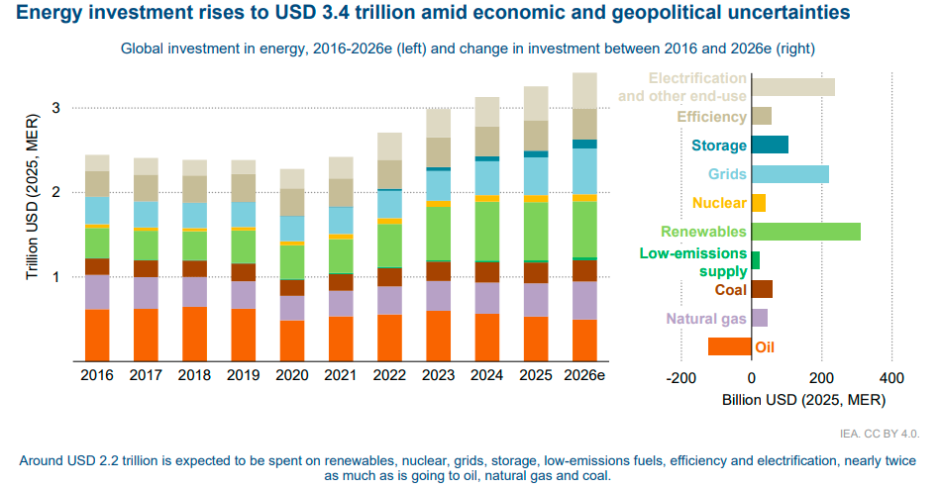
Electricity-related investment remains the dominant area of global energy spending. Investment in electricity supply and infrastructure is expected to reach nearly $1.6 trillion in 2026 and climb to approximately $2 trillion when electrification investments are included. Spending on electricity grids alone is projected to approach $550 billion, representing nearly 20 percent annual growth, while battery storage investment is expected to exceed $100 billion.
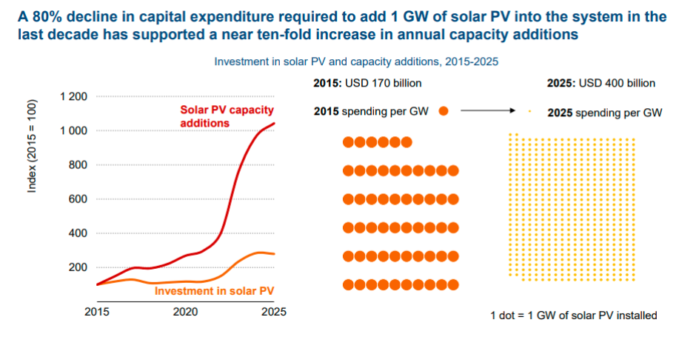
Renewable energy continues to attract the largest share of power-sector investment. Global renewable power project investment is forecast to reach around $665 billion in 2026, including approximately $365 billion allocated to solar energy projects alone. Low-emissions technologies now account for more than 70 percent of total global power generation investment.
Nuclear energy investment is also accelerating. Annual nuclear investment is expected to exceed $80 billion, with nearly 80 gigawatts of nuclear capacity currently under construction across 15 countries worldwide.
Natural gas investment is projected to rise to $330 billion in 2026, marking the highest level in a decade. The increase is being driven by a new wave of liquefied natural gas export projects, particularly in the United States and Qatar.
In contrast, oil investment is expected to decline for a third consecutive year despite elevated crude prices. Global oil investment is forecast to fall below $500 billion in 2026 due to uncertainty surrounding the duration of the price spike, supply-chain bottlenecks, limited offshore rig availability, and long project lead times outside the Middle East.
Coal investment is projected to increase to $180 billion in 2026, the highest level since 2012. China alone is expected to account for nearly 70 percent of global coal supply spending. Several Asian countries affected by the current energy disruptions may extend the operational life of existing coal-fired power plants to enhance energy security.
Energy efficiency investment worldwide currently stands at around $350 billion annually. The IEA said nearly 20 countries have already introduced new efficiency policies in response to the latest energy crisis, although significant policy and investment gaps remain.
The report also warned that financial market volatility linked to the Middle East conflict is increasing financing costs for future energy projects. Higher borrowing costs could disproportionately affect capital-intensive technologies, especially in emerging and developing economies where financing conditions are already challenging.
Artificial intelligence and data centre expansion are becoming major drivers of electricity demand and power-sector investment, particularly in the United States. Orders for new gas-fired power plants reached a 25-year high in 2025, with growing data centre electricity requirements playing a major role. Strong demand from the United States and Middle East is also limiting the availability of turbines for deployment in other regions.
BABURAJAN KIZHAKEDATH
