
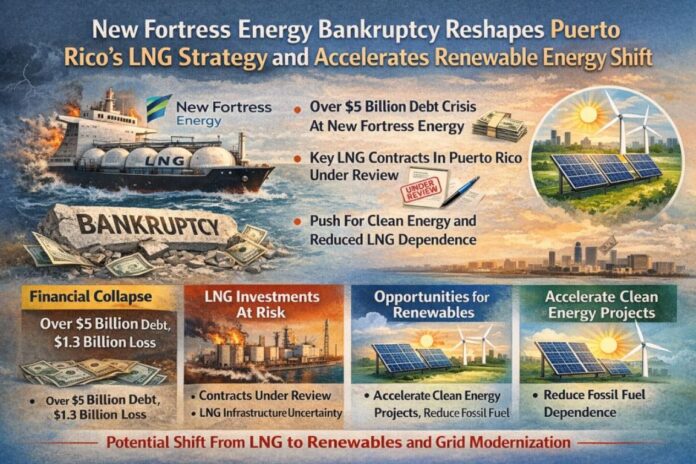
The bankruptcy and restructuring of New Fortress Energy (NFE) is emerging as a critical moment for Puerto Rico’s energy sector, with significant implications for LNG expansion, power sector contracts, and long-term investment direction. The development is not only exposing financial vulnerabilities within LNG-driven business models but also creating an opportunity to accelerate the island’s transition toward cleaner and more resilient energy systems.
A recent analysis by the Institute for Energy Economics and Financial Analysis (IEEFA) highlights how NFE’s financial collapse could alter competitive dynamics, shift capital allocation, and trigger a broader reassessment of fossil fuel dependence in Puerto Rico.
Financial Collapse Exposes LNG Business Model Risks
New Fortress Energy’s restructuring follows its inability to meet debt obligations, reflecting weakness in capital-intensive LNG strategies. NFE reported losses of $1.3 billion over the past year and accumulated more than $5 billion in debt, forcing a major balance sheet overhaul.
As part of the restructuring plan, NFE is expected to split into two entities, separating its Brazil operations from global assets, including Puerto Rico. This raises the likelihood of creditor-led ownership changes and reflects broader pressure across the LNG sector, where high capital expenditure, volatile demand, and execution risks are challenging leveraged players.
Puerto Rico Contracts Under Scrutiny
Puerto Rico is central to NFE’s operations, particularly through its role in supplying natural gas and managing thermal generation assets via Genera PR. These operations are closely tied to the Puerto Rico Electric Power Authority, which continues to face long-standing financial and operational challenges.
IEEFA analysis indicates that contractual provisions could allow Puerto Rico to renegotiate or terminate agreements if bankruptcy conditions are triggered. This creates a potential inflection point for policymakers to reassess long-term LNG commitments and reshape the island’s supplier ecosystem.
LNG Expansion Faces Growing Uncertainty
Despite its financial distress, NFE has continued to advocate for expanding LNG supply to Puerto Rico. However, current financial constraints and market conditions raise questions about the feasibility of scaling gas volumes in the near term.
This LNG-focused approach risks conflicting with Puerto Rico’s clean energy goals. Continued investment in LNG infrastructure could delay deployment of renewables, battery storage, and grid modernization, potentially locking the island into long-term fossil fuel dependence.
Puerto Rico’s energy sector is witnessing significant investment and deal activity across LNG infrastructure, power generation, and emerging clean energy solutions, led by companies such as New Fortress Energy, Crowley, Naturgy, and Island Renewable Energies.
New Fortress Energy has anchored the island’s LNG-to-power transition through long-term contracts and large-scale project development. The company signed a 20-year gas supply agreement with Energiza to support a 478 MW combined-cycle power plant in San Juan scheduled for 2028, while also securing a 7-year LNG supply contract covering up to 75 TBtu annually with Puerto Rico authorities. In parallel, it is advancing additional gas-fired capacity of around 550 MW linked to its LNG terminal infrastructure, reflecting a vertically integrated strategy spanning fuel supply, logistics, and power generation.
Crowley has committed more than $550 million to LNG logistics and infrastructure, including shipping assets, terminals, and port facilities. The company operates an LNG loading terminal in Peñuelas supplying over 94 million gallons annually and has strengthened supply reliability through deployment of the 130,400 cubic meter LNG carrier “American Energy.” Its investment in an LNG-fueled microgrid at the San Juan terminal highlights a parallel focus on distributed energy systems and resilience.
Naturgy is reinforcing LNG supply stability through strategic partnerships, including a multi-year agreement with Crowley to ensure consistent deliveries from the U.S. mainland. The company also operates LNG infrastructure in Peñuelas, supporting gas-fired power generation and contributing to diversification of fuel sourcing in Puerto Rico’s energy mix.
Island Renewable Energies is emerging as a key player in the clean energy transition, investing in renewable natural gas and waste-to-energy projects aligned with ESG goals. Its focus on decarbonization and circular economy solutions signals growing momentum toward low-carbon alternatives alongside traditional LNG investments.
Puerto Rico is attracting large-scale capital for grid and cross-border energy integration. The $2.5 billion Project Hostos aims to deliver 500 MW of electricity from the Dominican Republic via submarine cable by 2031, potentially powering around 600,000 homes and highlighting increasing private sector participation in long-term infrastructure development.
Competitive Landscape: Grid Modernization and Private Sector Roles
The restructuring of NFE is unfolding alongside broader transformation in Puerto Rico’s power sector. LUMA Energy, which manages transmission and distribution, is leading grid modernization efforts supported by multi-billion-dollar investments aimed at improving resilience and integrating renewable capacity.
At the same time, companies such as Crowley and Naturgy continue to invest in LNG logistics, supply chains, and infrastructure, ensuring short-term energy security.
Emerging players like Island Renewable Energies are focusing on renewable natural gas, waste-to-energy, and decarbonization solutions, reflecting a gradual shift toward sustainable energy models.
Investment Trends Signal Shift Toward Clean Energy
The challenges faced by New Fortress Energy align with broader global investment trends. Capital is increasingly flowing toward renewable energy, battery storage, and grid infrastructure, driven by cost competitiveness and decarbonization policies.
In Puerto Rico, federal funding and policy support are accelerating investments in distributed solar, storage, and grid resilience. LNG projects, by contrast, are facing higher financing costs and growing investor scrutiny, particularly in markets where renewable alternatives are becoming more viable.
Key data points underline this transition:
Long-term LNG contracts ranging from 7 to 20 years are being reassessed amid financial uncertainty
Power generation projects in the 478 MW to 550 MW range highlight ongoing but cautious expansion
LNG infrastructure investments exceeding $550 million are now facing higher risk perception
Large-scale grid and cross-border projects, such as the $2.5 billion Project Hostos, signal a pivot toward diversified energy sources
Strategic Outlook: Puerto Rico at an Energy Crossroads
The bankruptcy of New Fortress Energy places Puerto Rico at a strategic crossroads. Renegotiation or termination of LNG contracts could accelerate renewable deployment, diversify the energy mix, and reduce exposure to fuel price volatility.
However, maintaining existing LNG agreements may prolong dependence on imported natural gas, exposing the system to continued financial and geopolitical risks.
The broader takeaway is clear. Energy systems are shifting toward flexibility, decentralization, and clean energy integration, while LNG-heavy models face increasing financial and operational pressure.
For Puerto Rico, the decisions taken in response to this crisis will determine whether the island advances toward a resilient, renewable energy future or remains tied to an increasingly uncertain LNG-driven pathway.
FASNA SHABEER
