
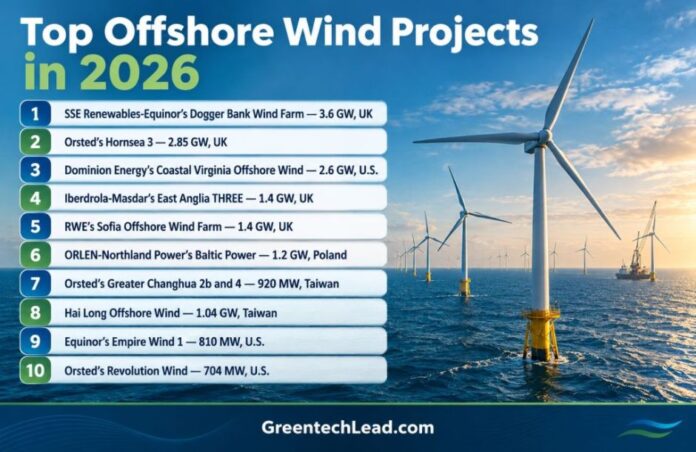
Global offshore wind investment is entering a major construction cycle in 2026 as developers deploy larger turbines, raise billions of dollars in project financing and invest heavily in transmission, ports, vessels and subsea infrastructure.
Global offshore wind capacity reached 92.5 GW at the end of 2025, after more than 9 GW was installed during the year. The industry entered 2026 with more than 300 GW of projects in the pipeline, indicating substantial growth potential through 2030.
The technology is changing rapidly. 14-15 MW offshore turbines are increasingly becoming the standard for major projects, led by Siemens Gamesa, Vestas and GE Vernova. However, project economics increasingly depend on financing, power contracts, grid connections and supply-chain execution rather than turbine size alone.
Here are 10 major offshore wind projects shaping global investment in 2026.
1. Dogger Bank Wind Farm — 3.6 GW, UK
The 3.6 GW Dogger Bank Wind Farm is the largest project in this ranking. Located around 130-190 kilometers from northeast England, it comprises three 1.2 GW phases.
SSE Renewables and Equinor each own 40 percent, while Vargronn owns 20 percent.
Dogger Bank A and B secured approximately £5.5 billion in financing from 29 banks and three export credit agencies. The financing figure covers the first two phases rather than the entire project.
The development uses 277 GE Vernova Haliade-X turbines. Dogger Bank A and B use 13 MW turbines, while Dogger Bank C uses 14 MW machines. Once fully operational, the project is expected to generate approximately 18 TWh annually.
Its distance from shore also makes Dogger Bank an important investment in HVDC transmission infrastructure, not simply wind generation.
2. Hornsea 3 — 2.85 GW, UK
Orsted’s 2.85 GW Hornsea 3 represents another massive UK offshore wind investment. The project is under construction and is expected to begin commercial operation in 2027.
Hornsea 3 has 197 turbines rated at 14 MW, while total project investment is estimated at approximately DKK 70-75 billion.
Apollo-managed funds acquired a 50 percent stake, demonstrating the growing role of infrastructure investors in financing offshore wind.
The transaction also shows how developers can recycle capital by selling partial ownership while retaining exposure to major projects.
3. Coastal Virginia Offshore Wind — 2.6 GW, U.S.
Dominion Energy’s 2.6 GW Coastal Virginia Offshore Wind (CVOW) is the largest offshore wind project under construction in the United States.
CVOW includes 176 turbines and three offshore substations. Estimated project cost has risen to approximately $10.7 billion, excluding financing costs, representing indicative investment intensity of around $4.1 billion per GW.
Stonepeak has invested approximately $2.6 billion for a noncontrolling interest and is funding 50 percent of remaining project costs.
CVOW is expected to support approximately 2,000 direct and indirect jobs and generate around $2 billion in economic activity. Siemens Gamesa supplies the turbines, while the U.S.-built Charybdis turbine-installation vessel supports the country’s emerging domestic offshore wind supply chain.
4. East Anglia THREE — 1.4 GW, UK
ScottishPower Renewables, part of Iberdrola, and Masdar are developing the 1.4 GW East Anglia THREE project with total investment of approximately £4 billion.
The project uses 95 Siemens Gamesa turbines rated at around 14.7 MW. All 95 foundations were installed in 2026, and turbine installation is progressing.
Its electrical infrastructure includes a 10,700-tonne offshore HVDC converter station, illustrating how transmission equipment represents an increasingly significant part of offshore wind CAPEX.
East Anglia THREE combines a UK Contract for Difference with an Amazon corporate PPA covering 159 MW, showing how corporate electricity buyers can support renewable project revenues.
5. Sofia Offshore Wind Farm — 1.4 GW, UK
RWE’s 1.4 GW Sofia Offshore Wind Farm is located around 195 kilometers off northeast England across a 593-square-kilometer site.
The project uses 100 Siemens Gamesa SG 14-222 DD turbines, each rated at 14 MW. Turbine installation was completed in June 2026.
Each turbine has a 222-meter rotor diameter, while maximum tip height reaches approximately 252 meters.
RWE’s final investment decision represented approximately £3 billion, equivalent to indicative investment intensity of roughly £2.1 billion per GW.
Its location far offshore increases the importance of subsea cables, transmission equipment and HVDC infrastructure.
6. Baltic Power — 1.2 GW, Poland
The 1.2 GW Baltic Power project, developed by ORLEN and Northland Power, represents a major milestone for Poland’s emerging offshore wind industry.
Located approximately 23 kilometers offshore, Baltic Power will deploy 76 Vestas V236-15.0 MW turbines.
Total project cost is approximately C$6.5 billion, equivalent to indicative investment intensity of around C$5.4 billion per GW.
The project is expected to generate approximately 4 TWh annually, equivalent to around 3 percent of Poland’s current electricity demand.
Infrastructure includes two offshore substations, four export cables and an onshore substation, creating investment opportunities across ports, marine services, cables and engineering.
7. Greater Changhua 2b and 4 — 920 MW, Taiwan
Orsted’s 920 MW Greater Changhua 2b and 4 project is located around 35-60 kilometers offshore Taiwan.
The development uses 66 Siemens Gamesa SG 14-236 turbines rated at 14 MW. All 66 turbines were installed by January 2026.
The project’s commercial structure is particularly significant because Taiwan Semiconductor Manufacturing Company (TSMC) has secured electricity through a corporate PPA, connecting offshore renewable energy directly with Taiwan’s electricity-intensive semiconductor industry.
The development also deploys suction-bucket jacket foundations at scale, demonstrating how foundation technologies are evolving alongside larger turbines.
8. Hai Long Offshore Wind — 1.04 GW, Taiwan
The Hai Long offshore wind development combines Hai Long 2A, 2B and 3 for total capacity of approximately 1.04 GW.
Northland Power, Mitsui and Yushan Energy participate in the development, which uses 73 Siemens Gamesa 14 MW-class turbines.
Total project cost is approximately C$9 billion, implying indicative investment intensity of roughly C$8.6 billion per GW.
The relatively high cost illustrates how offshore wind CAPEX varies considerably according to seabed conditions, marine construction, transmission requirements, localization rules and supply-chain complexity.
9. Empire Wind 1 — 810 MW, U.S.
Equinor’s 810 MW Empire Wind 1, located off New York, will deploy 54 Vestas V236-15.0 MW turbines.
A long-term New York offtake agreement provides a power price of $155/MWh, giving the project significant revenue visibility.
Equinor is also developing the South Brooklyn Marine Terminal as an assembly, staging and operations hub. Empire Wind therefore represents investment not only in offshore generation but also in U.S. port infrastructure and marine logistics.
The project demonstrates the importance of state-level procurement and long-term electricity contracts for financing U.S. offshore wind.
10. Revolution Wind — 704 MW, U.S.
The 704 MW Revolution Wind project is being developed by Orsted and Skyborn Renewables and supplies electricity to Rhode Island and Connecticut.
It uses 65 Siemens Gamesa turbines of approximately 11 MW each.
Revolution Wind started delivering electricity in March 2026, making it an important milestone for the U.S. offshore wind sector.
Its 20-year utility agreements provide long-term revenue visibility, highlighting why contracted electricity revenues have become critical to offshore wind financing.
14-15 MW Turbines Reshape Offshore Wind Investment
One of the clearest trends across these projects is the transition toward 14-15 MW turbines.
Siemens Gamesa supplies turbines for Sofia, East Anglia THREE, Greater Changhua, Hai Long and Revolution Wind. Its offshore wind turbine portfolio reflects the industry’s shift toward increasingly powerful machines.
Vestas’ V236-15.0 MW platform is being deployed at Baltic Power and Empire Wind, while GE Vernova’s Haliade-X technology powers Dogger Bank.
Larger turbines can reduce the number of foundations required for a project, but they also demand bigger ports, heavier foundations, larger vessels and more sophisticated installation equipment.
Financing and Power Contracts Become Critical
The 2026 project pipeline demonstrates that offshore wind competition is increasingly about capital discipline and revenue security.
UK developments rely heavily on Contracts for Difference, while U.S. projects depend on state procurement and utility agreements. Taiwan is emerging as an important market for corporate PPAs.
Institutional investors are also taking larger roles. Apollo acquired 50 percent of Hornsea 3, Stonepeak invested approximately $2.6 billion in CVOW, and Masdar participates in East Anglia THREE.
These partnerships allow developers to share construction risk and release capital for additional projects.
The scale of the next investment cycle remains substantial. RWE has secured UK Contracts for Difference covering 6.9 GW of offshore wind capacity, while the GWEC Global Offshore Wind Report 2026 points to a global project pipeline exceeding 300 GW.
Offshore Wind Investment Outlook to 2030
Offshore wind’s next growth phase will increasingly depend on project execution rather than headline capacity announcements.
Developers must control financing costs, turbine prices, vessel availability, subsea cable constraints, port capacity, permitting and grid connections. At the same time, projects moving farther offshore will increase demand for HVDC systems, offshore substations, foundations, installation vessels and marine engineering.
Dogger Bank, Hornsea 3 and CVOW demonstrate the enormous capital requirements of modern offshore wind, while Baltic Power and the Taiwan projects show the industry’s geographic expansion.
The winners through 2030 are therefore likely to be developers and suppliers that combine large-scale capacity, disciplined CAPEX, bankable power contracts, reliable 14-15 MW turbine technology and resilient supply chains. Offshore wind is becoming not merely a renewable generation business, but a global infrastructure investment market spanning turbines, transmission, ports, vessels, cables and long-term electricity supply.
SHAFANA FAZAL
