
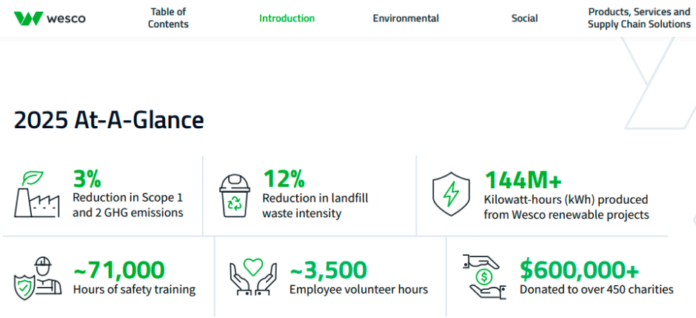
Wesco strengthened its sustainability performance in 2026 by delivering measurable progress across climate action, energy efficiency, circular economy initiatives, workplace safety, responsible sourcing, and ESG governance.
The company continued advancing its long-term sustainability strategy through investments in sustainable infrastructure, supply chain responsibility, environmental transparency, and customer-focused decarbonization solutions.
Hemant Porwal is the Executive Vice President, Supply Chain and Operations on Sustainability at Wesco.
Climate action remained a key priority as Wesco worked toward its target of reducing absolute Scope 1 and Scope 2 greenhouse gas emissions by 30 percent by 2030 compared with its 2019 baseline. During 2026, the company achieved a 12 percent absolute emissions reduction against its revised 2023 baseline, reflecting steady progress toward its long-term carbon reduction objectives. In 2025, Scope 1 and 2 emissions were 91,554 MTCO2 e, Wesco Sustainability Report 2025 indicated.
Operational emissions continue to be driven primarily by facility energy consumption, which accounts for approximately 70 percent of Wesco’s carbon footprint. Transportation activities contribute the remaining 30 percent through a fleet of around 1,300 delivery trucks and 1,800 sales and corporate vehicles.
To support further emissions reductions, Wesco introduced mandatory energy-efficiency requirements across all new property leases, encouraging renewable energy adoption, including rooftop solar installations, and promoting high-performance building standards.
Through Wesco Energy Solutions, the company expanded its sustainability impact beyond its own operations. During 2026, Wesco completed 1,624 customer energy and infrastructure projects while conducting energy audits across 47 million square feet of facilities. These initiatives generated approximately $3 million in utility rebates for customers and helped avoid an estimated 26,836 metric tons of carbon dioxide emissions through energy-efficiency upgrades, electrification programs, renewable energy integration, and infrastructure modernization projects.
In 2025, Wesco launched a new rooftop solar project at its 409,000-square-foot Avondale, Ariz. facility, one of the largest facilities in the portfolio. The installation will significantly reduce the building’s carbon emissions.
Wesco also achieved significant progress in resource efficiency and waste management. The company exceeded its goal of reducing landfill waste intensity by 15 percent from its 2020 baseline ahead of schedule. Expanded recycling programs, material recovery initiatives, and operational improvements contributed to stronger circular economy performance while reducing environmental impacts across distribution and logistics operations.
In 2025, U.S. and Canada operations generated 0.68 metric tons of landfill waste per 1,000 square feet of facility space, a 12 percent drop from 2024.
Responsible sourcing remained a cornerstone of Wesco’s ESG strategy. The company surpassed its objective of directing more than 25 percent of annual procurement spending to diverse suppliers, reinforcing supply chain resilience and supplier inclusion. Wesco also retained its EcoVadis Gold Medal rating, placing it among the top 5 percent of companies globally assessed for sustainable procurement performance.
Employee health and safety continued to receive significant attention. Wesco is pursuing a target of reducing its Total Recordable Incident Rate by 15 percent from its 2020 baseline and has strengthened workplace safety through extensive training programs. Employees have completed more than 425,000 cumulative hours of safety training, helping improve risk awareness, accident prevention, and workforce well-being.
Strong governance and accountability supported the company’s sustainability efforts throughout 2026. Climate-related risks and ESG priorities remained under board-level oversight, with 60 percent of directors possessing professional experience in environmental or sustainability-related fields. Wesco also expanded third-party limited assurance coverage for Scope 1 and Scope 2 emissions reporting internationally, enhancing transparency and confidence in environmental disclosures.
The company’s sustainability achievements earned external recognition through inclusion in the Dow Jones Sustainability North America Index, placing Wesco among the top 20 percent of the 600 largest companies evaluated for sustainability performance and governance practices. The retention of its EcoVadis Gold Medal further highlighted leadership in sustainable procurement and responsible supply chain management.
Looking ahead, Wesco continues investing in grid modernization, utility-scale solar and wind projects, high-voltage transmission infrastructure, electric vehicle charging networks, sustainable data center technologies, advanced cooling systems, and broadband expansion initiatives. These investments support customer decarbonization efforts while positioning the company to benefit from growing demand for clean energy and sustainable infrastructure solutions.
With progress across emissions reduction, waste diversion, supplier diversity, workplace safety, governance, and customer sustainability programs, Wesco remains on track toward its 2030 sustainability objectives while contributing to the transition to a more resilient and lower-carbon economy.
SHAFANA FAZAL
