
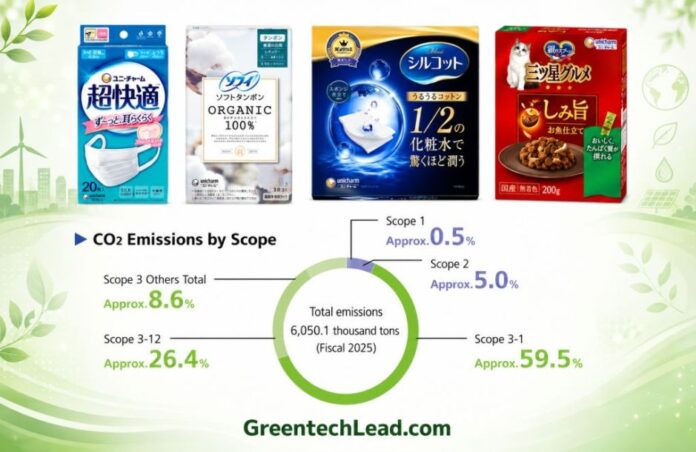
Unicharm is accelerating its climate strategy with targets to cut Scope 1 and Scope 2 greenhouse gas emissions by 46.2 percent by 2031 and reduce Scope 3 emissions by 27.5 percent, using 2021 as the base year.
Unicharm Sustainability Report 2025 indicated that the consumer products company is targeting 100 percent renewable electricity across its manufacturing facilities and operations by 2030, compared with a current consolidated renewable electricity share of 25.8 percent.
Kenji Ueda, Head of the ESG Division at Unicharm, said: “In formulating Kyo-sei Life Vision 2035, we integrated
Environmental Targets 2030, which focuses on environmental issues, and Kyo-sei Life Vision 2030—two initiatives that were promoted in tandem until now.”
These near-term targets support Unicharm’s longer-term ambition to achieve net-zero CO₂ lifecycle emissions across its entire product chain by 2050, combining operational decarbonization with renewable energy, value-chain emissions reduction and circular resource management.
Solar projects are contributing to the transition, including 35,000 square meters of dedicated solar generation space at its Ahmedabad plant in India and a rooftop solar project at its Chachoengsao facility in Thailand that is projected to mitigate 73,500 tCO₂e by 2027.
Unicharm Targets 46.2 Percent Cut in Scope 1 and 2 Emissions
Unicharm has established a 46.2 percent reduction target for Scope 1 and Scope 2 GHG emissions by 2031, compared with the 2021 baseline.
The target is aligned with a 1.5°C pathway and covers emissions from Unicharm’s direct operations and purchased energy.
Scope 1 emissions originate from sources directly controlled by the company, while Scope 2 covers indirect emissions associated with purchased electricity and energy. Reducing these emissions will therefore depend heavily on improvements in operational efficiency and the transition toward renewable electricity.
The 2031 milestone provides a measurable checkpoint ahead of the company’s longer-term 2050 climate ambition.
Scope 3 Emissions Targeted to Fall 27.5 Percent by 2031
Unicharm is extending its climate programme beyond its own operations by targeting a 27.5 percent reduction in Scope 3 GHG emissions by 2031, also using 2021 as the base year.
The Scope 3 target addresses indirect emissions across Unicharm’s wider value chain, complementing the 46.2 percent Scope 1 and Scope 2 reduction target.
Managing Scope 3 emissions is particularly relevant to Unicharm because its environmental footprint extends across raw materials, manufacturing, logistics, consumer use and the disposal or recycling of products.
The combination of the two 2031 targets establishes separate reduction pathways for operational and value-chain emissions while supporting the broader goal of lowering lifecycle carbon emissions.
Unicharm Aims for Net-Zero Product Lifecycle CO₂ by 2050
Unicharm has established 2050 as the long-term target for achieving net-zero CO₂ lifecycle emissions across its entire product chain as part of its Zero-Carbon Society ambition.
The lifecycle approach expands the focus beyond manufacturing plants and purchased electricity to consider carbon emissions associated with products throughout the value chain.
The 2031 targets of 46.2 percent lower Scope 1 and 2 emissions and 27.5 percent lower Scope 3 emissions provide near-term milestones toward the 2050 objective.
Achieving the long-term target will require continued reductions in operational emissions as well as changes in energy procurement, materials, manufacturing, logistics and end-of-life resource management.
Renewable Electricity Share Reaches 25.8 Percent
Renewable electricity currently represents 25.8 percent of Unicharm’s consolidated electricity consumption, leaving a substantial transition ahead as the company works toward its 100 percent renewable electricity target by 2030 under its RE100 commitment.
Progress differs considerably by market.
Unicharm has already reached 100 percent renewable electricity in the United States and Brazil.
Renewable electricity represents approximately 55 percent of electricity consumption in China, while the share is approximately 35 percent in Japan and approximately 23 percent in Malaysia.
The figures demonstrate strong progress in selected markets but also underline the scale of additional renewable procurement and generation required to achieve 100 percent across global operations by 2030.
Expanding renewable electricity is expected to play a central role in achieving the company’s 46.2 percent Scope 1 and Scope 2 emissions reduction target.
India Plant Allocates 35,000 Square Metres for Solar Power
Solar energy is one of the technologies supporting Unicharm’s transition away from conventional electricity sources.
At its Ahmedabad manufacturing plant in India, Unicharm has allocated 35,000 square meters of dedicated space for solar power generation.
The project expands on-site renewable-energy capacity within the company’s manufacturing footprint and contributes to the wider 2030 renewable electricity objective.
Unicharm is also exploring renewable-energy applications beyond conventional rooftop installations, including floating solar power arrays and solar-powered equipment for warehouse logistics.
These initiatives extend solar energy into both manufacturing and supporting operational activities.
Thailand Solar Project to Mitigate 73,500 tCO₂e by 2027
Unicharm’s Chachoengsao plant in Thailand provides one of the company’s most clearly quantified examples of renewable energy’s expected emissions impact.
The company is implementing a major rooftop solar installation that is projected to mitigate 73,500 tCO₂e by 2027.
The project links renewable electricity deployment with a specific carbon-reduction outcome, complementing the company’s broader Scope 1 and Scope 2 reduction programme.
Together with the 35,000-square-metre solar area in Ahmedabad, the Thailand project demonstrates how Unicharm is using site-level renewable generation to support global climate targets.
RefF Recycling Targets Used Diapers and Material Recovery
Unicharm is also addressing environmental impacts through circular resource management, particularly in disposable hygiene products.
Its RefF recycling technology uses ozone treatment to recover high-purity pulp from used disposable diapers, enabling the material to be reused instead of relying entirely on virgin resources.
The approach is designed to reduce waste while improving resource efficiency across the lifecycle of disposable hygiene products.
Unicharm is expanding circular recycling activities beyond Japan, including initiatives in Thailand and Indonesia. This international expansion could increase the role of recovered materials within the company’s broader product lifecycle strategy.
Circularity is particularly relevant to Unicharm’s 2050 net-zero lifecycle CO₂ ambition, because achieving the target will require environmental improvements beyond factory energy consumption.
Unicharm Faces Major Renewable Energy Transition to 2030
Unicharm has established a measurable climate roadmap covering emissions, renewable electricity and product lifecycle impacts.
Its near-term climate targets call for a 46.2 percent reduction in Scope 1 and Scope 2 emissions and a 27.5 percent reduction in Scope 3 emissions by 2031, both measured against the 2021 baseline.
Renewable electricity currently accounts for 25.8 percent of consolidated consumption, compared with the company’s 100 percent target for 2030. Regional adoption has already reached 100 percent in the United States and Brazil, approximately 55 percent in China, 35 percent in Japan and 23 percent in Malaysia.
Solar investments provide additional measurable progress. Unicharm has allocated 35,000 square meters to solar generation at its Ahmedabad plant, while the Chachoengsao rooftop solar project in Thailand is projected to mitigate 73,500 tCO₂e by 2027.
The next major test will be accelerating renewable electricity adoption from the current 25.8 percent toward 100 percent by 2030, while simultaneously delivering the 2031 Scope 1, Scope 2 and Scope 3 reductions.
Combined with RefF diaper recycling and its 2050 net-zero CO₂ lifecycle emissions target, the strategy puts renewable energy, operational decarbonization, value-chain emissions and circular resource management at the centre of Unicharm’s sustainability transition.
SHAFANA FAZAL
