
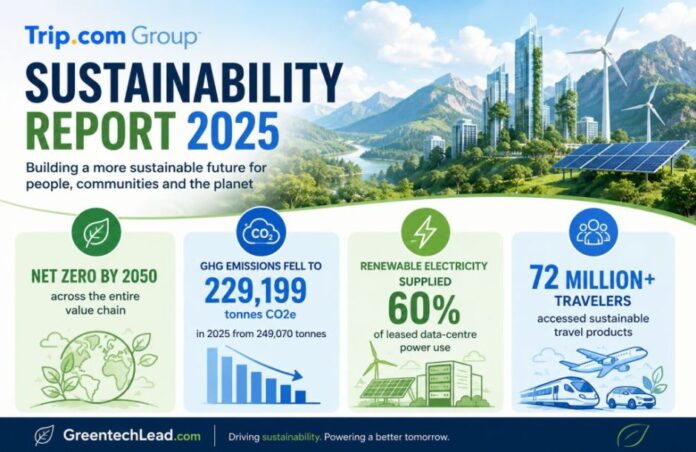
Trip.com Group is accelerating its sustainability strategy through science-based emissions reductions, renewable energy, energy efficiency, lower-carbon travel, responsible tourism and community development as the global travel company works toward net-zero greenhouse gas emissions across its entire value chain by 2050.
The company’s sustainability approach is built around its “Friendly Four” framework — Environmentally-Friendly, Community-Friendly, Family-Friendly and Stakeholder-Friendly — covering environmental performance, employees, travelers, communities and partners across the tourism ecosystem.
Trip.com’s climate strategy is aligned with the 1.5°C climate pathway, with its near-term and net-zero targets validated by the Science Based Targets initiative (SBTi) in 2025, Trip.com Group Sustainability Report 2025 indicated.
Trip.com Group Sets 50 Percent GHG Reduction Target for 2030
Using 2024 as its base year, Trip.com Group aims to reduce absolute Scope 1 and Scope 2 greenhouse gas emissions by 50 percent by 2030. The company is also targeting a 25 percent reduction in Scope 3 emissions associated with purchased goods and services and franchised activities.
Its longer-term climate targets call for absolute Scope 1 and Scope 2 emissions to fall 90 percent by 2050, accompanied by a 90 percent reduction in absolute Scope 3 emissions. The ultimate objective is net-zero greenhouse gas emissions across the entire value chain by 2050.
Trip.com Group reported total Scope 1, Scope 2 and Scope 3 greenhouse gas emissions of 229,199 tonnes CO2e in 2025, down from 249,070 tonnes CO2e in 2024.
Scope 1 emissions were 4,012 tonnes CO2e, compared with 3,325 tonnes in 2024. Scope 2 emissions declined to 20,523 tonnes from 25,088 tonnes, while Scope 3 emissions decreased to 204,664 tonnes from 220,657 tonnes.
Combined Scope 1 and Scope 2 emissions fell to 24,535 tonnes CO2e from 28,413 tonnes. Emissions intensity also improved to 0.39 tonnes CO2e per CNY 1 million of revenue, compared with 0.53 tonnes previously.
Trip.com Energy Consumption Drops to 43,883 MWh
Energy efficiency is becoming another important component of Trip.com Group’s decarbonization strategy.
Total energy consumption decreased to 43,883 MWh in 2025 from 47,514 MWh in 2024, while energy intensity declined to 0.7 MWh per CNY 1 million of revenue from 0.9 MWh.
Across its office buildings, Trip.com Group completed 14 energy-efficiency improvement projects, generating annual electricity savings of 2,346 MWh and natural gas savings of 61,500 cubic metres. The projects reduced annual carbon emissions by approximately 1,370 tonnes.
The company has also installed 12,571 LED T5 tubes, reducing annual office electricity consumption by 640,618 kWh.
At its LEED Gold-certified headquarters, water consumption declined 26 percent year over year to 87,046 tons, supported by water-efficient appliances and recovery systems.
Renewable Electricity Reaches 60 Percent at Leased Data Centres
Trip.com Group is expanding renewable electricity across offices, operating sites and data centres.
Renewable electricity represented 60 percent of the electricity consumed by leased data centres, contributing to an estimated annual carbon emissions reduction of approximately 17,800 tonnes.
PV systems installed across self-operated branches generated approximately 103 MWh of electricity in 2025, avoiding around 54.49 tonnes CO2e.
The Anhui Jinzhai Dawan Country Retreat generated approximately 95 MWh during the year. Clean-energy solutions deployed at sustainable rural tourism properties, including photovoltaic and solar-storage installations at the Anhui Jinzhai location, have also generated approximately 65,000 kWh of electricity, contributing to a 30.8 percent annual reduction in carbon emissions, equivalent to approximately 80,000 kilograms.
The SKYBRIDGE office building generated 71.6 MWh of solar electricity in 2025, equivalent to more than 70,000 kWh.
Trip.com Group’s Nantong office has meanwhile deployed rooftop solar across approximately 3,000 square metres. The installation is expected to generate 385 MWh annually, representing around 4.2 percent of the building’s annual energy consumption.
72 Million Travelers Gain Access to Sustainable Travel Products
Trip.com Group is extending its sustainability strategy beyond its own operational footprint by encouraging travelers to consider lower-carbon options.
More than 72 million travelers have been enabled to select sustainable travel products covering flights, rail journeys and car rentals.
In partnership with Travalyst, Trip.com Group has integrated the Travel Impact Model, which provides flight-emissions information using factors such as aircraft type, capacity, flight distance and cruise time. The initiative is designed to make carbon information more visible when travelers compare their options.
Low-Carbon Hotel Initiative Reaches 2,600 Hotels and 4.3 Million Guests
Accommodation represents another focus of Trip.com Group’s sustainability strategy.
Its Low-Carbon Hotel Initiative covers more than 2,600 hotels across 140 enterprises and has reached approximately 4.3 million guests.
The initiative encourages hotels to adopt lower-carbon practices while increasing the availability and visibility of more sustainable accommodation choices. This allows Trip.com Group to extend environmental improvements beyond its direct operations into the wider hospitality value chain.
USD 100 Million Tourism Innovation Fund Supports Sustainable Travel
Trip.com Group has established a USD 100 million Tourism Innovation Fund to support tourism innovation, sustainable destination development and initiatives aimed at strengthening the long-term resilience of destinations.
The fund complements the company’s investments in renewable energy, lower-carbon accommodation, sustainable travel products and destination partnerships, expanding the scope of its sustainability strategy from corporate operations into the broader tourism ecosystem.
Trip.com Group also works with more than 230 destination marketing organizations, strengthening its engagement with destinations and tourism stakeholders worldwide.
Country Retreats Support 51,000 Employment Opportunities
Community development is another pillar of Trip.com Group’s ESG agenda.
The company has developed 31 Country Retreats across 13 provinces and municipalities in China, using tourism development to support employment, rural incomes and local businesses.
The program has contributed to approximately 51,000 cumulative employment opportunities, while local employees represent at least 80 percent of personnel.
Trip.com Group estimates that the initiative has contributed to an increase in local annual income of around USD 5,500 per capita. Participating bed-and-breakfast businesses recorded a 122 percent year-over-year increase in revenue, highlighting the potential economic impact of tourism-led rural development.
On a broader scale, Trip.com Group estimates that its business activities support approximately 100,000 direct jobs and 10 million indirect jobs globally.
Trip.com Expands Employee Sustainability Across 39 Countries
Trip.com Group is also combining environmental objectives with employee well-being and family-friendly workplace policies.
Its global paid paternity leave program provides employees with a minimum of 20 days of paid leave.
Childcare subsidy programs have received approximately USD 1.6 million in investment and supported more than 1,100 employee families. Trip.com Group also reports a 100 percent return-to-work rate for female employees following maternity leave.
The company’s hybrid working framework operates across 39 countries and has saved employees an estimated 900,000 hours of commuting time, supporting workplace flexibility while potentially reducing transportation requirements associated with commuting.
Trip.com Sustainability Strategy Targets Travel Industry Decarbonization
Trip.com Group’s sustainability and ESG strategy is led by Jane McFadzean, Senior Director of Global Sustainability and ESG, while CEO Jane Sun has highlighted climate action, employee investment and global collaboration as important components of building a more resilient tourism industry.
The company’s climate roadmap combines a 50 percent Scope 1 and Scope 2 emissions reduction target for 2030, a 90 percent reduction target by 2050, growing renewable electricity adoption, lower energy consumption and a long-term commitment to net-zero emissions across the value chain by 2050.
With total GHG emissions declining to 229,199 tonnes CO2e, renewable electricity reaching 60 percent of leased data-centre electricity consumption, more than 72 million travelers gaining access to sustainable travel products and the Low-Carbon Hotel Initiative reaching 2,600 hotels and 4.3 million guests, Trip.com Group is increasingly extending its sustainability strategy from its own operations to travelers, hotels, destinations and communities across the global tourism ecosystem.
SHAFANA FAZAL
