
Trane Technologies delivered significant sustainability achievements in 2025, accelerating progress toward its 2030 Sustainability Commitments and long-term net-zero emissions target for 2050. Under the leadership of Mauro Atalla, Senior Vice President and Chief Technology & Sustainability Officer, the company advanced decarbonization, renewable energy adoption, circular economy initiatives, water stewardship, innovation, and workforce development.
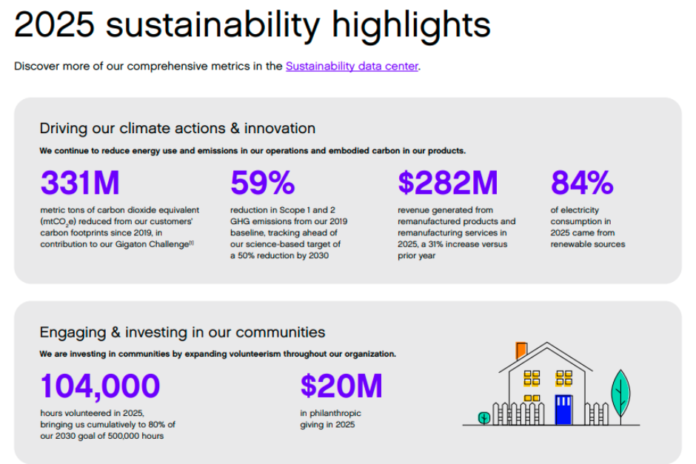
A central pillar of Trane Technologies’ sustainability strategy remains the Gigaton Challenge, which aims to help customers reduce one billion metric tons of carbon dioxide equivalent (CO2e) emissions by 2030. Since 2019, customers have avoided a cumulative 331 million metric tons of CO2e emissions through the deployment of advanced thermal management systems, electrification technologies, and low-global-warming-potential refrigerants. Supporting this effort, the company launched 110 new decarbonization-focused products during 2025, strengthening its portfolio of energy-efficient and climate-friendly solutions, according to the Trane Technologies Sustainability Report 2025.
“We deliver energy-efficient technologies at scale, lowering energy use and operating costs to generate environmental and economic benefits for our customers,” Mauro J. Atalla Senior Vice President & Chief Technology & Sustainability Officer Trane Technologies, said.
Trane Technologies achieved one of its most notable sustainability milestones by reducing absolute Scope 1 and Scope 2 greenhouse gas emissions by 59 percent compared with its 2019 baseline. This performance exceeded the company’s Science Based Targets initiative (SBTi)-validated goal of a 50 percent emissions reduction by 2030, reaching the target years ahead of schedule. The achievement was driven by renewable energy expansion, operational efficiency improvements, and investments in lower-emission manufacturing processes. Trane Technologies reported annual revenue of $21.3 billion in 2025.
Renewable electricity played a major role in reducing operational emissions. In 2025, 84 percent of electricity consumed across global operations came from renewable energy sources, moving the company closer to its RE100 commitment of sourcing 100 percent renewable electricity by 2040. Increased renewable energy usage has significantly reduced dependence on conventional energy while improving environmental performance.
The company also strengthened operational efficiency, reporting a 38 percent improvement in energy intensity compared with 2019 levels. These gains reflect ongoing investments in energy management systems, manufacturing optimization, and operational efficiency programs that reduce energy consumption while maintaining productivity and competitiveness.
Circular economy initiatives generated both environmental and financial benefits. Trane Technologies reported that 44 percent of its primary materials, including steel, aluminum, copper, plastics, and refrigerants, contained recycled content. The company’s remanufacturing business generated approximately $282 million in annual revenue, representing a 31 percent increase year-over-year. These efforts support the company’s goal of generating 10 percent of total revenue from circular products and services by 2030 while reducing waste and extending product lifecycles.
Water stewardship remained a key sustainability priority. Since 2019, Trane Technologies has reduced its overall water footprint by 49 percent. Facilities located in water-stressed regions achieved an additional 8 percent reduction in water consumption, helping improve resilience and support responsible resource management in environmentally sensitive areas.
Waste reduction efforts continued to gain momentum. By the end of 2025, 80 percent of the company’s operational sites had achieved Zero Waste to Landfill status. The milestone reflects successful waste diversion, recycling, and resource recovery programs designed to minimize landfill disposal and support circular manufacturing practices.
Innovation investments continued to support sustainability objectives and future growth. Trane Technologies invested $348 million in research and development focused on artificial intelligence, digital twins, smart building technologies, and energy-efficient cooling systems. Capital expenditures reached approximately $383 million, supporting facility modernization, automation, manufacturing efficiency enhancements, and deployment of lower-emission technologies.
The company also expanded its social impact and workforce development initiatives. The new Advanced Technology Training Center in Davidson, North Carolina, was established to train HVAC technicians and support workforce readiness for the clean energy transition. Trane Technologies invested $3 million in employee tuition advancement programs, resulting in a 30 percent increase in participation. In addition, the company contributed $20 million through global charitable giving initiatives and recorded more than 104,000 employee volunteer hours, achieving approximately 80 percent of its cumulative 2030 volunteerism target.
Trane Technologies’ 2025 sustainability performance demonstrates substantial progress across climate action, renewable energy, circularity, water conservation, innovation, and community engagement. With a 59 percent reduction in operational emissions, 84 percent renewable electricity usage, 331 million metric tons of customer CO2e emissions avoided, $282 million in circular economy revenue, and continued investments in sustainable innovation, the company remains well positioned to achieve its 2030 sustainability goals while advancing toward net-zero emissions by 2050.
SHAFANA FAZAL
