
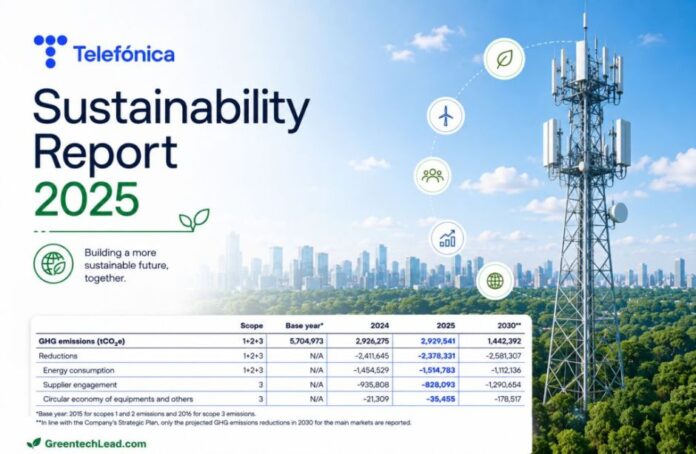
Telecommunications giant Telefonica has strengthened its sustainability leadership by accelerating its net-zero strategy through renewable energy adoption, energy efficiency improvements, supplier decarbonization programs, and climate-focused investments, according to its Sustainability Report 2025.
Telefonica has reaffirmed its commitment to achieving net-zero greenhouse gas (GHG) emissions across Scope 1, Scope 2 and Scope 3 by 2040, aligned with the Paris Agreement’s 1.5°C climate target and science-based pathways validated by the Science Based Targets initiative (SBTi). The company aims to reduce emissions by at least 90 percent from its base year before neutralizing the remainder through high-quality carbon credits and nature-based solutions.
Renewable Energy Powers Decarbonization
Renewable energy remains a cornerstone of Telefonica’s Climate Action Plan. In 2025, 93 percent of the electricity consumed across Telefonica’s own facilities came from renewable sources, compared with 92 percent in 2024, Telefonica Sustainability Report 2025 indicated.
The company’s Renewable Energy Plan is based on three pillars: self-generation of renewable energy through solar photovoltaic and biomethanol systems at telecom sites, renewable electricity purchases backed by Guarantees of Origin, and long-term Power Purchase Agreements (PPAs). These PPAs secure renewable electricity at fixed or predictable prices, reduce exposure to energy market volatility, and support the development of new renewable energy parks in Telefonica’s operating markets.
Renewable energy initiatives also contributed significantly to emissions reduction, helping Telefonica lower Scope 2 emissions and emissions associated with the fossil energy lifecycle in Scope 3.
Emissions Fall Nearly 49%
Telefonica reported total greenhouse gas emissions of 2,929,541 tonnes of CO₂ equivalent (tCO₂e) in 2025, down from a base-year level of 5,704,973 tCO₂e, representing a 48.6 percent reduction.
The company achieved a total emissions reduction of 2,378,331 tCO₂e in 2025 and expects cumulative reductions to reach 2,581,307 tCO₂e by 2030. Telefonica’s emissions are projected to decline further to 1,442,392 tCO₂e by 2030.
Energy-related initiatives delivered the largest impact, reducing emissions by 1,514,783 tCO₂e in 2025. Supplier engagement programs contributed a further 828,093 tCO₂e reduction, while circular economy initiatives accounted for 35,455 tCO₂e.
Looking ahead to 2030, Telefonica expects energy-related initiatives to reduce emissions by 1,112,136 tCO₂e, supplier engagement to deliver 1,290,654 tCO₂e of reductions, and circular economy programs to contribute 178,517 tCO₂e.
Energy Efficiency Reaches New Milestone
Telefonica continued to decouple network traffic growth from energy consumption through modernization of its telecom infrastructure.
Energy intensity improved to 29 MWh per Petabyte in 2025, compared with 38 MWh per Petabyte in 2024, reflecting major gains in network efficiency. Since 2015, Telefonica has improved this metric by 92 percent.
The company attributed these gains to fiber deployment, 5G optimization, virtualization, intelligent power-saving features, modernization of network equipment, replacement of legacy infrastructure, sustainable mobility initiatives, and advanced energy management systems.
Sustainable Revenue and Green Capex Grow
Under the European Union Taxonomy framework, Telefonica generated €2.397 billion in Taxonomy-aligned revenue, representing 6.9 percent of total turnover in 2025.
The company also reported €581 million in Taxonomy-aligned capital expenditure, equivalent to 7.4 percent of total Capex.
Among sustainable business activities, Telefonica generated €1.635 billion from circular service models, €743 million from data-driven solutions designed to reduce greenhouse gas emissions, including teleworking, smart mobility and e-health services, and €939 million in eligible revenue from data processing and hosting services.
In addition, Telefonica generated €19 million from renewable energy technology installation and maintenance services, including solar photovoltaic systems for residential and business customers.
Climate Risks Create New Growth Opportunities
Telefonica’s climate resilience analysis assessed climate risks and opportunities through 2030, 2040 and 2050 using IPCC climate scenarios.
The company identified risks associated with extreme weather events, rising electricity prices, temperature variability, and increasing carbon credit costs. However, Telefonica concluded that opportunities linked to the transition toward a low-carbon economy outweigh the risks.
Key opportunities include access to sustainable financing, lower energy costs through renewable energy procurement and PPAs, expansion of green digital services, and revenue growth from solutions that help customers reduce their own carbon emissions.
With 93 percent renewable electricity consumption, €2.397 billion in green revenue, €581 million in green Capex, and a roadmap to cut emissions from 5.7 million tCO₂e to 1.44 million tCO₂e by 2030, Telefonica is positioning sustainability as a key driver of long-term business growth, operational resilience, and climate leadership.
SHAFANA FAZAL
