
H&M Group’s 2025 Sustainability Report demonstrates how the company is aligning rapid business expansion with measurable environmental and social progress. The group delivered a 22 percent increase in net sales to 276 billion SEK while simultaneously advancing its “Circular and Climate Positive” roadmap through deep emissions cuts, material transformation, and supply chain modernization.
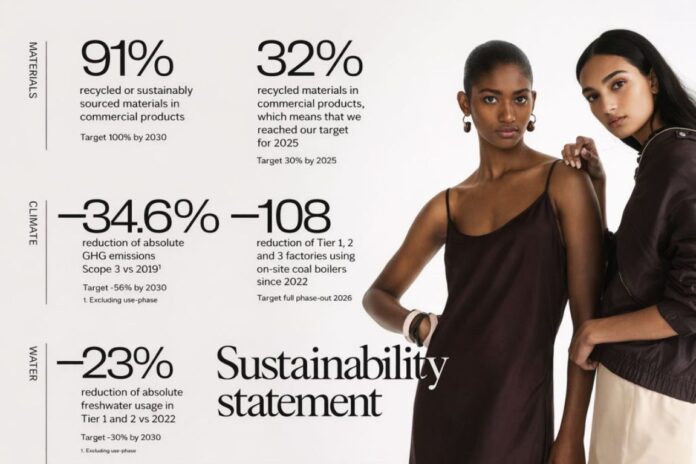
H&M Group, as part of its sustainability targets, remains focused on its goal of reducing greenhouse gas emissions by 56 percent by 2030 from a 2019 baseline. By 2025, H&M Group achieved a 41 percent reduction in Scope 1 and Scope 2 emissions along with a 34.6 percent reduction in Scope 3 emissions. This decoupling of growth from emissions was enabled by a transition to 95 percent renewable electricity across its supply chain and a disciplined investment of 2.8 billion SEK, equivalent to about $298 million, in decarbonization and material innovation initiatives.
A key structural shift in governance is the integration of sustainability into financial decision-making. H&M Group has linked 25 percent of its Long-Term Incentive plan for senior management to climate performance, ensuring accountability for delivering Science Based Targets. This is reinforced by the introduction of an internal carbon price of 900 SEK per metric ton of CO2e, which is applied to capital allocation decisions to prioritize low-carbon investments such as electrification and renewable thermal energy sourcing.
Material transformation has accelerated significantly, with 91 percent of all materials now either recycled or sustainably sourced, placing the company close to its 100 percent target for 2030. The share of recycled materials reached 32 percent, exceeding the company’s 30 percent target for 2025 ahead of schedule. In addition, H&M Group achieved 100 percent organic or recycled cotton usage, marking a critical milestone in reducing reliance on virgin raw materials and supporting its ambition to double revenue while halving its carbon footprint by 2030.
Circularity initiatives have also delivered strong results in packaging and business models. The company reduced plastic packaging by 54 percent compared to its 2018 baseline, significantly surpassing its 25 percent reduction target for 2025. At the same time, circular business models such as resale and second-hand offerings expanded across 26 markets, supported by 38 physical stores and digital platforms, while contributing 0.8 percent of total turnover.
Water stewardship has emerged as another area of overperformance. H&M Group reduced freshwater consumption in wet processing by 22.8 percent compared to a 2022 baseline, exceeding its 10 percent target, while achieving a 9.5 percent reduction in water use among garment suppliers. These improvements were supported by wastewater recycling systems implemented by 30 percent of key suppliers in high water-stress regions, resulting in total water savings of 7.2 million cubic meters and a 15 percent improvement in water efficiency per product.
Decarbonization of the supply chain continues to progress, particularly in the phase-out of coal. The number of factories using on-site coal boilers declined to 27 in 2025, down from 46 in 2023 and 118 in 2022, with a full phase-out targeted by 2026. In parallel, the company achieved a 98 percent compliance rate with Zero Discharge of Hazardous Chemicals wastewater guidelines across Tier 1 and Tier 2 suppliers, supported by 100 percent implementation of the Higg Facility Environmental Module in Tier 1 factories.
On the social front, H&M Group has expanded its human rights and workforce programs across global operations. Human rights due diligence now covers 100 percent of strategic production markets, while 85 percent of workers in strategic supplier factories are protected by collective bargaining agreements or worker representation structures. The company has also enabled 1.2 million supply chain workers to access fair wage programs and digital payment systems, with 99 percent of Tier 1 factories now using digital wage payments. In addition, renewed labor agreements continue to safeguard more than one million workers across the supply chain.
Overall, H&M Group’s 2025 sustainability performance reflects a data-driven transformation where climate action, circularity, and social equity are embedded into core business operations. The company’s ability to achieve a 41 percent reduction in operational emissions, reach 91 percent sustainable materials, and deliver a 54 percent cut in plastic packaging while growing revenue to 276 billion SEK highlights a scalable model for sustainable retail.
The report underscores that while significant progress has been made, particularly in emissions reduction, water efficiency, and circular materials, continued focus on supply chain decarbonization and full resource independence will be critical. H&M Group’s integration of governance, capital allocation, and measurable sustainability outcomes positions it as a leading example of how global fashion companies can transition toward long-term environmental and economic resilience.
FASNA SHABEER
