
The Compass Group Sustainability Report 2025 highlights how the company is leveraging its global scale to reshape food supply chains and strengthen community health outcomes. Through its “Value Beyond the Plate” strategy, Compass Group is embedding environmental and social priorities into core business operations, targeting net-zero greenhouse gas emissions across its value chain by 2050. The company has also committed to a science-based interim goal of reducing absolute emissions by 46 percent by 2030, positioning sustainability as a key driver of long-term profitability and growth.
A major focus area of Compass Group, under CEO Dominic Blakemore, is supply chain decarbonization, which accounts for nearly 90 percent of Compass Group’s total carbon footprint. The company’s Supplier Engagement Program requires key vendors to align with 1.5 degree Celsius pathways, reinforcing accountability across the ecosystem.
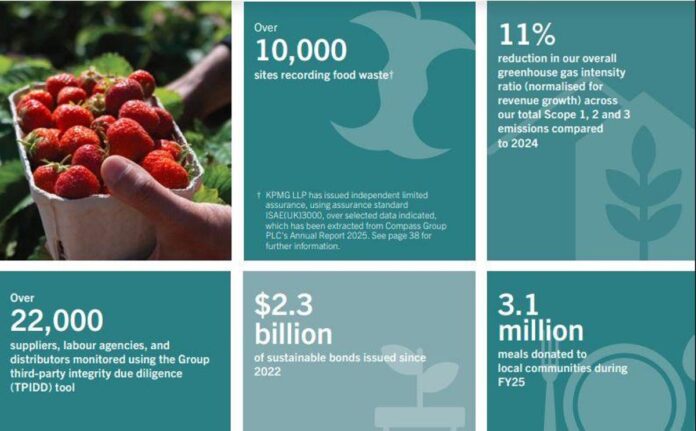
Compass Group is advancing its sustainability strategy by integrating climate action across its operations, supply chain, and customer engagement. In 2025, the company reduced its overall greenhouse gas (GHG) intensity ratio by 11 percent compared to 2024, with a 2 percent absolute emissions reduction, supported in part by improved emissions calculation methods.
For Scope 1 and 2 emissions, intensity fell by 4 percent year on year, although total emissions rose slightly due to acquisitions. The company is focusing on renewable electricity, energy efficiency, and logistics optimisation to cut emissions, while monitoring the development of electric refrigerated transport.
Scope 3 emissions account for 98 percent of Compass Group’s footprint, highlighting the importance of supplier collaboration. The company expanded Scope 3 reporting to cover 85 percent of revenue and reported total emissions of 11,674,889 tCO2e. Its Climate Transition Framework supports progress toward net zero by 2050.
By 2025, Compass Group transitioned 42 percent of its global energy consumption to renewable sources while enhancing Scope 3 emissions transparency. It is actively collaborating with dairy and meat suppliers to adopt regenerative agriculture practices and reduce emissions through optimized logistics and increased use of electric transport solutions in urban markets.
Food sourcing remains central to Compass Group’s sustainability strategy, with a strong shift toward plant-forward dining. The company aims to make 40 percent of its main meal offerings plant-based by 2030, and adoption accelerated significantly across corporate and education segments in 2025.
Sustainable procurement milestones include achieving 100 percent deforestation-free certification for palm oil and soy used in European operations, while 85 percent of globally sourced seafood meets recognized sustainability standards such as MSC and ASC. Additionally, animal welfare initiatives have progressed, with 70 percent implementation of cage-free eggs and improved broiler chicken standards across North America and Europe.
Community impact is another critical pillar of Compass Group’s sustainability framework. Through its Social Promise initiative, the company is working to improve the lives of one million people by 2030 via education, skills development, and employment opportunities.
In 2025, Compass Group strengthened partnerships with NGOs to redistribute surplus food, diverting 15 million meals from waste to food-insecure communities. The company also increased procurement spending with small, medium, and minority-owned enterprises to 15 percent of its total supply chain expenditure, supporting inclusive economic growth.
Food waste reduction and circularity initiatives continue to deliver measurable results. Leveraging platforms like Stop Food Waste Day and advanced tracking technologies, Compass Group achieved a 38 percent reduction in food waste compared to its 2019 baseline. The company also eliminated an additional 20 percent of single-use plastics in 2025, expanding the adoption of compostable and reusable packaging. These initiatives are part of a broader circular economy approach that emphasizes waste minimization and converting organic waste into bioenergy or compost.
Looking ahead, Compass Group is aligning executive incentives with sustainability performance, ensuring accountability at the highest levels of leadership. As the company advances toward its 2030 targets, it will continue to prioritize regenerative food systems, low-carbon operations, and social impact, reinforcing its position as a leader in sustainable food services worldwide.
FASNA SHABEER
