
Beko accelerated its sustainability strategy in 2025 by expanding renewable energy, improving resource efficiency, increasing recycled material use, and deploying AI-powered manufacturing to support its Science Based Targets initiative (SBTi)-validated commitment to achieve net zero greenhouse gas emissions across its value chain by 2050. The company continues to align its climate roadmap with the 1.5 degrees Celsius pathway while advancing circular economy and sustainable manufacturing initiatives.
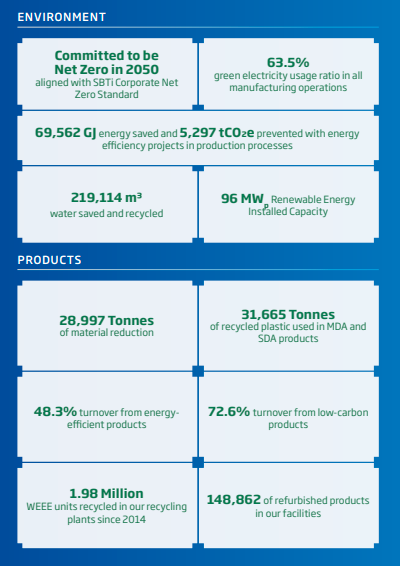
Beko has committed to reducing absolute Scope 1 and Scope 2 greenhouse gas emissions by 42 percent by 2030 from a 2022 baseline, while also targeting a 42 percent reduction in Scope 3 use-phase emissions during the same period. By 2050, the company aims to cut 90 percent of emissions across Scope 1, Scope 2, and Scope 3, with residual emissions offset through permanent carbon removal solutions. During 2025, operational improvements generated energy savings of 69,562 GJ, preventing approximately 5,297 metric tons of CO2e emissions across manufacturing operations.
Renewable energy remained central to Beko’s decarbonization strategy. The company increased installed solar photovoltaic capacity from 90.2 MWp to 96 MWp across its manufacturing facilities, while green electricity accounted for 63.5 percent of total manufacturing electricity consumption. Beko is targeting 100 percent green electricity by 2030, where market conditions permit, and has committed to invest at least USD 50 million in renewable energy and energy efficiency projects by 2030.
Energy efficiency initiatives continued to reduce the environmental footprint of manufacturing operations. Beko is expanding ISO 50001 Energy Management Systems and integrating artificial intelligence into production through predictive maintenance, real-time monitoring, and intelligent production planning. These initiatives support the company’s objective of reducing manufacturing energy consumption per product by 45 percent by 2030.
Water stewardship remained another key sustainability priority. Rainwater harvesting and water efficiency projects saved 219,114 cubic meters of water during 2025. Beko aims to reduce water withdrawal per product by 45 percent by 2030 while increasing water recycling and reuse across manufacturing facilities to 70 percent.
The company’s circular economy strategy also delivered measurable progress. Manufacturing sites achieved a 98.6 percent waste recycling rate, moving toward a 99 percent waste recovery target by 2030. During the year, Beko incorporated 27,835 metric tons of recycled plastic into its products and reduced material consumption by 17,163 metric tons through product redesign and engineering improvements. Since 2014, the company has recycled 1.86 million Waste Electrical and Electronic Equipment units. By 2030, Beko plans to increase recycled plastic content in products to 40 percent while achieving 5 percent bio-based material content.
Product sustainability continued to contribute significantly to business performance. Energy-efficient products generated 61.9 percent of total turnover, while low-carbon products represented 71.5 percent of total revenue. The company continues to improve appliance energy efficiency, durability, repairability, recyclability, and recycled material content to reduce lifecycle emissions and support its Scope 3 emissions reduction targets.
Digital transformation is also strengthening Beko’s sustainability performance. The company operated 13 AI-enabled smart factories during 2025 and plans to expand this network to 17 by the end of 2026. Three manufacturing facilities have been recognized by the World Economic Forum’s Global Lighthouse Network, while the Ulmi facility earned Sustainability Lighthouse recognition for combining advanced manufacturing technologies with environmental performance improvements.
Beko’s 2025 sustainability progress demonstrates a comprehensive approach to climate action, renewable energy expansion, circular manufacturing, water conservation, AI-driven operational efficiency, and sustainable product innovation. Supported by 96 MWp of solar capacity, 63.5 percent green electricity usage, ambitious emissions reduction targets, and continued investment in clean energy and resource efficiency, the company is advancing its long-term strategy to achieve net zero emissions across its value chain by 2050.
SHAFANA FAZAL
