
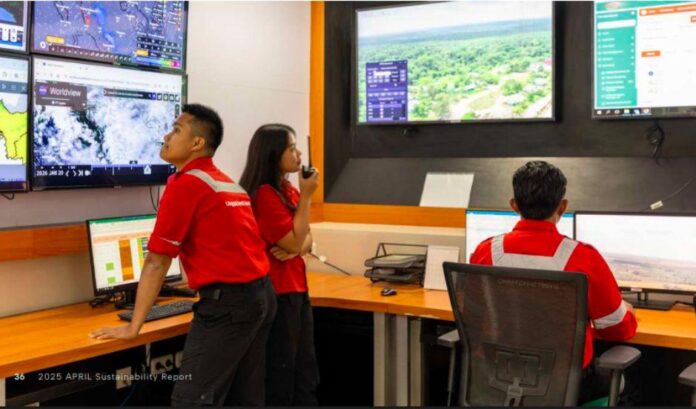
APRIL Group accelerated progress toward its APRIL2030 sustainability targets in 2025, delivering significant gains in climate action, renewable energy adoption, conservation investment, circular economy initiatives, and community development.
Wang Bo, President of APRIL Group, said: “2025 was a milestone year for APRIL, marking the midpoint of our APRIL2030 agenda and the 10-year anniversary of our foundational Sustainable Forest Management Policy 2.0 (SFMP 2.0).”
APRIL Group reported a 20 percent reduction in land-use emissions to 3.5 million tonnes of CO2 equivalent from a baseline of 4.8 million tonnes, strengthening its pathway toward achieving net-zero land-use emissions by 2030.
Renewable and clean energy supplied 84.9 percent of APRIL’s manufacturing energy demand during 2025. The company expanded installed solar capacity to 26.3 MW, surpassing earlier goals and prompting an increase in its long-term solar ambition to 50 MW by 2030.
APRIL Group’s clean energy adoption in logistics operations also improved significantly to 33.2 percent from a 19 percent baseline, supported by biomass energy systems and the transition to B35 biodiesel.
APRIL reported total greenhouse gas emissions of approximately 16.18 million tonnes of CO2 equivalent across Scope 1, Scope 2, and Scope 3 emissions. Scope 3 emissions reached approximately 4.97 million tonnes of CO2 equivalent, accounting for 30.7 percent of total emissions, highlighting the growing importance of supply-chain decarbonization through sustainable sourcing, logistics optimization, renewable energy integration, and responsible forestry management, APRIL Sustainability Report 2025 indicated.
Nature-based climate solutions continued to generate substantial environmental benefits. Conservation and restoration activities delivered approximately 11.87 million tonnes of avoided emissions through peatland protection and ecosystem restoration projects across key landscapes, including Restorasi Ekosistem Riau Kampar and Pulau Padang. These initiatives complement operational emissions reductions while supporting biodiversity conservation and long-term carbon storage.
The company made a record conservation investment of US$14.8 million in 2025, bringing cumulative conservation spending since 2020 to US$67 million. APRIL maintained 465,886 hectares of conservation and restoration landscapes, equivalent to approximately 77 percent of its plantation footprint, reinforcing its commitment to protecting critical ecosystems and enhancing environmental resilience.
Resource efficiency improvements also contributed to sustainability performance. Landfill waste intensity fell to 32.3 kilograms per tonne of product, down from 71 kilograms per tonne in 2021, driven by waste-to-value programs that convert manufacturing residuals into organic fertilizers and reduce landfill dependency.
In sustainable forestry operations, APRIL increased Mean Annual Increment (MAI) productivity to 22.8 tonnes per hectare per year, representing a 12.3 percent improvement since 2019. These gains were achieved without expanding land use, supporting the company’s commitment to responsible forestry and no-deforestation principles.
Community development programs delivered measurable social outcomes. Infant stunting rates declined to below 14 percent across 74 villages, while a socioeconomic assessment covering approximately 7,700 households helped strengthen development planning in health, education, and livelihoods. Women accounted for 69 percent of participants in APRIL’s community programs, reflecting strong progress in diversity, equity, and inclusion initiatives.
Guided by the APRIL2030 framework’s four pillars — Climate Positive, Thriving Landscapes, Inclusive Progress, and Sustainable Growth — APRIL continues to expand investments in decarbonization, renewable energy, ecosystem restoration, circular economy innovation, and community empowerment. The company’s 2025 performance demonstrates measurable progress toward building a low-carbon, nature-positive, and socially inclusive future while advancing long-term sustainability commitments.
SHAFANA FAZAL
