The U.S. utility-scale solar industry is moving from a race for development pipelines toward execution, financing and storage integration.
Developers plan to add a record 43.4 GW of utility-scale solar capacity in 2026, 60 percent above the 27.2 GW installed in 2025, according to the U.S. Energy Information Administration’s 2026 capacity outlook. Solar represents 51 percent of planned U.S. utility-scale generation additions, while another 24 GW of battery storage is expected.
S&P Global Market Intelligence says nearly 7.5 GW of utility-scale solar was installed in Q2 2026, lifting cumulative capacity to 172.5 GW. Nearly 300 GW of additional solar is targeted for completion between 2026 and 2031.
Against that backdrop, operating capacity, construction-stage projects, PPAs, financing and storage are becoming as important as headline pipeline size.
NextEra Energy Resources: Scale Backed by Major Projects
NextEra Energy Resources remains one of America’s largest renewable developers. S&P Global ranked NextEra as the leading U.S. renewable developer in Q2 2026 with approximately 23.5 GW of planned capacity.
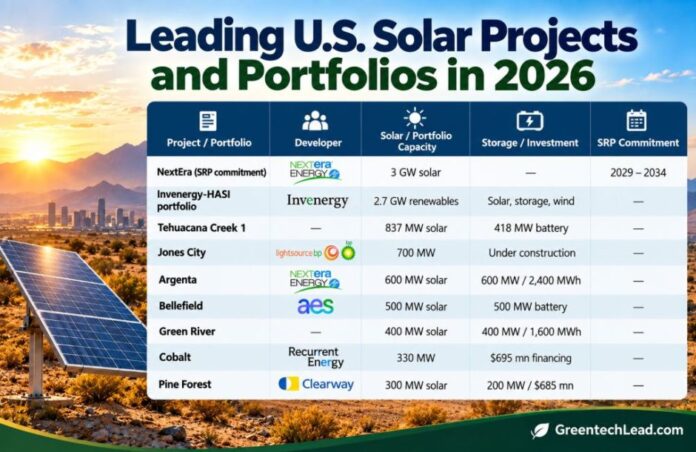
Its future solar portfolio includes the Argenta Solar Energy Center in California, designed with 600 MW of solar and a 600 MW four-hour battery, equivalent to 2,400 MWh. The project could generate approximately $138 million of additional county revenue over 30 years.
NextEra also secured one of the largest U.S. solar commitments of 2026 when Salt River Project agreed to procure 3 GW of solar, involving 500 MW annually in Arizona from 2029 through 2034.
This combination of pipeline scale, storage and contracted demand strengthens NextEra’s position.
Invenergy: 2.7 GW Portfolio Demonstrates Execution
Invenergy operates across solar, wind and storage and has built a large multi-state development platform.
In September 2026, Invenergy and HASI expanded their partnership around a 2.7 GW portfolio of solar, solar-plus-storage and wind projects across seven states.
More than 850 MW was already operating, with additional projects scheduled to enter operation through 2027. Invenergy retains control and majority ownership.
The Invenergy-HASI 2.7 GW portfolio demonstrates how developers are using institutional capital to move contracted renewable projects from development into operation.
AES: Bellefield Combines 500 MW Solar with Storage
AES demonstrates the growing importance of hybrid projects.
Its Bellefield project in California combines 500 MW of solar with 500 MW of battery storage, creating one of the larger integrated solar-storage developments in the market.
The project illustrates why solar developers can no longer be assessed using photovoltaic MW alone. Battery capacity, storage duration, interconnection and PPAs determine the commercial value of projects.
Storage allows developers to move solar generation from midday into higher-demand evening periods, effectively extending the value of solar assets beyond daylight hours.
Origis Energy: 20 GW Pipeline and 3 GW Operating Target
Origis Energy provides one of the clearest examples of converting development pipeline into operating assets.
The company reached more than 2.3 GW of owned and operating solar and battery storage capacity across 13 projects and six states by March 2026 after adding 1.2 GW in the preceding year.
Origis aims to reach 3 GW of owned and operating capacity by the end of 2026, supported by a development pipeline exceeding 20 GW.
The distinction is important. A 20 GW pipeline indicates development potential, while the operating portfolio demonstrates the company’s ability to secure customers, financing, equipment and interconnections and complete construction.
Clearway: $685 Million Pine Forest Solar-Storage Project
Clearway Energy Group provides another strong example of execution.
In February 2026, Clearway brought the Pine Forest Energy Center in Texas into operation. The development combines 300 MW of solar with 200 MW of battery storage.
Total investment was approximately $685 million, and the project can generate enough electricity for more than 100,000 homes.
The Pine Forest Energy Center is particularly significant because it is Clearway’s first battery-storage facility in Texas.
Clearway has also secured a 650 MW solar agreement with Google, highlighting the growing role of corporate electricity buyers in supporting large renewable projects.
Recurrent Energy: $695 Million Financing for Cobalt Solar
Financing is becoming another important measure of pipeline quality.
Recurrent Energy secured $695 million in project financing and tax equity in August 2026 for its 330 MW Cobalt Solar project in California.
The financing includes approximately $484 million of debt led by MUFG and Nord/LB. The fully permitted project is under construction and is expected to enter commercial operation by the end of 2027.
The Cobalt Solar financing demonstrates the difference between an announced pipeline and financeable capacity. Once permitting, financing and construction are secured, execution risk becomes substantially clearer.
Lightsource bp: 700 MW Jones City Leads Construction Portfolio
Lightsource bp also has a significant portfolio of U.S. operating and development projects.
Its commercial assets include 300 MW Bighorn Solar, 293 MW Sun Mountain Solar, 259 MW Impact Solar, and 188 MW each at Honeysuckle Solar and Peacock Solar.
The company lists the 700 MW Jones City Energy Center under construction, while advanced developments include 675 MW Big Bronco Solar and Storage and 342 MW Zion Valley Solar and Storage.
Separating operating, construction and advanced-development projects provides a more meaningful indication of growth than aggregating every project into one headline pipeline.
Tehuacana Creek Shows Scale of 2026 Projects
Individual projects are also getting larger.
EIA identified Tehuacana Creek 1 Solar and BESS in Texas as the largest photovoltaic project expected to enter service during 2026, with 837 MW of solar plus 418 MW of battery storage.
Another important hybrid development is the Green River Energy Center in Utah, which combines 400 MW of solar with a 400 MW/1,600 MWh battery system. The project was among the major additions highlighted in the second quarter of 2026.
These projects demonstrate why battery capacity is becoming integral to utility-scale solar economics.
Battery Storage Is Redefining Solar Leadership
Storage is becoming one of the biggest differentiators between U.S. solar developers.
EIA originally projected 24 GW of utility-scale battery additions in 2026, with Texas accounting for 12.9 GW, California 3.4 GW and Arizona 3.2 GW.
By the end of June, U.S. operational utility-scale battery capacity had already approached 52 GW, following 8.3 GW of additions during the first half of 2026.
Battery duration matters as much as MW. A 600 MW four-hour system such as that planned for NextEra’s Argenta project represents 2,400 MWh, allowing substantial volumes of daytime solar generation to be shifted into later demand periods.
Pipeline Quality Matters More Than Headline Gigawatts
The leading U.S. solar companies represent different growth models. NextEra combines enormous scale with utility commitments; Invenergy uses partnerships to finance multi-state portfolios; AES emphasizes solar-plus-storage; Origis is rapidly expanding operating capacity; Lightsource bp has large construction-stage assets; Clearway combines storage with corporate offtake; and Recurrent Energy demonstrates how project financing converts pipelines into construction.
With 43.4 GW of solar and 24 GW of battery storage originally planned for 2026, the market is shifting from announced capacity toward execution.
For investors and customers comparing the top U.S. solar companies in 2026, the strongest indicators are therefore operating capacity, projects under construction, contracted PPAs, financing, interconnection progress and storage capacity.
A 10 GW mature pipeline with financing and customers can ultimately be more valuable than a much larger collection of early-stage projects. In the next phase of the U.S. solar market, execution capability will determine which developers convert pipeline leadership into operating capacity.
SHAFANA FAZAL