
Battery energy storage capacity in the European Union has expanded in recent years, highlighting its growing role in supporting renewable energy integration and grid stability. Installed battery storage has increased from less than 1 GWh in 2019 to more than 27 GWh in 2025, bringing the total battery capacity connected to the EU grid to about 77 GWh in the European Union.
A large share of these installations remains in the residential segment, which accounts for nearly 60 percent of total capacity. However, the structure of the market is changing quickly as utility-scale battery systems gain momentum across Europe, SolarPower Europe said in its report.
Utility-Scale Batteries Become the Fastest Growing Segment
For much of the past decade, grid-scale battery storage experienced slow growth due to regulatory uncertainty and market conditions that were not favorable for large-scale projects. That situation has changed significantly.
In 2025, utility-scale battery systems represented 55 percent of all new installations in the EU, marking the highest share ever recorded for the segment. The rapid expansion is expected to continue as these systems become essential for grid flexibility, system stability, and resilience in power networks with increasing renewable energy penetration.
Utility-scale batteries are particularly valuable for balancing electricity supply and demand, managing fluctuations from solar and wind generation, and providing backup capacity during peak demand periods.
Government Incentives Accelerate Grid-Scale Storage Deployment
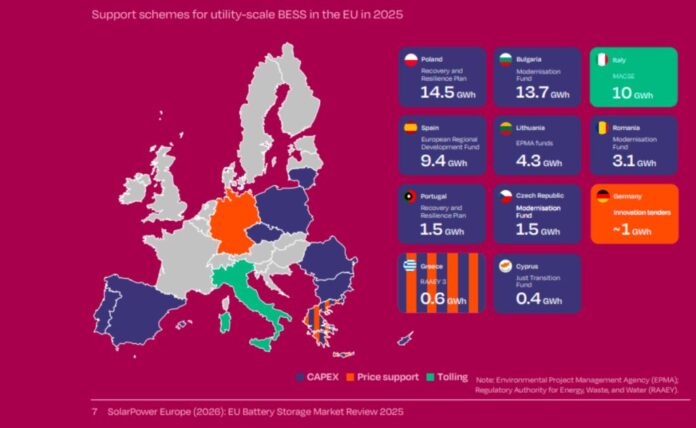
Government financial support has played a crucial role in accelerating large-scale battery deployment across Europe. EU member states typically support battery projects through three major mechanisms:
Upfront capital expenditure (CAPEX) grants
Price-support mechanisms such as feed-in premiums or contracts for difference
Fixed-price tolling agreements offered to asset owners
These support frameworks have significantly improved the financial viability of battery projects, attracting strong developer interest.
Record 70 GWh of Battery Storage Procured in 2025
In 2025 alone, EU member states procured around 70 GWh of grid-scale battery storage, an unprecedented level that nearly matches the entire battery capacity currently connected to the EU grid.
Approximately 50 GWh of this capacity was contracted through CAPEX-based support programs financed by EU funding instruments including:
The Modernisation Fund
The Recovery and Resilience Facility
The Just Transition Fund
Several countries launched large-scale incentive programs to support battery deployment.
Poland introduced a 14.5 GWh battery storage support scheme, combining upfront investment grants and loans to accelerate energy storage investments. Spain also launched a 9.4 GWh CAPEX-driven incentive program, further boosting battery deployment in its renewable energy system.
Additional storage support programs were implemented in Portugal, Lithuania, the Czech Republic, Romania, Bulgaria, and Cyprus. Many of these initiatives initially offered smaller volumes but were expanded after attracting strong interest from developers, prompting governments to increase budgets and allocate additional capacity.
Price Support Schemes and Auctions Support Storage Growth
Price support mechanisms have also contributed to the development of battery storage projects in Europe. Germany has deployed storage through innovation tenders that include feed-in premium support for hybrid solar and battery systems. These tenders have successfully delivered projects at declining price levels.
However, the German program still restricts some of the potential benefits of battery storage. Hybrid projects are allowed to draw only limited electricity from the grid, limiting their ability to provide broader system services that batteries could otherwise offer.
Greece and Italy Introduce New Battery Market Models
Greece recently concluded its third battery storage auction, awarding around 600 MWh of standalone battery capacity. However, none of the selected projects have yet been connected to the transmission grid due to regulatory uncertainty and slow permitting processes.
With auctions now discontinued, Greece has shifted its approach toward granting grid connection approvals for merchant battery projects, which have already reached 4.7 GWh of capacity.
Meanwhile, Italy launched its first MACSE battery storage auction in September 2025, marking a major shift in the country’s energy storage market. Developers competed to secure 15-year fixed tolling contracts offered by transmission system operator Terna, prioritizing long-term revenue stability over merchant market opportunities.
All 10 GWh of battery storage capacity offered in the auction was allocated, with average prices below EUR 13,000 per MWh per year, significantly lower than the EUR 37,000 ceiling price.
Long-Duration Batteries Gain Momentum
Another notable trend from Italy’s MACSE auction was the dominance of long-duration battery systems. Winning projects averaged 6.7 hours of storage capacity, indicating strong investor interest in technologies capable of delivering longer discharge durations.
Shorter-duration batteries would have sacrificed too much potential merchant revenue to compete in the auction, making longer-duration systems more attractive within the fixed-price contract framework.
Battery Storage Set to Power Europe’s Energy Transition
The rapid growth of battery storage across the European Union reflects its growing importance in enabling the region’s clean energy transition. As renewable energy generation expands, energy storage will play a critical role in balancing power systems, improving grid reliability, and supporting the large-scale deployment of solar and wind energy.
With continued policy support, falling battery costs, and rising demand for grid flexibility, utility-scale battery storage is expected to become one of the fastest-growing energy infrastructure segments in Europe over the coming decade.
BABURAJAN KIZHAKEDATH
