
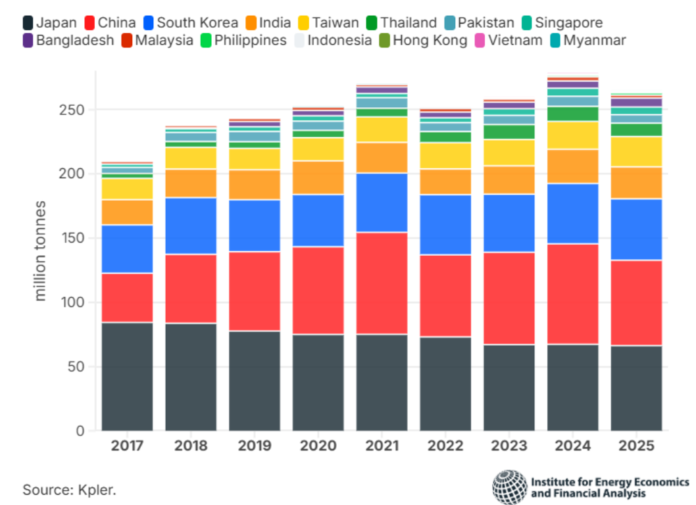
The Iran conflict is accelerating a structural transformation in Asia’s energy landscape by disrupting liquefied natural gas (LNG) supply chains while reinforcing long-term shifts in investment flows toward renewable energy, storage systems, and electrified infrastructure.
According to the Institute for Energy Economics and Financial Analysis (IEEFA), the geopolitical shock is not only increasing short-term LNG price volatility but also reshaping capital allocation decisions, project financing pipelines, and long-term demand expectations across Asia’s power and gas sectors.
The report emphasizes that LNG is losing its position as a transition fuel as investors, utilities, and governments reassess exposure to geopolitical risk, fuel price volatility, and long-term asset stranding risks linked to accelerating clean energy adoption.
Geopolitical Disruption in the Strait of Hormuz Elevates LNG Investment Risk
IEEFA’s Sam Reynold highlights that instability in the Strait of Hormuz continues to be a key risk factor for global LNG flows, given that a significant share of exports from Qatar and other Gulf producers passes through this corridor. The increased uncertainty has raised insurance costs, shipping premiums, and long-term contract risk pricing.
This is directly impacting investment decisions in LNG infrastructure, as higher geopolitical risk is increasing the cost of capital for export terminals, shipping networks, and regasification infrastructure. Financial institutions are now embedding risk premiums into LNG project financing models, making long-cycle gas investments less attractive compared to renewable energy assets with more predictable cash flows, IEEFA report indicated.
Asia LNG Prices Signal Structural Shift in Investment Expectations
LNG prices in Asia have remained elevated following geopolitical disruptions, but the more important shift is how investors are interpreting these price signals. IEEFA notes that price volatility is now being treated as structural rather than cyclical, reshaping procurement strategies and long-term capital allocation.
As a result, utilities and sovereign buyers are becoming more cautious in signing long-term LNG contracts, especially those requiring 20 to 30-year commitments. This is slowing investment decisions in new LNG import terminals and encouraging a pivot toward flexible, modular renewable energy systems.
Global LNG Companies and Investment Activity Reshaping Market Structure
The LNG industry is currently being reshaped by aggressive expansion strategies from major global players, even as long-term demand signals weaken in Asia. Companies such as QatarEnergy, ExxonMobil, Shell, TotalEnergies, Chevron, and ADNOC continue to dominate global LNG investment flows, but their strategies are increasingly focused on securing long-term contracts and optimizing portfolio exposure rather than pure capacity expansion.
QatarEnergy remains the central force in global LNG supply expansion, with its North Field development program pushing capacity toward more than 120 million tons per annum in the coming years. The company continues to anchor long-term supply agreements with Asian buyers and global energy majors, reinforcing its dominance in contract-based LNG trade flows.
ExxonMobil is also expanding its LNG footprint through major investments such as the Golden Pass LNG project in the United States in partnership with QatarEnergy. The project is part of ExxonMobil’s broader strategy to double its LNG business capacity by the end of the decade, reflecting continued confidence in long-term gas demand despite short-term volatility.
Shell is focusing on portfolio optimization and trading strength, expanding its LNG supply chain through acquisitions such as Pavilion Energy and maintaining significant positions in Qatar’s North Field expansion. The company is increasingly positioning itself as a global LNG trader and portfolio integrator rather than just a project investor.
TotalEnergies is pursuing a diversified LNG strategy that combines upstream production exposure with downstream power integration. Its investments in Qatar, the United States, and Asia reflect a shift toward controlling the full LNG value chain, including trading, shipping, and power generation.
ADNOC has emerged as a new aggressive LNG player, rapidly expanding its export capacity while integrating shipping and trading infrastructure to strengthen its global market position. Its strategy reflects a broader Middle Eastern push to secure long-term LNG market share before structural demand shifts fully accelerate.
At the same time, a growing number of long-term LNG contracts are being signed to support new US export projects, as seen in recent multi-decade agreements linked to emerging LNG terminals in North America. However, these investments are increasingly dependent on securing long-term offtake agreements from Asian buyers, highlighting rising demand uncertainty.
Investment Reallocation From LNG to Renewables and Grid Infrastructure
IEEFA notes a clear structural shift in global capital flows, where LNG infrastructure is increasingly being deprioritized in favor of renewable energy and grid modernization projects. Institutional investors, sovereign wealth funds, and development banks are redirecting capital toward solar, wind, and battery storage due to lower execution risk and faster return cycles.
LNG projects, by contrast, are facing higher financing costs due to long asset lifecycles, exposure to fuel price volatility, and uncertainty over long-term utilization rates. This is leading to delays and re-evaluations of several LNG import terminals and gas-fired generation projects across Asia.
China: Capital Shift Toward Electrification and Domestic Energy Security
China continues to reduce its reliance on LNG import expansion while accelerating investments in renewable energy, electrification, and ultra-high-voltage grid infrastructure. LNG is increasingly being treated as a balancing fuel rather than a growth asset, with capital being redirected toward domestic energy resilience.
India: Dual Investment Strategy Between LNG Imports and Clean Energy Expansion
India is maintaining a hybrid investment approach, using LNG imports to manage short-term demand while continuing to aggressively expand renewable energy capacity. However, investment momentum is clearly shifting toward solar and wind projects, which are attracting stronger long-term capital inflows due to cost competitiveness and reduced fuel risk exposure.
Pakistan: Distributed Energy Investment Reducing LNG Dependency
Pakistan is experiencing a structural shift in energy investment patterns, with capital increasingly flowing into distributed solar systems due to foreign exchange constraints and high LNG import costs. This is reducing dependence on centralized LNG infrastructure and reshaping the country’s long-term energy investment model.
South Korea: Strategic Shift Toward Nuclear and Storage Investments
South Korea is reallocating energy capital toward nuclear restart programs, renewable expansion, and battery storage systems. This investment shift is aimed at reducing LNG dependency and improving energy security through diversified domestic generation assets.
Southeast Asia: LNG Project Financing Under Pressure
Across Southeast Asia, LNG infrastructure investments are facing increased scrutiny due to rising financing costs, currency risk, and uncertainty over long-term demand. Countries such as Vietnam, the Philippines, and Thailand are reassessing LNG project pipelines as renewable energy becomes more financially attractive.
External Value Addition: LNG Losing Capital Advantage in Global Energy Markets
From a global investment perspective, LNG is increasingly losing its historical advantage as a stable infrastructure asset. Investors are applying higher discount rates to LNG projects due to long payback periods and uncertain demand trajectories in Asia. In contrast, renewable energy projects are benefiting from lower financing costs, ESG-driven capital inflows, and policy-backed risk reduction mechanisms.
Capital Markets Are Now Driving Asia’s Energy Transition
The Iran conflict is accelerating more than just geopolitical instability—it is fundamentally reshaping how capital is allocated across global energy markets. According to IEEFA, LNG is losing competitiveness not only due to environmental considerations but also due to shifting investment fundamentals, rising financing risks, and accelerating renewable energy adoption.
The result is a structural transformation in Asia’s energy system where capital markets, rather than policy alone, are becoming the primary driver of the transition away from LNG toward a renewable energy-dominant future.
FASNA SHABEER
