
Global energy demand has reached new highs in 2025 while renewable energy accelerated its role in the world’s electricity system, according to the 75th edition of the Energy Institute Statistical Review of World Energy, produced in partnership with Ember and with collaboration from Kearney and KPMG.
Global total energy supply (TES) increased 1.7 percent in 2025, marking the second consecutive year in which every major energy source reached an all-time high. Despite efficiency improvements of 2 percent relative to GDP growth, the world remained well below the 4 percent annual energy efficiency improvement target agreed at COP28.
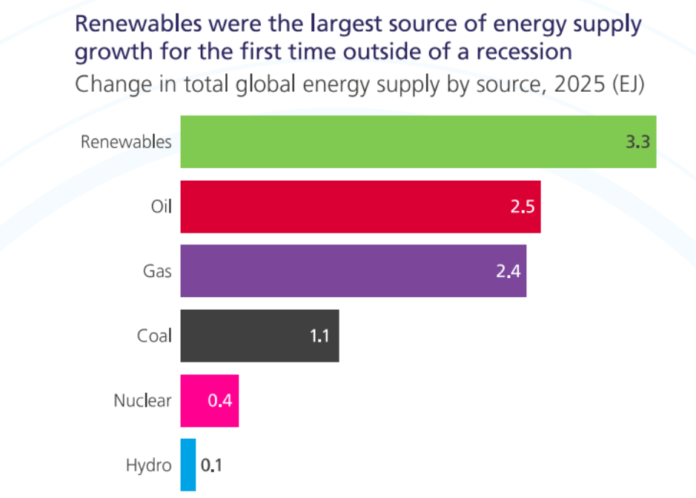
Renewable energy became the largest contributor to global TES growth for the first time outside a recession, with solar accounting for 71 percent of the increase. Solar power generation expanded 30 percent globally, while installed battery storage capacity surged 66 percent, highlighting the rapid deployment of clean energy technologies.
Global electricity demand rose 3 percent, outpacing overall energy demand. For the first time, all additional electricity demand was met entirely by low-carbon sources, with renewables and hydropower overtaking coal as the world’s largest source of electricity generation. Overall fossil-fuel-based power generation declined as clean electricity increasingly displaced conventional generation.
New electricity demand from electric vehicles, artificial intelligence and data centres continued to reshape power consumption. Global data centres consumed 788 TWh of electricity during 2025, with the United States accounting for 40 percent of total data centre electricity use.
China remained the global leader in renewable deployment, adding more wind and solar capacity than the rest of the world combined, while coal generation continued to decline. China’s electricity demand expanded by more than 5 percent, adding power consumption equivalent to Germany’s entire annual electricity usage within a single year.
India also advanced its clean energy transition, with renewable electricity generation rising nearly 24 percent, while electricity generated from coal, oil and natural gas all declined.
Europe experienced 7 percent growth in renewable generation, although weaker hydropower output offset part of the gains and wind generation declined slightly. The United Kingdom’s solar generation jumped 37 percent, making it one of Europe’s strongest renewable performers.
In the United States, solar generation increased 28 percent, while wind generation grew only 3 percent. However, the 13 percent rise in coal-fired generation contributed significantly to the country’s higher emissions despite continued renewable expansion.
Energy security also remained a major theme during 2025. Oil production in the Americas increased 4.8 percent, helping reduce supply risks associated with geopolitical tensions in the Middle East. The region now produces 20 percent more oil than the Middle East, a dramatic reversal from two decades ago when the Middle East produced 20 percent more oil than the Americas. US oil and gas production alone increased 4 percent during 2025, reinforcing the region’s growing role in global energy markets.
Global carbon emissions increased 1.1 percent, although regional trends varied significantly. The United States recorded the fastest emissions growth among major economies at 3.2 percent, largely due to a 13 percent increase in coal-fired electricity generation. In absolute terms, US emissions growth was four times larger than China’s. By comparison, China’s emissions rose only 0.3 percent, while India’s increased 0.9 percent, both remaining below the global average.
BABURAJAN KIZHAKEDATH
