
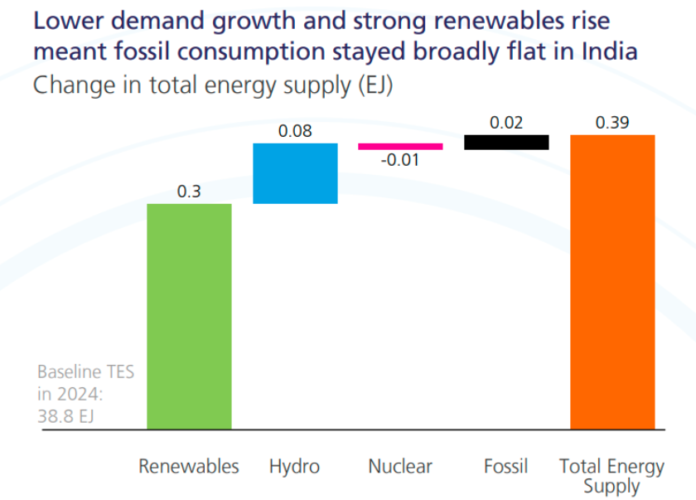
India’s energy transition gathered momentum in 2025 as coal demand growth slowed sharply, renewable electricity generation accelerated, and carbon emissions remained below the global average, according to the Energy Institute Statistical Review of World Energy 2026. The report highlights that while India continues to rely heavily on coal for energy security, rising renewable capacity is beginning to reshape the country’s energy mix.
India’s coal consumption increased just 0.6 percent year-on-year in 2025, significantly below its 10-year average annual growth rate of 3.6 percent. At the same time, domestic coal production reached a record 17.9 exajoules (EJ), enabling the country to meet approximately 78 percent of its coal demand from domestic supplies, although India remained a net coal importer.
The report indicates that India’s electricity sector became cleaner during 2025. Electricity generation from coal, oil and natural gas declined, while renewable electricity generation increased by nearly 24 percent, reflecting continued investments in solar and other clean energy sources. This renewable expansion helped moderate emissions growth despite rising energy demand.
India’s energy-related carbon dioxide (CO₂) emissions increased only 0.9 percent in 2025, remaining below the global average increase of 1.1 percent. By comparison, the United States recorded a 3.2 percent rise, while China’s emissions increased 0.3 percent, highlighting India’s relatively moderate emissions growth among major economies.
Despite stronger domestic coal production, India continues to depend heavily on imported fossil fuels. The report states that the country remains highly reliant on oil and natural gas imports, while importing the remaining 22 percent of its coal requirements not met by domestic production. India also imported 86 percent of its oil consumption during 2025, underlining its continued exposure to global energy markets and price volatility.
India’s refining industry remains a strategic strength. The country accounts for approximately 4.7 percent of global refining capacity and continues to operate as a net exporter of refined petroleum products, particularly middle distillates and gasoline.
The report also highlights India’s growing importance in global energy demand. Between 2016 and 2025, India accounted for 17 percent of the increase in total energy supply (TES) across the Asia-Pacific region, while China contributed 71 percent, making India the second-largest driver of regional energy demand growth.
The findings suggest that India is balancing energy security with decarbonization by expanding domestic coal production to strengthen supply while accelerating renewable energy deployment. Although coal remains central to India’s energy system, slowing coal demand growth, record domestic production, nearly 24 percent growth in renewable electricity, and 0.9 percent emissions growth indicate that the country’s energy transition is gradually gaining pace even as overall energy demand continues to rise.
BABURAJAN KIZHAKEDATH
