
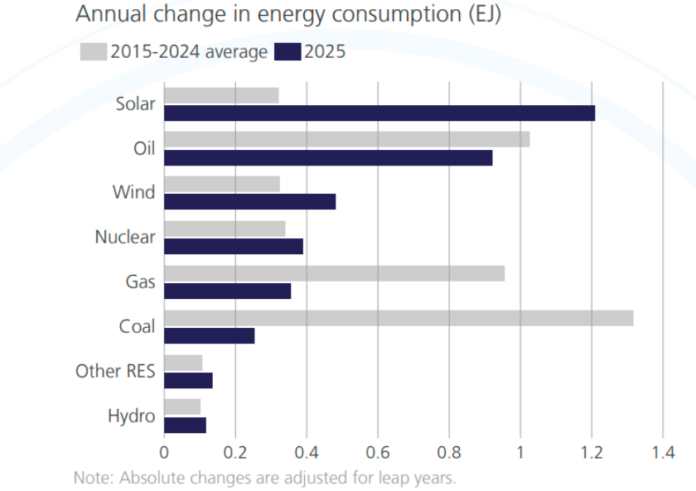
China achieved a significant milestone in its energy transition during 2025 as coal consumption remained flat for the first time in a decade, supported by record growth in solar and wind power, according to the Energy Institute Statistical Review of World Energy 2026. The report highlights China’s expanding leadership in renewable energy, battery storage, electric vehicles (EVs), and advanced manufacturing while continuing efforts to strengthen domestic energy security.
Coal Demand Levels Off as Renewable Energy Expands
China’s coal consumption remained flat in 2025, marking the first year in ten years without meaningful growth. After adjusting for the leap year, coal demand increased only 0.3 percent.
The slowdown was driven by a 40 percent surge in solar power generation, adding 336.5 terawatt-hours (TWh) during the year, alongside 13 percent growth in wind power generation, equivalent to 133.6 TWh. The rapid expansion of renewable electricity contributed to a decline in coal-fired power generation, while reduced coal use in the steel industry offset modest increases in coal consumption across other sectors.
China Accelerates Grid Modernization
China continued upgrading its electricity system to integrate record levels of renewable energy.
By mid-2024, the country had retrofitted 360 gigawatts (GW) of coal-fired generating capacity to provide grid flexibility instead of operating solely as baseload power plants. Authorities have set a target to retrofit the entire coal power fleet by 2027.
Battery storage also expanded rapidly, with lithium-ion energy storage capacity increasing 81 percent between 2024 and 2025, supporting greater integration of intermittent solar and wind generation. In 2025, China also introduced new market-based mechanisms for wind and solar projects to improve power system efficiency.
Oil Demand Shifts Beyond Transportation
China’s oil consumption increased 2.8 percent in 2025, although the composition of demand is changing significantly.
The widespread adoption of electric vehicles has curbed demand for gasoline and diesel. During the 10 years prior to 2023, gasoline and diesel accounted for one-fifth of China’s oil consumption growth, while total oil demand increased at an average annual rate of 4.7 percent.
Across the Asia-Pacific region, reported gasoline and diesel consumption has remained flat for the past two years, while overall oil demand has slowed to an average annual growth rate of 1.7 percent. The report identifies China’s chemicals industry as a major new driver of both coal and oil demand growth.
Domestic Energy Production Continues to Rise
China strengthened its energy security strategy by increasing domestic production across all major fossil fuels.
During 2025, coal, natural gas and oil production all increased, while coal imports declined 10 percent and domestic coal production rose 1.7 percent.
Despite higher domestic output, China remained dependent on imports for 37 percent of its natural gas supply, even while retaining its position as the world’s fourth-largest natural gas producer.
China also maintained the world’s largest oil refining capacity, although it continued to rely on imports for 73 percent of its oil requirements.
‘New Three’ Industries Drive Economic Transformation
China’s economy continues shifting from traditional heavy industry toward advanced manufacturing powered by its “new three” industries—solar, batteries and electric vehicles.
In 2025, China installed a record 315 GW of new solar capacity, equivalent to three times Germany’s total installed solar capacity.
Electric vehicles also reached a major milestone, accounting for more than 50 percent of annual new car sales for the first time. As the world’s largest manufacturer of clean energy technologies, Chinese companies are increasingly expanding exports to international markets, with particularly strong growth across emerging economies during 2025.
BABURAJAN KIZHAKEDATH
