Four-hour battery storage is becoming a lower-cost alternative to gas peaker plants for meeting short electricity-demand peaks. However, the investment decision depends on how long power is required, charging availability, fuel costs and the revenues each project can earn.
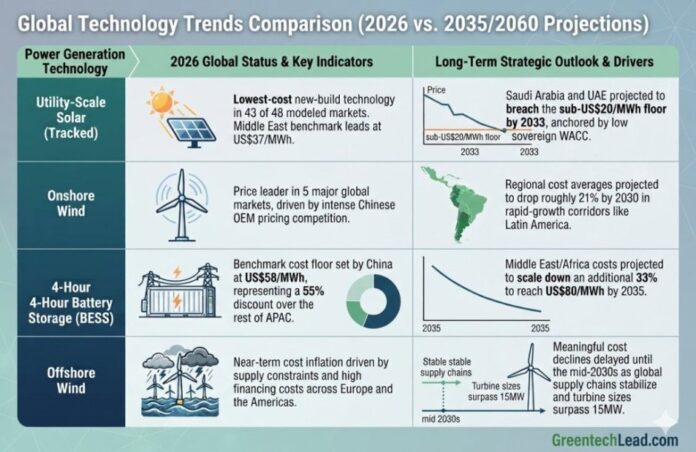
According to Wood Mackenzie’s latest global analysis, four-hour battery storage is less expensive than open-cycle gas turbines in all 43 markets where both technologies were modeled.
That finding strengthens the economic case for batteries serving evening peaks and balancing renewable generation. It does not mean a four-hour battery can replace every function of a gas plant, particularly during prolonged electricity shortages.
Four-Hour Battery Storage Beats Gas in 43 Modeled Markets
Wood Mackenzie attributes the changing cost balance to expanding battery manufacturing, gas turbine shortages and fuel-price volatility.
The regional figures illustrate the shift. In the Middle East and Africa, four-hour storage costs are forecast to decline 33 percent to $80/MWh by 2035. Utility-scale solar already leads the region’s generation-cost comparison at $37/MWh.
China remains the lowest-cost storage benchmark, with costs more than 55 percent below the average for the rest of Asia Pacific, according to the same analysis.
These results highlight the importance of manufacturing scale and supply chains. However, modeled levelized costs depend on assumptions about utilization, financing, charging electricity and asset life. Developers must test those assumptions against local project conditions.
Upfront Construction Costs Still Favor Gas in US Data
Lower lifetime costs do not necessarily mean lower construction costs.
The EIA’s generator construction-cost data, released in July 2026 for equipment installed in 2024, show capacity-weighted average costs of $841/kW for natural-gas combustion turbines and $1,469/kW for battery storage. These historical averages are not current project quotations or a duration-matched comparison.
| Cost or operating factor | Battery storage | Gas peaker plant |
| US construction-cost benchmark | $1,469/kW | $841/kW |
| Energy input | Purchased or onsite electricity | Natural gas |
| Operating duration | Limited by stored energy | Extended operation if fuel is available |
| Lifetime cost pressures | Charging losses, degradation and augmentation | Fuel, maintenance and emissions costs |
| Additional earning opportunities | Arbitrage, capacity and ancillary services | Energy, capacity and eligible ancillary services |
Battery duration is crucial. A 100 MW, four-hour battery has a nominal energy capacity of 400 MWh. Extending the same power rating to eight hours requires 800 MWh, increasing the required energy-storage investment.
Gas turbines do not need an equivalent onsite battery block, but dependable operation requires adequate fuel infrastructure.
Batteries Avoid Gas Purchases, but Charging Is Not Free
A battery has no combustion-fuel bill. It still pays for charging electricity, energy losses, maintenance and capacity degradation.
Gas peakers incur fuel costs whenever they generate. Their operating costs also depend on efficiency, starts, maintenance requirements and emissions charges where applicable.
For batteries, the difference between charging and discharge prices determines energy-arbitrage margins. Cheap midday electricity can make evening discharge attractive, but narrow price spreads can weaken returns.
The 2025 utility-scale battery storage benchmark uses a representative 85 percent round-trip efficiency assumption. At that efficiency, delivering 100 MWh requires approximately 117.6 MWh of charging electricity, before any additional project-specific losses.
This makes charging costs essential to a fair battery storage versus gas peaker comparison.
Short Demand Peaks Strengthen the Battery Case
Batteries are particularly suited to predictable peaks lasting a few hours. They can charge during lower-demand periods and discharge when consumption rises or solar output declines.
Their rapid response also supports frequency regulation and reserves. Depending on location and market rules, storage can relieve congestion or defer selected transmission and distribution investments.
For commercial and industrial customers, peak shaving may reduce demand charges. Utilities can use batteries to limit purchases during expensive hours and improve renewable-energy utilization.
However, these benefits require careful dispatch planning. A battery committed to a capacity obligation must retain enough charge to meet that obligation, potentially limiting its participation in other markets.
Revenue Stacking Can Improve Battery Returns
Battery projects can combine several income sources: energy arbitrage, capacity payments, frequency regulation and other contracted services.
These battery storage revenue streams must be assessed alongside charging expenses, operating restrictions and market competition.
Revenue stacking does not mean every service can be delivered simultaneously. Reserving capacity for one obligation can reduce the energy available for another. Ancillary-service prices can also fall as competing storage capacity enters the market.
Gas plants may likewise earn capacity and ancillary-service revenues. The investment comparison should therefore examine realistic dispatch and contractual arrangements for both technologies rather than assigning multiple revenues only to batteries.
Battery Degradation Changes Lifetime Economics
Battery capacity declines with age and use. Project economics must include expected cycling, temperature management, warranty conditions and augmentation or replacement expenditure.
The National Laboratory of the Rockies’ methodology incorporates augmentation into fixed operating costs to maintain rated capacity over a modeled 15-year lifetime. It also evaluates storage durations of two, four, six, eight and 10 hours.
Gas projects face their own lifetime expenses, including turbine maintenance, major overhauls and fuel-system upkeep.
Comparing complete project cash flows is therefore more useful than comparing initial equipment prices alone.
Gas Retains Value During Extended Shortages
A four-hour battery cannot sustain its rated output indefinitely. After discharge, it needs electricity and time to recharge.
Gas peakers can operate for longer periods when fuel supplies and equipment remain available. That endurance can be valuable during extended demand surges or prolonged renewable-generation shortfalls.
Fuel availability is nevertheless a condition, not a guarantee. Pipeline constraints, supply interruptions and extreme-weather conditions can affect gas generation.
Utilities should compare accredited capacity, outage risks and expected shortage duration. The EIA’s electricity data resources provide useful operating and fuel-market context for that assessment.
Which Is Cheaper in 2026?
Four-hour batteries now have a strong modeled cost advantage for short-duration peaking, supported by Wood Mackenzie’s findings across 43 markets.
Gas retains an endurance advantage where sustained generation is required and reliable fuel is available. Its lower historical construction cost does not automatically establish lower lifetime costs.
For developers and utilities, the deciding factors are the required discharge duration, charging prices, fuel exposure, capacity accreditation, degradation and contracted revenues. Batteries can cover daily peaks and fast balancing needs, while longer reliability events require resources capable of sustaining output throughout the shortage.
SHAFANA FAZAL