
Global battery energy storage systems (BESS) continued their rapid expansion in 2025 as installation costs fell to record lows, making energy storage increasingly affordable for renewable energy integration and grid stability.
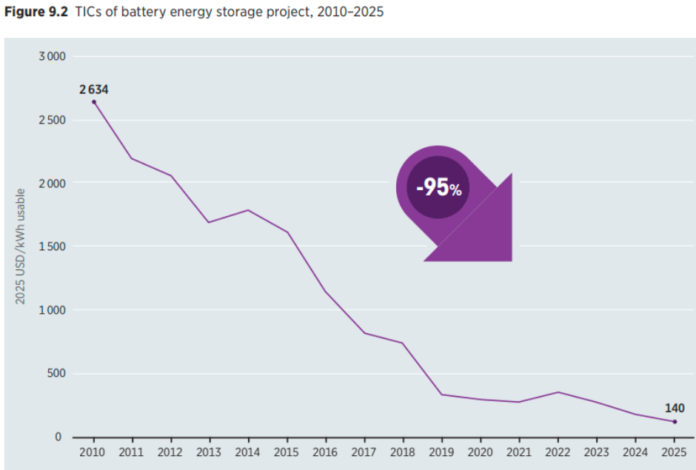
According to IRENA, global weighted-average battery energy storage costs have declined by 95 percent since 2010, while annual deployments reached an all-time high of 307 GWh.
Global BESS Capacity Additions Surge to 307 GWh
Battery energy storage deployments have accelerated dramatically over the past decade.
Annual additions increased from just 2 GWh of gross capacity in 2015 to 307 GWh in 2025, representing a 67 percent increase over the 184 GWh installed in 2024, IRENA report said.
China and the United States remained the dominant markets.
China installed 173 GWh (61 GW) of battery storage during 2025, a 74 percent increase over 2024, accounting for 56 percent of total global additions.
The United States ranked second, deploying 55 GWh (18 GW), representing 18 percent of worldwide installations.
Europe added 32 GWh, accounting for 11 percent of global deployments.
Utility-Scale Projects Dominate Growth
Large-scale battery storage projects continued to drive market expansion.
Utility-scale systems represented 86 percent of all new battery storage deployments in 2025.
Within the United States:
47 percent of deployments (26 GWh) were standalone battery systems.
52 percent (29 GWh) were co-located with solar power plants.
1 percent (1 GWh) were paired with wind projects.
Across Europe, utility-scale battery storage overtook residential installations for the first time.
Co-located solar-plus-storage projects also gained momentum, accounting for 15 percent of new grid-scale battery installations compared with less than 10 percent in 2024.
The United Kingdom, Germany, and Italy collectively represented 59 percent of Europe’s utility-scale battery storage additions during 2025.
Major Government Storage Targets Support Demand
Governments continued introducing ambitious battery storage targets to strengthen electricity grids.
China is pursuing deployment of more than 180 GW of new energy storage by 2027, making storage a central component of its renewable energy strategy.
Italy has established a 50 GWh battery storage target by 2030, helping accelerate investment through the country’s MACSE auction program.
Saudi Arabia has announced plans to deploy 48 GWh of battery energy storage by 2030.
Meanwhile, the Al Dhafra project in Abu Dhabi will combine 5.2 GW of solar PV with 19 GWh of battery storage to deliver a continuous 1 GW electricity output.
Battery Storage Costs Drop 95 percent Since 2010
The economics of battery energy storage improved dramatically in 2025.
IRENA reported that the global weighted-average total installed cost (TIC) declined from USD 2,634/kWh in 2010 to just USD 140/kWh in 2025, representing a 95 percent reduction.
Compared with 2024, installation costs declined by almost 30 percent.
The steep decline has been driven by manufacturing scale, improved production processes, greater material efficiency, and widespread adoption of higher energy-density lithium iron phosphate (LFP) battery technology.
China continues to dominate global battery manufacturing through its large domestic market and export-oriented supply chain.
During the first quarter of 2026, China exported 27.3 GWh of battery storage products, representing 32.4 percent of all Chinese battery exports.
Battery Modules Represent the Largest Cost Component
Battery modules remain the biggest contributor to overall system costs.
Across major markets in 2025:
Battery modules accounted for an average of 56 percent of total installed costs.
Average battery module cost reached USD 240/kWh.
Their share varied significantly across countries:
73 percent of total installed costs in China
51 percent in both Germany and South Korea
Power conversion systems represented an average of 13 percent of total installed costs.
Country differences included:
8 percent in Canada
17 percent in Germany
Installation costs and electrical balance-of-system (BoS) components each represented approximately 7 percent of global total installed costs.
Balance-of-system expenses ranged from 4 percent to 14 percent depending on project location.
Other project cost categories—including land acquisition, permitting, developer overheads, profit margins, contingency, and miscellaneous costs—each contributed approximately 3 percent of total installed costs on average.
Belgium recorded the highest land acquisition cost share at approximately 8 percent, while India had the highest developer overhead and profit component at around 7 percent of total installed costs.
Turnkey Battery Prices Continue Sharp Decline
Turnkey battery storage prices also continued falling rapidly.
Average turnkey BESS prices reached USD 117/kWh in 2025, representing a 31 percent decline compared with 2024.
Further reductions are expected as battery energy density improves, rack designs become more efficient, manufacturing productivity increases, and system integration advances.
For major global markets:
2-hour battery storage systems averaged USD 125/kWh
4-hour systems averaged USD 111/kWh
Four-hour battery systems were approximately 11 percent cheaper than two-hour systems.
Compared with 2024:
Prices for 2-hour systems declined 26 percent
Prices for 4-hour systems fell 27 percent
Raw Material Costs Stabilize
Battery cell prices remained broadly stable during 2025 despite ongoing market expansion.
The cost of battery cells remains closely linked to raw materials such as lithium, nickel, and cobalt.
The cathode and anode together account for approximately 50 percent of total battery cell manufacturing costs, making raw material pricing a critical factor in future battery cost trends.
Lower Costs Strengthen Global Energy Storage Adoption
With total installed costs falling 95 percent since 2010, turnkey prices dropping to USD 117/kWh, and annual deployments reaching 307 GWh, battery energy storage has become one of the fastest-growing and most cost-competitive technologies supporting renewable energy integration. Continued improvements in manufacturing efficiency, battery chemistry, and system design are expected to drive additional cost reductions while accelerating the global transition toward flexible, low-carbon electricity systems.
BABURAJAN KIZHAKEDATH
