
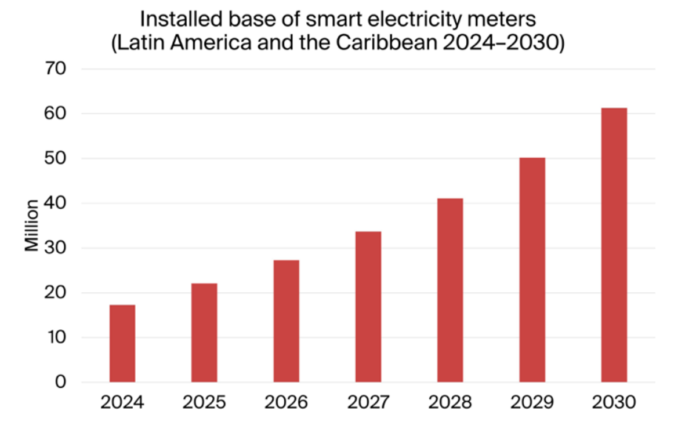
The smart electricity meter market in Latin America and the Caribbean is set for rapid expansion through the end of the decade, according to Berg Insight.
The installed base of smart meters across the region is forecast to grow at a compound annual growth rate of 23.5 percent, rising from 17.3 million units in 2024 to 61.3 million units by 2030. This growth will be driven by the installation of about 48.5 million new smart electricity meters during the forecast period, with annual shipments increasing from 2.8 million units in 2024 to nearly 11.3 million units in 2030. As a result, smart meter penetration across the region is expected to climb from 7.7 percent to 24.8 percent by 2030.
Latin America and the Caribbean represent a sizable and largely untapped opportunity for the Smart metering industry, with more than 223 million electricity customers and a significantly lower penetration of smart meters compared with East Asia, Europe, and North America.
Annual demand for electricity meters in Latin America and the Caribbean is estimated at 20 to 30 million units, with Brazil and Mexico accounting for more than 65 percent of total demand. Despite this scale, most countries in the region have yet to launch nationwide smart metering programs, with only a few Caribbean nations moving ahead at a national level.
Momentum is now building as several utilities expand pilot projects into larger deployments. A key driver behind these initiatives is the urgent need to cut high non-technical electricity losses, largely caused by widespread energy theft. As utilities modernize their grids to improve efficiency, billing accuracy, and network visibility, smart metering is expected to play an increasingly important role in the region’s power sector transformation.
South America will remain the dominant and fastest growing subregion, accounting for roughly 60 percent of the installed smart meter base and around 70 percent of electricity users in Latin America and the Caribbean. Brazil stands out as the most significant growth market, supported by its 94 million electricity users, low smart meter penetration of 6.5 percent in 2024, and new government policies promoting large-scale deployments. Brazil alone is forecast to account for more than half of all smart electricity meters shipped in the region during the forecast period.
Uruguay has already achieved near universal smart metering coverage following the completion of its nationwide rollout by the end of 2024. Argentina is expected to see strong momentum, with the installed base projected to grow more than six-fold to over 4.6 million units by 2030. In contrast, smart meter deployments in Chile have slowed since peaking in 2018–2019 due to regulatory uncertainty, though the market could recover if policy clarity improves. Colombia is also expected to post significant growth despite policy challenges, driven mainly by deployments from major utilities such as Grupo EPM and Enel Colombia.
Peru and Ecuador are emerging markets where recent regulatory progress is laying the groundwork for larger rollouts later in the decade. Meanwhile, Bolivia and Paraguay are expected to remain in the pilot phase throughout the forecast period, making them the least mature smart metering markets in the region. Overall, the outlook points to strong long-term growth as regulatory support improves and utilities accelerate grid modernization efforts.
Central America remains the most nascent smart metering market in Latin America and the Caribbean, although momentum is building in several countries. Costa Rica is the regional leader, having surpassed a smart meter penetration rate of 50 percent, while Honduras closed 2024 with an installed base exceeding 500,000 smart meters. Belize also took a major step forward by launching a nationwide smart metering rollout in 2024.
Other Central American markets, including El Salvador, Guatemala, and Panama, currently have relatively small installed bases, but deployments are expected to expand gradually. Recent policy developments in Panama and growing utility-led initiatives in El Salvador are laying the foundation for wider adoption. In Mexico, the region’s largest electricity market, the state-owned utility CFE is continuing efforts to scale the replacement of traditional electricity meters with smart meters.
In contrast, Caribbean utilities were early adopters of smart metering technology. Barbados has achieved near universal coverage, while Jamaica has surpassed a 75 percent penetration rate. Trinidad and Tobago and Puerto Rico are already entering a second wave of smart meter deployments. The Bahamas is preparing to launch its first major rollout, and installations in the Dominican Republic are set to rise steadily as part of the country’s national electricity loss reduction strategy.
BABURAJAN KIZHAKEDATH
