
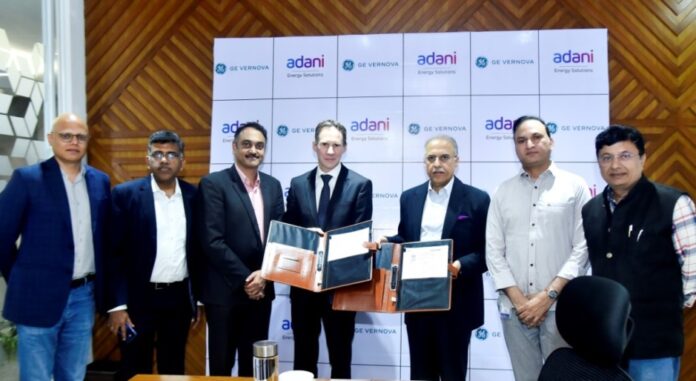
GE Vernova has secured a major contract from Adani Energy Solutions to supply high-voltage direct current (HVDC) technology for the 2.5-gigawatt Khavda–South Olpad renewable power transmission corridor in India.
The project is a key element of India’s strategy to strengthen transmission infrastructure and support the large-scale integration of renewable energy into the national grid. GE Vernova did not reveal financial details of the HVDC contract.
Khavda–South Olpad corridor strengthens India’s renewable backbone
The Khavda–South Olpad transmission corridor is designed as a critical backbone for India’s renewable energy expansion. Khavda, located in Gujarat’s Kutch region, is being developed as one of the world’s largest renewable energy zones, while South Olpad serves as a major pooling and injection point into India’s national transmission network.
By connecting renewable generation from western India to load centers across the country, the corridor will enable efficient, long-distance transfer of clean electricity. The project plays a central role in reducing transmission losses and ensuring that large volumes of renewable power can be reliably delivered to the grid.
GE Vernova’s scope of work
Under the contract, GE Vernova’s Electrification Systems business will supply a high-capacity ±500 kV, 2,500 MW (2 x 1,250 MW) voltage sourced converter based bipolar HVDC system for the point-to-point link. HVDC technology is widely recognized for its ability to transmit power over long distances with lower losses and higher controllability than conventional alternating current transmission, making it well suited for renewable-heavy systems.
GE Vernova’s scope includes the complete design of the HVDC system, converter stations at both ends of the link, and the supply of all major converter station equipment. The company will be responsible for erection, testing, and commissioning activities, excluding associated civil works. The system will be delivered using GE Vernova’s eLumina control platform to support efficient grid operations.
Execution in India with phased delivery
The project will be largely executed by GE Vernova’s India-based teams, leveraging local engineering expertise and manufacturing capabilities. Delivery is planned in phases, with overall completion targeted by 2030. GE Vernova views India as one of the world’s most important power markets, driven by rapidly growing electricity demand and large-scale renewable development.
The company considers projects such as the Khavda–South Olpad HVDC corridor to be critical in demonstrating the importance of high-capacity transmission infrastructure for connecting renewable energy zones with the national grid.
Milestone for high-capacity HVDC deployment in India
With a rated capacity of 2,500 MW, the Khavda–South Olpad project represents the highest-rated VSC-based HVDC system planned in India to date. The project highlights the growing role of advanced HVDC technology in strengthening transmission networks and enabling large-scale renewable integration in fast-growing power markets.
The deployment also reflects the increasing maturity of next-generation VSC-based HVDC systems and their readiness to meet complex grid requirements in regions experiencing rapid electrification and demand growth.
VSC-based HVDC technology plays a crucial role in renewable-heavy power systems by providing fast frequency response, precise control of power flows, and enhanced grid stability. These capabilities help manage variability in renewable generation, reduce congestion, and maintain reliable grid performance as renewable penetration continues to rise.
GE Vernova’s track record in India
GE Vernova has a long-standing presence in India’s transmission sector, including its role in supplying HVDC technology for landmark projects such as the Champa–Kurukshetra HVDC link, one of the country’s earliest ultra-high-capacity transmission systems.
Baburajan Kizhakedath
