
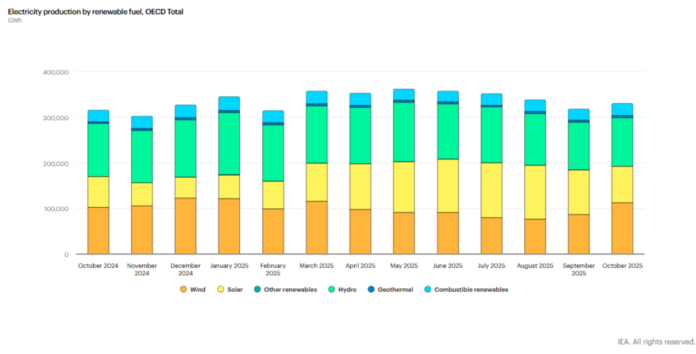
Renewable energy strengthened its position in the OECD power mix in October 2025, as clean electricity generation outpaced overall demand growth and expanded its share across major regions. New data shows renewable sources generated 329.8 TWh of electricity during the month, accounting for 37.3 percent of total net generation of 883.8 TWh.
On a year-on-year basis, renewable electricity generation in the OECD increased by 4.7 percent, adding 14.8 TWh. This growth was faster than the 2.5 percent rise in total net electricity production, underlining the accelerating role of renewables in meeting incremental power demand.
Solar and wind lead renewable expansion
Solar power continued to be the standout contributor to renewable growth. Across the OECD, solar electricity generation surged by 18.2 percent year-on-year, adding 12.3 TWh in October 2025. Wind power also delivered strong gains, rising 10.1 percent year-on-year and contributing an additional 10.3 TWh.
Hydropower, however, acted as a drag on overall renewable output. Electricity generation from hydro declined by 7.9 percent year-on-year, equivalent to a reduction of 9.2 TWh, reflecting weaker water availability in several regions.
Regional momentum remains strong
The OECD Americas led renewable growth, with generation rising 6.6 percent year-on-year, or 8.9 TWh. OECD Europe followed with a 2.3 percent increase, adding 3.4 TWh, while OECD Asia Oceania recorded a 7.1 percent year-on-year rise, contributing 2.5 TWh.
Despite regional differences in the pace of growth, renewables expanded across all OECD regions, reinforcing their role as a key pillar of electricity supply alongside fossil fuels and nuclear power.
Renewables gain share as nuclear output falls
In contrast to renewables, nuclear power generation in the OECD declined by 4.1 percent year-on-year in October 2025, falling by 5.9 TWh to 138.0 TWh. The drop was led by OECD Asia Oceania, particularly Korea, while declines were also recorded in Europe and the Americas.
Fossil fuels remained the largest single source of electricity, producing 411.8 TWh or 46.6 percent of total generation. However, the faster growth rate of renewables compared with fossil fuels highlights a gradual shift in the OECD electricity mix.
Spain highlights shifting fossil fuel dynamics
Spain stood out in October 2025 for a sharp shift within its fossil fuel generation. Electricity generation from oil jumped 32.9 percent year-on-year, while coal-fired generation collapsed by 93.2 percent. As a result, oil effectively replaced coal among combustible fuels, though natural gas remained the dominant fossil energy source.
Overall, electricity generation from combustible fuels represented 34.3 percent of Spain’s total power output during the month, reflecting ongoing structural changes alongside rising renewable capacity.
Outlook
The October 2025 data underscores a clear trend across the OECD: renewables, led by solar and wind, are increasingly driving electricity growth even as variability in hydropower and declining nuclear output shape the broader energy balance. With renewable generation expanding faster than total electricity demand, the clean energy transition continues to gain momentum across advanced economies.
BABURAJAN KIZHAKEDATH
