
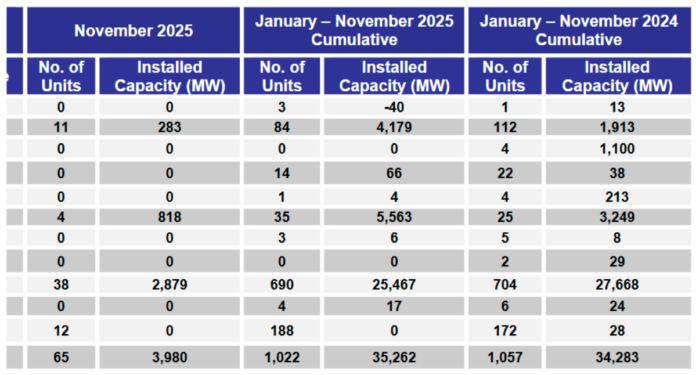
The Federal Energy Regulatory Commission (FERC) has revealed that new solar and wind capacity additions in November 2025 were the second highest of the year and accounted for 93 percent of all new generating capacity brought online during the month. Solar continued to dominate new power additions, extending its lead over all other energy sources to 27 consecutive months.
Solar leads new capacity additions in November and year to date
According to FERC’s latest Energy Infrastructure Update report, 38 new solar units totaling 2,879 megawatts were placed into service in November. This represented 72.3 percent of all new generating capacity added during the month and marked solar’s second largest monthly capacity increase in 2025, behind only January.
Among the new projects were 13 large-scale solar facilities of 100 megawatts or more. The largest were the 484.6 megawatt Parliament Solar Project in Waller County, Texas, and the 256.3 megawatt Stampede Solar and Storage Expansion Project in Hopkins County, Texas.
During the first 11 months of 2025, utilities added 690 utility-scale solar projects totaling 25,467 megawatts. While this was slightly lower than the 27,668 megawatts added during the same period in 2024, solar still accounted for 72.1 percent of all new generating capacity placed into service year to date.
Solar has now been the largest source of new generating capacity every month since September 2023. Over this 27-month period, total utility-scale solar capacity expanded from 91.82 gigawatts to 163.44 gigawatts. By comparison, wind capacity grew by 13.20 gigawatts, while natural gas saw a net increase of just 6.83 gigawatts.
Utility-scale solar now represents 12.09 percent of total installed U.S. generating capacity. It has become the nation’s largest renewable energy source and is exceeded only by natural gas and coal. FERC data indicates solar is on track to surpass coal capacity before the end of 2026.
Wind additions outpace natural gas in 2025
Wind power also recorded a strong month in November, with 818 megawatts of new capacity added. This represented 20.6 percent of total new capacity for the month and was the second highest monthly increase for wind in 2025. In contrast, natural gas added only 283 megawatts.
Each of the four wind projects that came online in November was larger than any of the 11 new natural gas projects added during the month.
From January through November, wind contributed 5,563 megawatts of new capacity, an increase of 71 percent compared to the same period a year earlier. Wind additions were also more than one-third higher than natural gas, which added 4,179 megawatts over the same period. Wind accounted for 15.8 percent of total new capacity added in 2025 and now represents 11.9 percent of total installed U.S. generating capacity.
Renewables dominate U.S. capacity growth
Combined, wind and solar accounted for 92.9 percent of new generating capacity added in November. Together, they now make up 24.0 percent of the nation’s installed utility-scale generating capacity.
On a year-to-date basis, wind and solar, along with small additions from hydropower and biomass, represented 87.9 percent of all new generating capacity added in 2025. Natural gas contributed just 11.8 percent, with the remaining net additions coming from oil and waste heat recovery.
FERC notes that more than 25 percent of U.S. solar capacity comes from small-scale systems such as rooftop installations, which are not included in its data. Including this capacity would push the combined share of solar and wind to well over one-quarter of total U.S. generating capacity.
When hydropower, biomass, and geothermal energy are included, renewable sources now account for 32.9 percent of total U.S. utility-scale generating capacity. Factoring in small-scale solar would lift renewables to well above one-third of total U.S. power capacity.
Solar expected to become second largest power source by 2026
Looking ahead, FERC forecasts high-probability net solar additions of 86,130 megawatts between December 2025 and November 2028. This is more than four times the projected net additions for wind, estimated at 19,821 megawatts.
Over the same period, hydropower and geothermal are expected to post modest gains, while biomass capacity is projected to decline slightly. Natural gas capacity is forecast to grow by 10,022 megawatts, while nuclear additions are expected to be minimal. Coal and oil capacity are projected to fall sharply.
If FERC’s forecast materializes, utility-scale solar would account for 17.2 percent of U.S. installed generating capacity by late 2028, second only to natural gas. Total renewable capacity would exceed 38 percent, and inclusion of small-scale solar could push renewables beyond 41 percent of total generating capacity.
FERC also notes that total solar additions could be significantly higher, with all potential utility-scale solar additions over the next three years reaching as much as 225,818 megawatts.
Commenting on the outlook, SUN DAY Campaign executive director Ken Bossong said the sustained growth of solar and wind sends a clear signal about the future of U.S. energy. He added that renewable energy expansion is accelerating despite policy headwinds and will continue to reshape the nation’s power mix.
BABURAJAN KIZHAKEDATH
