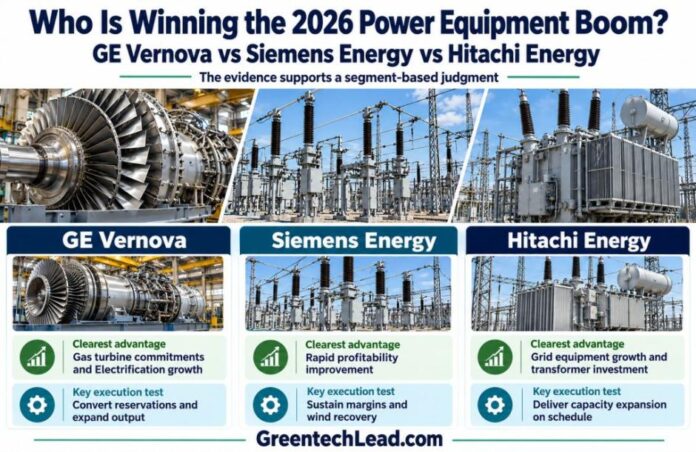
GE Vernova, Siemens Energy and Hitachi Energy are capturing rising demand for gas turbines, transformers and electricity infrastructure. However, their competitive strengths differ: GE Vernova is expanding gas power and electrification, Siemens Energy is delivering a sharp profitability improvement, and Hitachi Energy is increasing manufacturing capacity for critical grid equipment.
The results suggest three distinct advantages rather than one overall winner. The strongest long-term performer will be the company that converts growing orders into reliable deliveries, stronger margins and sustained cash generation.
Power Equipment Demand: Grid Investment Needs to Reach $600 Billion
The International Energy Agency’s Electricity 2026 grid outlook estimates that more than 2,500 GW of renewable energy, storage and large-load projects are stalled in grid connection queues worldwide.
Annual grid investment needs to increase approximately 50 percent, from $400 billion to roughly $600 billion by 2030, to meet electricity demand. The opportunity extends beyond new power plants to transformers, substations, transmission systems and grid automation.
Delivery timelines explain why equipment availability matters. New grid infrastructure can take 5–15 years to plan, permit and complete, compared with 1–3 years for data centers. Faster equipment production can ease one bottleneck, although permitting and construction remain separate constraints.
GE Vernova: $176 Billion Backlog Supports Gas Power Expansion
GE Vernova’s second-quarter 2026 financial results showed $24.2 billion in orders, up 88 percent organically, and $11.1 billion in revenue, up 22 percent.
Backlog reached $176 billion, while adjusted EBITDA margin was 11.3 percent. The company raised its full-year revenue outlook to $45.5 billion–$46.5 billion.
Gas turbines provide substantial growth visibility. Gas Power equipment backlog and slot reservation agreements together reached 116 GW, with at least 125 GW expected by year-end 2026. GE Vernova’s production targets indicate that it’s aiming for 24 GW in 2028 and 30 GW in 2030.
Importantly, the 116 GW total comprised 53 GW of equipment backlog and 63 GW of slot reservations. Reservations secure future manufacturing positions but should not be counted as equivalent to firm equipment orders.
Electrification also strengthened. Quarterly revenue increased 68 percent to $3.6 billion, including 29 percent organic growth, while equipment backlog reached $40.6 billion. Data center-related Electrification orders exceeded $5 billion in the first half.
Competitive assessment: GE Vernova has a strong combination of generation equipment and electrical infrastructure exposure. Its advantage depends on expanding production and converting reservations into deliveries.
Siemens Energy: Record Orders Accompany Stronger Profitability
Siemens Energy’s fiscal third-quarter 2026 earnings demonstrated progress in translating demand into financial results.
Orders reached €17.9 billion, revenue rose 18.5 percent on a comparable basis to €11.4 billion, and backlog increased to €162 billion. Its 1.57 book-to-bill ratio means incoming orders substantially exceeded quarterly revenue.
Profit before special items increased to €1.623 billion, from €497 million a year earlier. Free cash flow before tax rose to €2.319 billion, supported by improved cash earnings and customer advance payments.
Siemens Gamesa delivered its first positive quarterly result since 2022, strengthening the group’s recovery. However, one profitable quarter does not establish a sustained wind turnaround.
For fiscal 2026, Siemens Energy maintained guidance for 14–16 percent comparable revenue growth, a 10–12 percent profit margin before special items, and approximately €8 billion in free cash flow before tax. It expected profitability toward the upper end of its margin range.
Competitive assessment: Siemens Energy’s strongest evidence is improving profitability across its portfolio. Sustaining that improvement while executing large projects will determine the durability of its advantage.
Hitachi Energy: Transformer Capacity Targets a Critical Bottleneck
Hitachi Energy reported $19.8 billion in revenue, up 26 percent, for fiscal 2025, the year ended March 31, 2026. Orders reached approximately $32.8 billion, with a $57.9 billion backlog.
Adjusted EBITA totaled $2.64 billion, producing a 13.4 percent margin, up 3.9 percentage points. Hitachi’s April outlook projected fiscal 2026 revenue of $23.2 billion and a 14.3 percent adjusted EBITA margin for Hitachi Energy. These forecasts indicate expected growth beyond its completed financial year.
Manufacturing expansion is central to its strategy. Its Mississippi transformer factory investment commits $528 million to a new Gallman facility within an approximately $1.5 billion US manufacturing expansion program.
Production is scheduled to begin in 2029, with more than 700 jobs planned. The facility is expected to more than double capacity relative to the existing Crystal Springs plant, whose transformer production will transition to Gallman. This is an expansion and relocation plan; the two facilities should not be counted as permanently additive capacity.
Competitive assessment: Hitachi Energy is well positioned to address grid equipment constraints. Its new factory strengthens the longer-term supply outlook, while current growth must come from existing operations and earlier expansions.
Backlogs cannot establish an overall ranking: reporting periods, currencies, business scope and contract definitions differ. Profitability measures also vary — GE Vernova reports adjusted EBITDA, Siemens Energy profit before special items, and Hitachi Energy adjusted EBITA.
For utilities and data center developers, the practical comparison is therefore delivery availability, equipment reliability, project execution and lifecycle support. For the manufacturers, winning the power equipment boom requires profitable delivery of existing commitments while bringing additional capacity into operation.
SHAFANA FAZAL