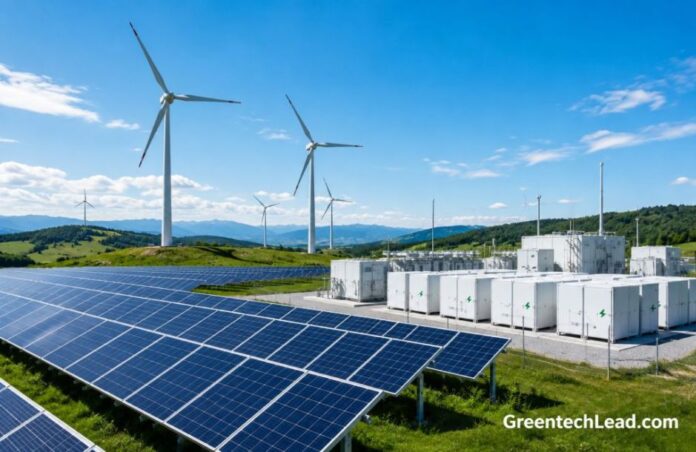
The latest renewable energy news includes announcements from Flow Power, Navaris, Qualitas Energy, Renalfa, Bennetts Creek battery energy storage system in Victoria, and others.
Flow Power Starts 100 MW / 223 MWh Victoria Battery and Plans 300 MW Expansion
Australian renewable-energy company Flow Power has broken ground on the 100 MW/223 MWh Bennetts Creek battery energy storage system in Victoria and announced plans for a second phase that could add another 300 MW. The initial BESS will provide more than two hours of storage, enabling it to absorb electricity during periods of high renewable production and return power to the grid when demand increases. Construction start converts the project from development into physical execution. The proposed second phase could ultimately increase the site’s power capacity to around 400 MW, creating a major flexible-energy hub. Victoria is rapidly adding battery capacity to support its growing solar and wind generation and improve electricity-system reliability.
Navaris Wins 304.5 MW Across 11 German Onshore Wind Projects
Navaris, the German renewable-energy platform established by Qualitas Energy, has secured contracts for 11 onshore wind projects totalling 304.5 MW in Germany’s latest renewable tender. All projects submitted by Navaris in the auction received awards, giving the company a sizeable contracted pipeline that can progress toward financing and construction. The 304.5 MW portfolio represents an average project size of almost 28 MW and adds to Germany’s accelerating pipeline of permitted wind capacity. Tender support provides revenue visibility needed for developers to commit capital and place turbine orders. Germany is seeking faster onshore wind additions as renewable electricity becomes increasingly important for power generation, industrial electrification and energy security.
Renalfa Expands Bulgarian Solar Plant to 65 MWp and Adds Battery Storage
Renalfa IPP has upgraded a Bulgarian photovoltaic plant to 65 MWp and added battery energy storage, converting the asset into a hybrid solar-plus-storage facility. The project illustrates the growing trend of adding batteries to existing renewable plants rather than developing storage only as standalone infrastructure. Hybridisation allows more solar electricity to be retained when generation exceeds immediate grid demand and dispatched later when market prices or system needs are stronger. The capacity expansion also increases the photovoltaic output available from the site. Bulgaria is becoming an active battery-storage market as developers respond to rapid solar growth and electricity-price volatility. Renalfa’s completed upgrade therefore adds both renewable-generation capacity and operational flexibility to its Bulgarian portfolio.