
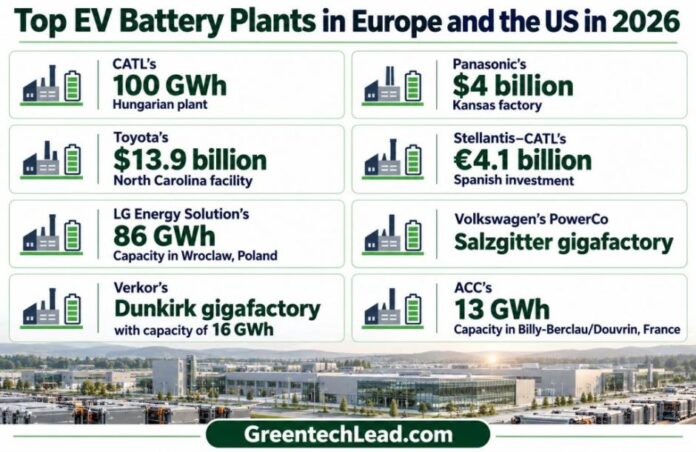
Europe and the United States are expanding EV battery manufacturing through multibillion-dollar factories, automaker partnerships and new cell technologies. Major projects include CATL’s 100 GWh Hungarian plant, Panasonic’s $4 billion Kansas factory, Toyota’s $13.9 billion North Carolina facility, and Stellantis–CATL’s €4.1 billion Spanish investment.
The projects differ substantially in maturity. Some factories already manufacture cells, others are ramping production, and several retain future capacity targets. Comparing investment, customer programmes and commissioning milestones provides a clearer picture than ranking announced gigawatt-hours alone.
Europe’s Major EV Battery Plants
CATL Debrecen, Hungary: €7.34 Billion and 100 GWh Planned
CATL’s Debrecen project carries an announced investment of €7.34 billion, with ultimate annual capacity planned at 100 GWh.
According to CATL’s Debrecen trial-production announcement, cell trial operations began on September 22, 2026. The company describes the completed project as its largest manufacturing base outside China.
The development brings substantial battery manufacturing capability closer to European automakers. However, the 100 GWh figure represents the completed factory’s target, rather than current annual cell output. Trial production must progress through process validation and commercial ramp-up.
LG Energy Solution Wroclaw, Poland: 86 GWh Disclosed Capacity
LG Energy Solution’s Wroclaw complex is an established European battery manufacturing hub. The company’s December 2024 update cited approximately 86 GWh of annual production capacity, making it a major benchmark for newer factories.
Its operating experience and proximity to European vehicle manufacturers support its competitive position. The disclosed capacity should nevertheless be distinguished from actual 2026 shipments, which depend on customer demand and utilisation.
PowerCo Salzgitter, Germany: Production Ramp-Up in 2026
Volkswagen’s PowerCo commissioned its Salzgitter gigafactory in December 2025, with production scheduled to increase progressively during 2026.
The PowerCo Salzgitter manufacturing programme of Volkswagen envisages initial annual capacity of up to 20 GWh, expandable to 40 GWh.
Salzgitter serves as the lead factory for PowerCo’s manufacturing system, supporting subsequent facilities in Valencia, Spain, and St. Thomas, Canada. The strategy connects cell design and manufacturing directly with Volkswagen’s vehicle platforms, while making factory utilisation central to its economics.
Stellantis–CATL Zaragoza, Spain: €4.1 Billion LFP Project
Stellantis and CATL are developing a lithium iron phosphate battery factory in Zaragoza through their joint venture, Contemporary Star Energy.
The project involves investment of up to €4.1 billion and potential annual capacity of 50 GWh. Construction began in November 2025, with production targeted for the end of 2026.
CATL said the project would create more than 4,000 direct jobs. Its eventual scale remains dependent on European EV demand and continued government support.
The factory adds a substantial European source of LFP batteries, supporting Stellantis investment plans for more affordable electric vehicles.
Verkor Dunkirk, France: 16 GWh and First Battery Deliveries
Verkor inaugurated its Dunkirk gigafactory in December 2025, with initial annual capacity of 16 GWh.
By August 2026, the company reported commissioning its second production line and delivering the first batteries manufactured entirely on-site. These milestones provide stronger evidence of industrial progress than construction announcements alone.
The project’s commissioning was expected to support 1,200 direct jobs and 3,000 indirect jobs. Verkor had secured more than €3 billion since 2020 for the Dunkirk factory and its Grenoble innovation centre — not exclusively for the gigafactory.
Its initial customer programme includes batteries for the Alpine A390.
ACC Billy-Berclau/Douvrin, France: 13 GWh First-Block Capacity
Automotive Cells Company’s French factory adds another manufacturing platform to the country’s battery cluster.
ACC identifies 13 GWh of capacity for its first production block. Its original development plan envisaged expansion towards 40 GWh by 2030 as additional blocks came online. That expansion remains a target rather than verified current output.
Major US EV Battery Plants
Panasonic Nevada and Kansas: Approximately 73 GWh Combined Potential
Panasonic’s Nevada operation has manufactured cells since 2017, with disclosed annual capacity of approximately 41 GWh.
Its Kansas factory began mass production in July 2025, targeting approximately 32 GWh annually once fully operational. Together, the facilities could provide approximately 73 GWh of US capacity.
The Panasonic Kansas battery factory represents a $4 billion investment, with an employment target of up to 4,000 jobs.
Panasonic’s production experience offers an advantage during ramp-up. By March 2025, its Nevada operation had supplied approximately 19 billion cells, powering around 3.7 million EVs.
Toyota North Carolina: $13.9 Billion and 30 GWh
Toyota began production at its Liberty, North Carolina battery plant in November 2025.
The $13.9 billion facility occupies approximately 1,850 acres and can reach 30 GWh of annual production at full capacity. It incorporates 14 production lines serving hybrid, plug-in hybrid and battery-electric vehicles.
Toyota’s $13.9 billion project is expected to create more than 5,000 jobs. Its mixed vehicle applications broaden its customer demand beyond fully electric models, making it inappropriate to classify the entire investment as BEV-only manufacturing.
LG Energy Solution Lansing: More Than 35 GWh Targeted
LG Energy Solution started production at its Lansing, Michigan factory on August 18, 2026.
The 226-acre facility targets more than 35 GWh of annual capacity at full scale, with employment expected to reach 1,700. It manufactures batteries for both electric vehicles and stationary energy storage.
That product mix gives Lansing access to two demand channels, although its total capacity should not be presented as exclusively available for EVs.
Ford BlueOval Battery Park Michigan: $3 Billion LFP Investment
Ford’s Marshall facility represents a $3 billion investment in domestic LFP manufacturing.
A 2026 update on BlueOval Battery Park Michigan said the factory remained on track to ship EV batteries during the year.
Its prismatic LFP batteries will power Ford’s planned affordable midsize electric truck, the first vehicle using its Universal EV Platform. The project strengthens Ford’s battery supply strategy, but shipment targets should remain separate from confirmed full-scale output.
What Will Determine Battery Factory Competitiveness?
The leading projects combine manufacturing scale with identifiable customers and measurable production milestones. CATL and LG Energy Solution bring established cell expertise; Panasonic contributes years of US manufacturing experience; Toyota diversifies across electrified powertrains; and European projects are building closer links with local vehicle programmes.
Commercial success will depend on saleable output, production yields, material sourcing and utilisation. Expanding factories in line with confirmed customer demand will be essential to converting these investments into competitively priced EV batteries.
SHAFANA FAZAL
