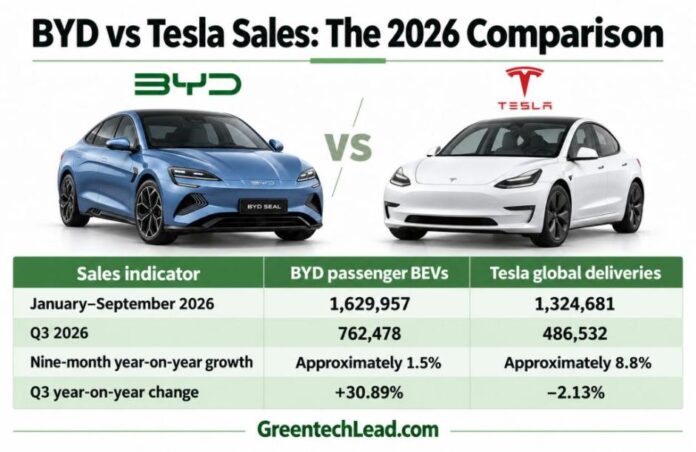
BYD leads Tesla in electric car sales through September 2026, while Geely and Volkswagen are strengthening their positions through expanding model ranges and regional growth.
The race among the world’s largest electric vehicle manufacturers is becoming more competitive. Sales volumes matter, but battery costs, affordable models, overseas expansion and profitability determine which companies can sustain growth.
Among BYD, Tesla, Geely Automobile and Volkswagen Group, BYD recorded the highest battery electric vehicle sales in 2025. Its lead continued during the first nine months of 2026, although the companies’ results reveal different strengths and challenges.
EV Sales Comparison: Why Vehicle Categories Matter
Electric vehicle comparisons require consistent definitions. Battery electric vehicles (BEVs) run entirely on electricity, while plug-in hybrid electric vehicles (PHEVs) combine rechargeable batteries with combustion engines.
BYD and Geely sell both categories. Tesla sells battery electric vehicles exclusively. Comparing BYD’s combined plug-in sales with Tesla’s deliveries would therefore overstate BYD’s advantage in the fully electric market.
The following table compares reported BEV sales for four major manufacturers. It is a selected comparison rather than a complete global ranking.
| Manufacturer | Reported BEV sales in 2025 | Reporting scope |
| BYD | 2,256,714 | Passenger battery electric vehicles |
| Tesla | 1,636,129 | Global vehicle deliveries |
| Geely Automobile | 1,073,805 | Geely Automobile’s reported brands |
| Volkswagen Group | 983,100 | Group battery electric vehicles, including commercial vehicles |
The figures show that Geely Automobile exceeded one million BEV sales and finished ahead of Volkswagen Group in this comparison. Differences in reporting scope still matter when assessing market position.
BYD vs Tesla in 2026: Who Is Selling More Electric Cars?
BYD sold 1,629,957 passenger BEVs between January and September 2026, according to its September 2026 sales disclosure. Tesla delivered 1,324,681 vehicles over the same period, based on its three quarterly announcements.
That puts BYD ahead by approximately 305,000 vehicles, or 23 percent relative to Tesla’s deliveries. These are year-to-date results, so they do not establish the final 2026 outcome. www1.hkexnews.hk
BYD’s results also demonstrate why the BEV–PHEV distinction matters. Its passenger BEV sales increased 1.5 percent year on year through September, while PHEV sales fell 10.2 percent. Total new energy vehicle sales, including commercial vehicles, declined approximately 3.9 percent. Growth in fully electric cars therefore coexisted with weaker overall plug-in sales. www1.hkexnews.hk
For manufacturers, a broad product range provides access to different buyers. Compact electric cars target price-sensitive customers, while plug-in hybrids appeal to drivers seeking electric commuting with combustion-engine flexibility.
Tesla: High Volumes From a Concentrated Product Range
Tesla delivered 486,532 vehicles in the third quarter of 2026, according to its Q3 production and delivery report.
Model 3 and Model Y accounted for 478,237 deliveries, approximately 98.3 percent of the quarterly total. Other models contributed 8,295 vehicles.
This concentration supports large production runs, but it makes performance heavily dependent on two core models. Pricing, product updates and competition in the electric sedan and SUV segments consequently have a substantial influence on Tesla’s sales.
Tesla retains a strong position at the individual-model level. The IEA estimates that Model Y represented nearly 8 percent of global BEV sales in 2025, while Model 3 accounted for approximately 3.6 percent.
Geely: Rapid EV Growth Across Multiple Brands
Geely Automobile’s BEV sales increased 86 percent to 1,073,805 vehicles in 2025. It also sold 613,962 plug-in hybrids, taking combined plug-in sales to approximately 1.69 million, according to Geely Automobile’s 2025 sales announcement.
Its reported portfolio includes Geely, Zeekr and Lynk & Co. These figures should not be confused with the entire Zhejiang Geely Holding portfolio, which includes additional automotive businesses.
The brand mix creates several routes to growth. Geely addresses mainstream demand, Zeekr competes in premium electric vehicles, and Lynk & Co expands the group’s electrified offering.
Financial performance adds another perspective. Geely Automobile reported RMB173.6 billion in first-half 2026 revenue, up 15 percent, and a 17.9 percent gross margin. These are company-wide figures covering its business, rather than standalone EV profitability measures.
Volkswagen: European Growth Offsets Weakness in China
Volkswagen Group delivered 983,100 BEVs in 2025, an increase of approximately 32 percent. Fully electric vehicles represented 10.9 percent of its total deliveries, according to its Volkswagen Group’s 2025 global delivery results.
Regional performance varied sharply:
Europe: 742,800 BEVs, up 65.9 percent.
China: 115,500 BEVs, down 44.3 percent.
United States: 72,000 BEVs, up 45.7 percent.
Within the group, Škoda delivered 174,900 BEVs, increasing 119.8 percent, while Audi delivered 223,000, up 35.6 percent. These examples show how growth across several brands can support group performance even when one major market weakens.
Volkswagen’s challenge is to convert growing electric vehicle demand into consistent performance across regions, where prices, competitors and customer preferences differ.
Affordable Models Are Reshaping EV Competition
The market extends beyond these four manufacturers. Smaller, affordable vehicles are gaining significant volumes alongside premium SUVs.
The IEA estimates that Geely’s Geome Xingyuan accounted for 3.5 percent of worldwide BEV sales in 2025, followed by the Wuling Hongguang Mini EV at 3.1 percent and BYD Seagull at 3 percent.
These examples demonstrate that manufacturers can build scale by meeting everyday transport needs. Purchase price, practical range and access to charging can be more influential than maximum battery capacity.
Battery Costs and Profitability Will Shape the Winners
Battery economics remains central to EV competitiveness. BloombergNEF reported that average lithium-ion battery pack prices fell 8 percent to $108 per kilowatt-hour in 2025. Its average for BEV packs was $99 per kilowatt-hour.
Consider an illustrative 60 kWh battery: a $10-per-kWh cost reduction would save $600 per vehicle. Across one million vehicles, that equals $600 million before other manufacturing costs and commercial factors.
However, higher sales do not automatically produce higher profits. Discounts, factory utilisation, warranty expenses and overseas expansion costs can absorb production savings.
Who Leads the Global EV Market in 2026?
BYD leads these manufacturers in reported BEV volume through September 2026. Tesla remains highly competitive through its core models, Geely has demonstrated rapid expansion, and Volkswagen has achieved strong European growth.
The decisive measures are profitable sales, competitive battery costs and sustained customer demand. Manufacturers that combine those advantages with affordable products will be better positioned to turn EV adoption into lasting business growth.
SHAFANA FAZAL